

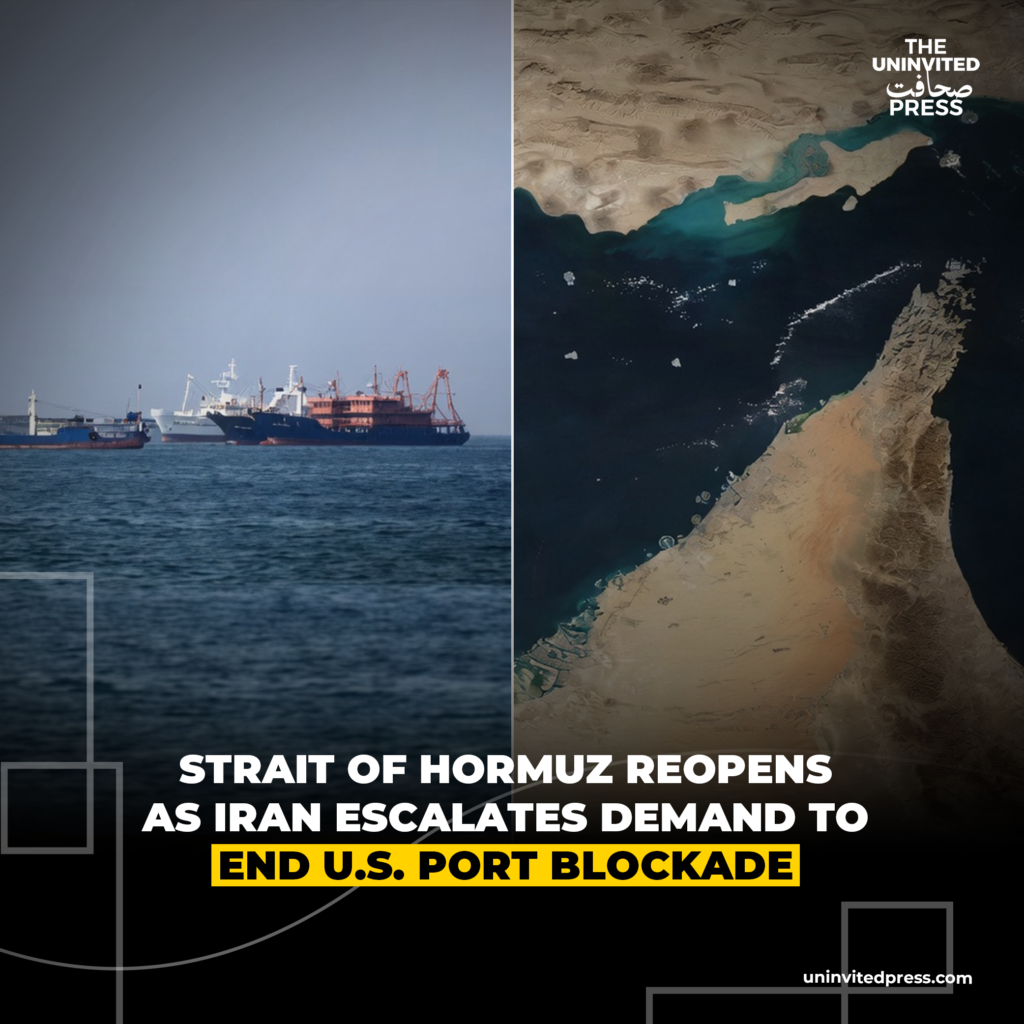
Partial reopening of the world’s key oil route follows tense standoff, with Tehran insisting U.S. blockade on Iranian ports must be lifted.
The strategic Strait of Hormuz has been partially reopened to commercial shipping after days of severe disruption, even as tensions escalate between Iran and the United States over Washington’s continued maritime restrictions on Iranian ports. The development has brought cautious relief to global energy markets, but officials warn that the situation remains fragile and politically charged.
Conditional Reopening of Strait of Hormuz Amid Ongoing Tensions:
Iranian officials announced that commercial vessels are now allowed to pass through the vital waterway under new navigation arrangements, following a period of restricted movement linked to wider regional tensions.
However, Tehran simultaneously intensified its demand for an immediate end to what it calls an “illegal U.S. blockade” on Iranian shipping and ports.
Iranian authorities said that while the strait is open, access remains conditional, with certain routes and inspections still overseen by Iranian naval forces, raising questions over how “normal” operations have truly resumed.
According to maritime monitoring reports, dozens of vessels remain delayed in the region as shipping companies assess security risks and insurance coverage concerns.
U.S. Pressure and Global Oil Market Concerns Deepen:
The United States has maintained that its naval pressure campaign will continue until a broader political agreement is reached with Tehran, including limits on Iran’s nuclear programme and regional activities.
U.S. officials argue that the measures are aimed at enforcing sanctions compliance and restricting revenue streams linked to Iranian energy exports.
The situation has further unsettled global oil markets, as the Strait of Hormuz handles nearly a fifth of the world’s crude shipments.
Analysts warn that even partial disruptions or renewed threats of closure could trigger sharp price volatility, underscoring how the waterway remains one of the most sensitive geopolitical chokepoints in the world.