

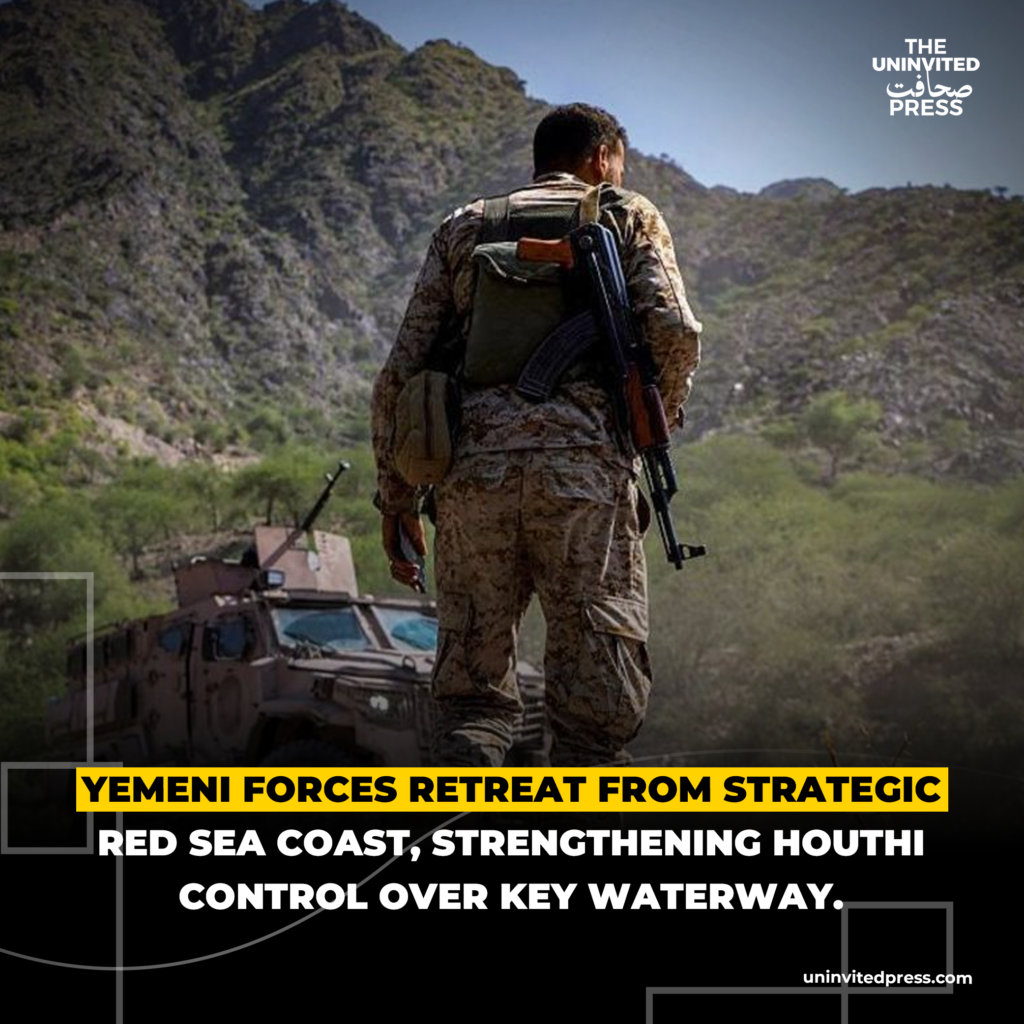
Saudi-backed troops redeploy to defend Aden as Houthis consolidate control over Bab al-Mandab approaches.
Saudi-backed Yemeni government forces have withdrawn from strategic positions overlooking the Bab al-Mandab Strait, ceding effective control of the vital Red Sea chokepoint to the Iran-aligned Houthi movement, military statements and reports confirmed on Sunday.
The Southern Armed Forces, the main pro-government contingent operating in southern Yemen, announced a “redeployment operation” from Dhubab Airport and the Bab al-Mandab area in western Taiz governorate. Officials said the move prioritises securing the interim capital Aden and neighbouring governorates amid intensifying Houthi pressure.
The pullback marks the end of a roughly six-week government counteroffensive launched in October. That campaign sought to reverse rapid Houthi gains made in September, when the group captured key coastal areas including the port of Mokha (Mocha) and positions near Perim Island at the mouth of the strait. Pro-government forces had earlier claimed to have secured parts of the area before the latest retreat.
Houthis Expand Control Near Strategic Red Sea Strait:
Houthi media reported that their forces had taken control of the evacuated territory. Independent accounts indicated the group now holds an expanded stretch of coastline along the southern Red Sea approaches. Military sources said Houthi fighters had also advanced in Lahj province, positioning themselves as close as 60 kilometres from Aden in some reports.
The Bab al-Mandab Strait is one of the world’s most critical maritime passages, linking the Red Sea to the Gulf of Aden and the Indian Ocean. A significant share of global trade and energy shipments, including oil exports, passes through the narrow waterway. Houthi control of the surrounding coastline strengthens their ability to monitor and potentially threaten shipping, raising concerns for international commerce and energy markets.
Yemen’s conflict, which had been largely frozen under a 2022 truce, reignited earlier in 2026. The Houthis, who control the capital Sanaa and much of the north and densely populated highlands, have combined territorial advances with missile and drone attacks targeting Saudi Arabia. Government forces remain based primarily in Aden, which has served as the seat of the internationally recognised authorities since the Houthis seized Sanaa more than a decade ago.
Yemen Conflict Escalates as Houthis Advance Near Aden:
In a related development, the International Committee of the Red Cross reported that the Houthis released 600 pro-government fighters in what it described as one of the largest unilateral prisoner releases in recent months. Separately, a Houthi missile strike near Aden killed eight people and wounded others, according to local sources.
Government forces stated that operations against the Houthis, including efforts to relieve the long-running siege of Taiz, would continue. Analysts note that the redeployment leaves the government stretched as it attempts to defend Aden while confronting Houthi advances on multiple fronts.
The shift underscores the fluid and high-stakes nature of the Yemen war, with direct implications for regional security and one of the planet’s busiest shipping lanes.