

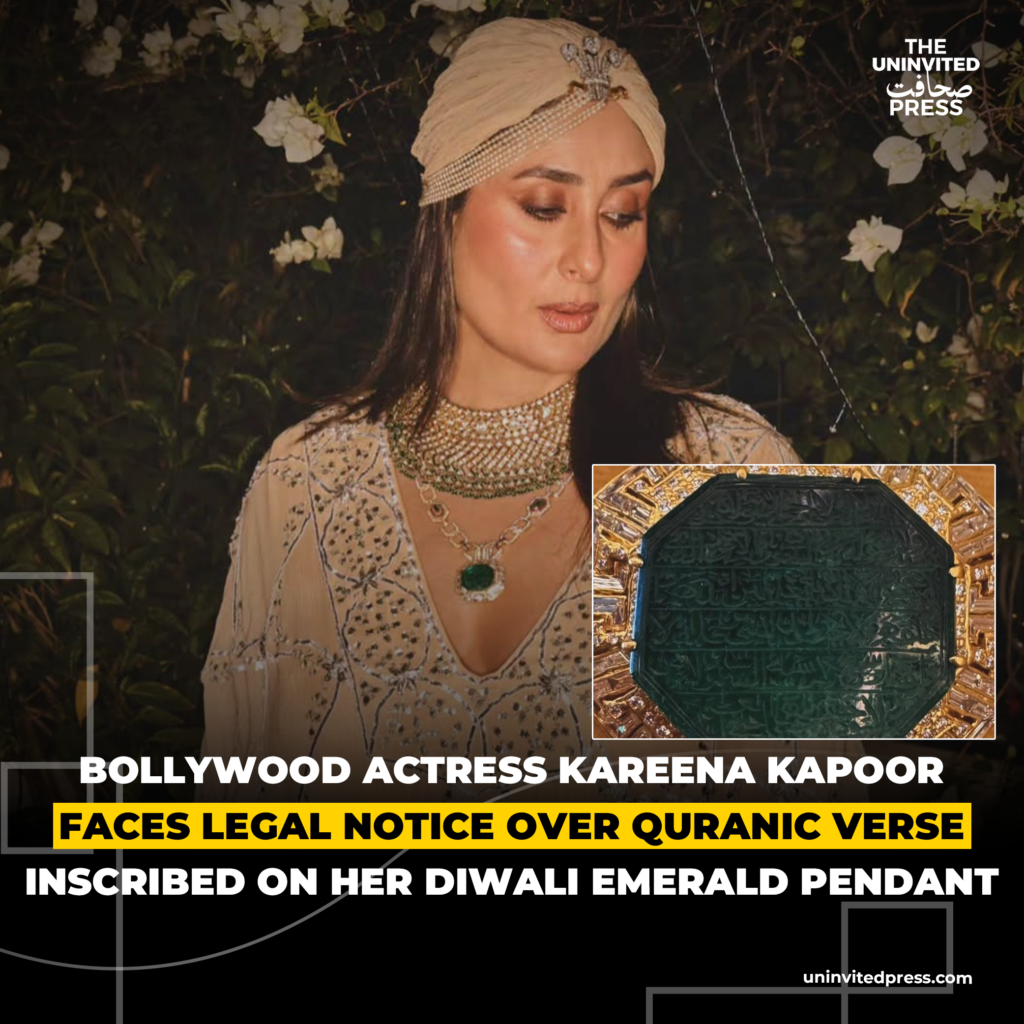
Congress leader objects to Bollywood star’s public display of Bhopal royal heirloom inscribed with Ayat-ul-Kursi, citing concerns over religious sanctity.
Bollywood actress Kareena Kapoor Khan has been served a legal notice after appearing in Diwali photographs wearing a historic 30-carat emerald pendant engraved with a verse from the Quran, triggering a debate over the public presentation of sacred Islamic text.
The notice, dated 11 November 2026, was issued by Abbas Hafeez, a Bhopal-based Congress leader and national media coordinator acting in his personal capacity. It was also addressed to celebrity stylist Rhea Kapoor, who styled Kapoor Khan for the occasion and publicly described the jewellery. The notice demands the removal of the relevant photographs and videos from social media and a public apology, arguing that the manner of presentation did not sufficiently reflect the reverence due to the inscription.
Quranic Heirloom Pendant Sparks Controversy Over Fashion Display:
Kapoor Khan had shared images of her Diwali ensemble on Instagram, featuring a beige silver kaftan and matching turban by designer Punit Balana. The standout accessory was the emerald pendant, identified as a roughly 200-year-old heirloom once belonging to the Begum of Bhopal. It carries the inscription of Ayat-ul-Kursi, the 255th verse of Surah Al-Baqarah, widely regarded by Muslims as one of the most powerful and protective passages in the Quran. Rhea Kapoor noted in her post that the pieces came through Saif Ali Khan’s family; his grandmother, Sajida Sultan, was the daughter of the last ruling Nawab of Bhopal.
Hafeez has emphasised that his objection is narrowly focused. He has stated he does not seek to dictate clothing choices, festival celebrations or the general right to wear jewellery. Rather, he argues that when an item bears a sacred Quranic verse, its public display-particularly in a fashion-oriented social media context-should uphold the respect traditionally accorded to such text. In Islamic practice, many hold that handling or reciting Quranic verses requires ritual purity, such as performing wudu (ablution). Hafeez described the pendant as a matter of faith for the Begums of Bhopal rather than a fashion accessory, and said it had customarily been worn in more private settings.
“This is a historic pendant of Bhopal associated with Islamic heritage. It cannot be used for a fashion parade,” Hafeez told media outlets. His lawyer, Mohammad Zafar, confirmed the notice seeks removal of the posts and left open the possibility of further legal steps if the demands are not met. Hafeez has also clarified that the action is personal and not an official position of the Congress party.
Religious Symbolism Meets Celebrity Fashion:
Some members of the Muslim community and activists have echoed concerns about the commodification or casual presentation of religious symbols. Others, including the Hindu Utsav Samiti, have defended Kapoor Khan’s right to wear family heirlooms and rejected calls for an apology, framing the criticism as an overreach into personal and cultural expression.
Ayat-ul-Kursi holds particular significance in Islamic tradition. Often recited for protection and as a declaration of divine sovereignty, it is commonly displayed in homes, vehicles and jewellery across the Muslim world. Scholarly opinions on wearing Quranic verses as adornment vary; some advise caution to avoid any risk of disrespect, while others accept it when done with intention and care. The controversy highlights ongoing sensitivities in India around the intersection of celebrity culture, interfaith symbolism and the public performance of religious identity.
Kapoor Khan and her team had not issued a public response at the time of the notice. The pendant’s royal provenance-linking a Hindu festival celebration by one of India’s most prominent film stars to the Muslim heritage of the Bhopal court-has added layers of historical and cultural resonance to what began as a festive fashion post.
The case underscores broader questions about how sacred texts and objects travel between private devotion, family inheritance and the highly visible world of social media celebrity. As legal notices of this kind proliferate in India’s polarised public sphere, the episode serves as a reminder of the fine lines that public figures must navigate when personal heritage collides with collective religious sentiment.