

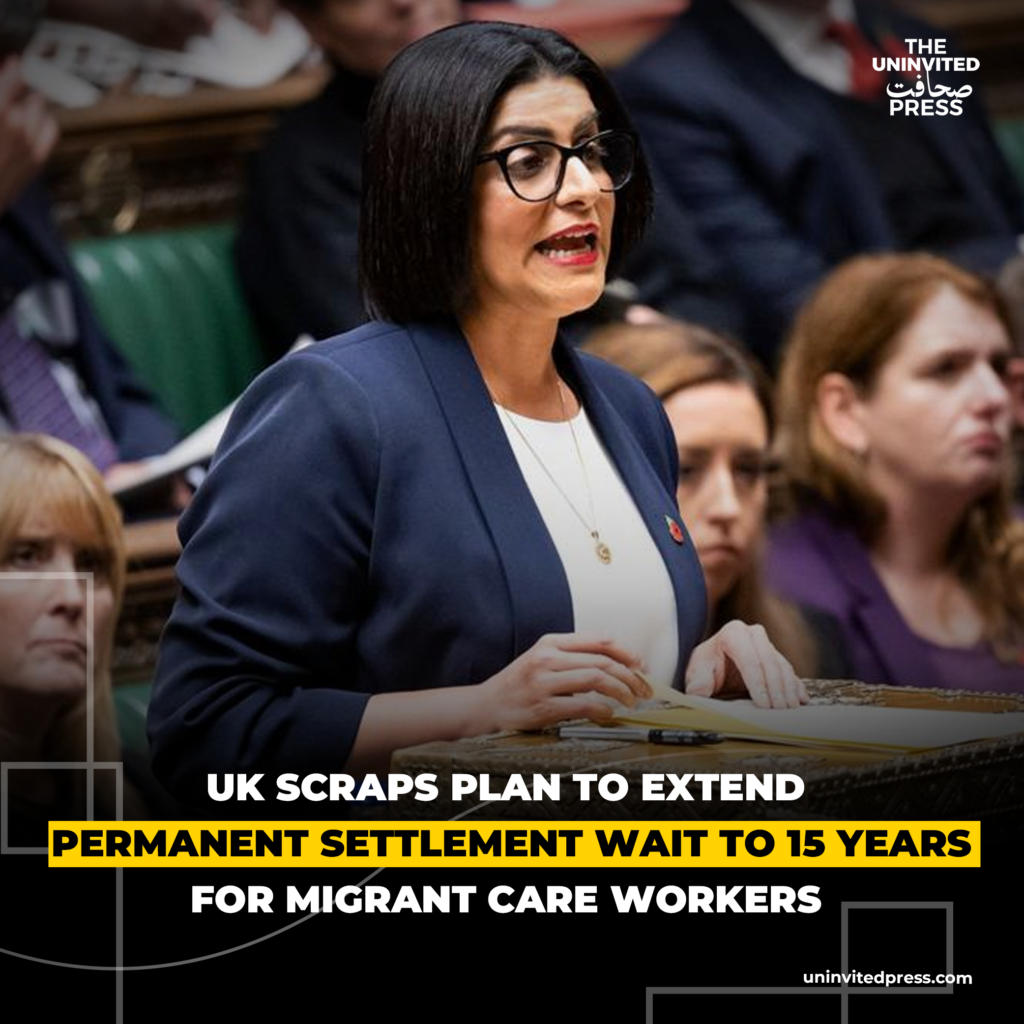
Home Secretary Shabana Mahmood revises immigration rules after Labour backlash, allowing eligible carers who arrived before May 2025 to qualify for permanent status after five years.
Britain’s Home Secretary Shabana Mahmood has abandoned plans that would have forced many migrant care workers already in the United Kingdom to wait up to 15 years for permanent settlement, offering instead a five-year pathway for those who meet key conditions. The announcement, made in the House of Commons on Monday, marks a significant revision to the government’s “earned settlement” reforms following sustained pressure from Labour MPs, care sector leaders and trade unions.
Under the updated rules, care workers who arrived in or switched into the social care route before May 2025, earn at least £25,000 a year and have met the conditions of their visas will retain the existing five-year route to Indefinite Leave to Remain (ILR). Settlement grants the right to live, work and study in the UK indefinitely and, in many cases, access to public funds. Officials estimate this concession will benefit around 146,000 care workers and 136,000 dependants-roughly three-quarters of those who came during the post-pandemic recruitment surge.
Those who did not fully meet visa conditions-often linked to exploitative or rogue employers-will be offered a further five-year visa as a “second chance” to qualify, rather than facing an immediate longer wait. Mahmood told MPs that “no one will be punished for the sins of their employer,” while noting that the government has already revoked the sponsorship rights of about 1,800 exploitative firms.
UK Eases Settlement Rules for Skilled Workers:
The original proposal, first outlined in a 2025 consultation, would have extended the standard qualifying period for permanent settlement from five to 10 years for most migrants and imposed a 15-year wait on lower-skilled workers, including many in social care. Mahmood had argued that settlement should be “earned” through contribution rather than granted almost automatically after five years. The revised framework keeps the new 10-year default for the majority of migrants earning below £50,000, while creating faster tracks for higher earners and certain public-sector workers.
Highest-rate taxpayers earning more than £125,000 will be able to apply after three years. Those earning at least £50,271, along with doctors, nurses, teachers and some other skilled public-service roles, retain a five-year path. Refugees who arrived via small boats or other irregular routes face the longest waits-20 years if they work or study, and up to 30 years otherwise. Overall, the government says the package will still mean about 500,000 people who arrived since 2021 will wait longer than five years to settle.
Mahmood framed the care-worker concession as recognition of those who “answered our call when we needed them” after the COVID-19 pandemic, when the social care sector faced acute shortages. Between 2022 and 2025, roughly 250,000 people and their dependants entered or switched into the health and care visa route. The sector continues to report tens of thousands of vacancies, and care providers had warned that a 15-year wait risked driving away experienced staff and worsening the workforce crisis.
UK Revises Migrant Settlement Policy After Backlash:
The climbdown followed months of internal Labour pressure. Housing Secretary Angela Rayner had publicly described the original plans as “un-British,” while other MPs, unions and care organisations raised concerns about fairness and the practical impact on an already strained sector. Conservative critics, including shadow home secretary Chris Philp, labelled the announcement a “U-turn” and claimed the concession could cost taxpayers up to £10 billion in future welfare and service costs. Mahmood rejected the characterisation, insisting the policy remained “guided above all by fairness” and that hundreds of thousands of people would still face longer waits.
The changes form part of a broader overhaul of the settlement system that will take effect next year. Applicants will also need to demonstrate a clean criminal record, higher English-language proficiency, no outstanding debts to the taxpayer and a sustained record of National Insurance contributions. The government presents the reforms as ending the previous near-automatic route to permanent status while still recognising the contribution of those who filled critical gaps in health and social care.
For many migrant care workers who arrived during the post-pandemic recruitment drive, the decision removes the prospect of a decade-and-a-half wait and offers a clearer path to stability. Sector leaders have welcomed the row-back as vital reassurance for workers, their families and the people they support. Whether the wider package succeeds in reducing net migration and balancing contribution with control will continue to shape Britain’s immigration debate in the months ahead.