

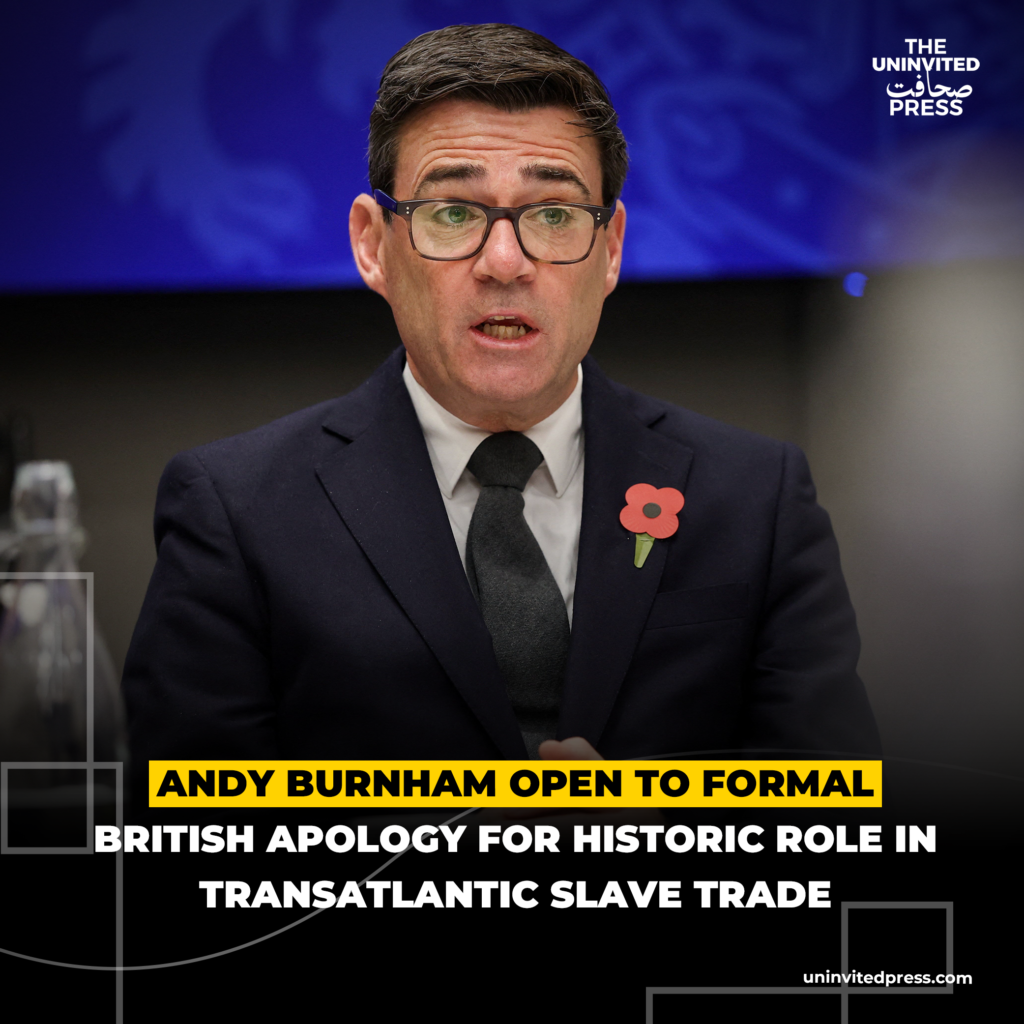
Prime minister offers ‘structured dialogue’ ahead of Commonwealth summit in Caribbean, expresses personal sorrow while rejecting financial compensation claims.
British Prime Minister Andy Burnham has said he is open to calls for a formal apology from the United Kingdom for its historic role in the transatlantic slave trade, marking a notable shift in tone from previous governments while firmly rejecting demands for financial reparations.
Burnham described the trade as a “brutal and barbaric violation” in which Africans were “denied their humanity,” separated from their families, “treated as property and worked to their deaths.” He expressed personal “sorrow and regret for the pain and suffering of so many millions of people” and recognised that the legacy of the trade “still shapes our world today.”
UK Offers Dialogue on Slave Trade Apology, Rejects Financial Reparations:
Burnham, who is preparing to attend the Commonwealth Heads of Government Meeting (CHOGM) in the Caribbean next week, said the UK would offer a “structured dialogue with those affected by the transatlantic slave trade.” Listening to calls for a formal apology on behalf of the British state, he added, “will form an important part of this process and I am open to them.”
The comments come as Caribbean nations have intensified longstanding demands for both an apology and reparations, particularly during King Charles III’s recent tour of the region. Successive British governments have acknowledged the horrors of the slave trade but have never issued a formal state apology or agreed to pay compensation.
Burnham drew a clear line on money. “Some have called for financial reparations for the slave trade. I do not believe that is the right answer,” he wrote. “I do not think that British people today can be held liable for historical wrongs, however heinous, that happened in a different age under different laws and in which they played no personal part.”
He framed the dialogue as both a moral and pragmatic step to strengthen the Commonwealth. “Having these difficult conversations to safeguard the Commonwealth for the future is the right thing to do. It is also the patriotic thing to do,” Burnham said. “Not just because it is in our interests, but because the Britain I believe in is confident, decent and brave. We led the world in abolishing slavery-and we can show leadership again today.”
Caribbean Leaders Renew Calls for UK Slavery Apology and Reparations:
The intervention has been described as going further than any previous British prime minister towards the possibility of an official apology, though Burnham stopped short of committing to one and made clear that any formal statement would depend on the outcome of the proposed talks. Caribbean responses have been cautious, with some leaders and activists welcoming the openness to dialogue while continuing to press for concrete reparative measures.
Britain played a central role in the transatlantic slave trade for more than two centuries, transporting an estimated 3.1 million Africans across the Atlantic, of whom about 2.7 million survived the journey to be sold into slavery, primarily in the Caribbean and North America. The trade was abolished in the British Empire in 1807, with slavery itself ending in 1834 after a period of “apprenticeship.” The British government paid compensation to slave owners at the time, but none to the formerly enslaved.
Burnham’s position maintains continuity with the long-standing UK government line against financial reparations while opening the door to a more formal reckoning with the past. As leaders gather in Antigua and Barbuda for CHOGM, the question of how Britain confronts this history is expected to feature prominently in discussions about the future of the Commonwealth “family of nations.”