

From midnight marches to group nature walks, women push back against restrictions and demand equal access to outdoor public spaces after recent assaults.
In the forests of Sanjay Van and the dimly lit streets of south Delhi, groups of women are deliberately claiming space that many say has long felt off-limits after dark. Facing routine street harassment, stalking and the lingering fear sparked by recent sexual assaults in public parks, they are organising collective walks, nature outings and protests to insist that outdoor spaces belong to them too.
The latest wave of action followed the alleged gang-rape of a 17-year-old girl inside Aastha Kunj Park near Kalkaji on 21 September 2026. Three men, reportedly posing as police officers, attacked the teenager and her male friend in the large public park. The case triggered student protests, solidarity marches and renewed scrutiny of safety gaps across the capital’s green spaces.
Delhi Women Take to Night Walks to Reclaim Public Spaces and Safety:
Within days, women took to the streets at night. Groups organised under banners such as “Women Walk at Midnight” and “Raat Hamari Hai” (The Night is Ours) walked through neighbourhoods including Kalkaji and Vasant Kunj. On one Friday night in early October, more than 150 women, many dressed in pink and carrying placards, moved through south Delhi streets. Participants of different ages walked, talked, sang and documented the experience, framing the action as both solidarity with survivors and a rejection of the idea that safety requires women to stay indoors.
“It was time to declare that you cannot erase us: we are part of public life, we are part of the city and we deserve safe public spaces,” one organiser wrote of the night walk. Similar events have drawn dozens to hundreds of participants, sometimes accompanied by police for the first time in years of such initiatives. Placards and chants emphasised a simple demand: if the day belongs to women, so should the night.
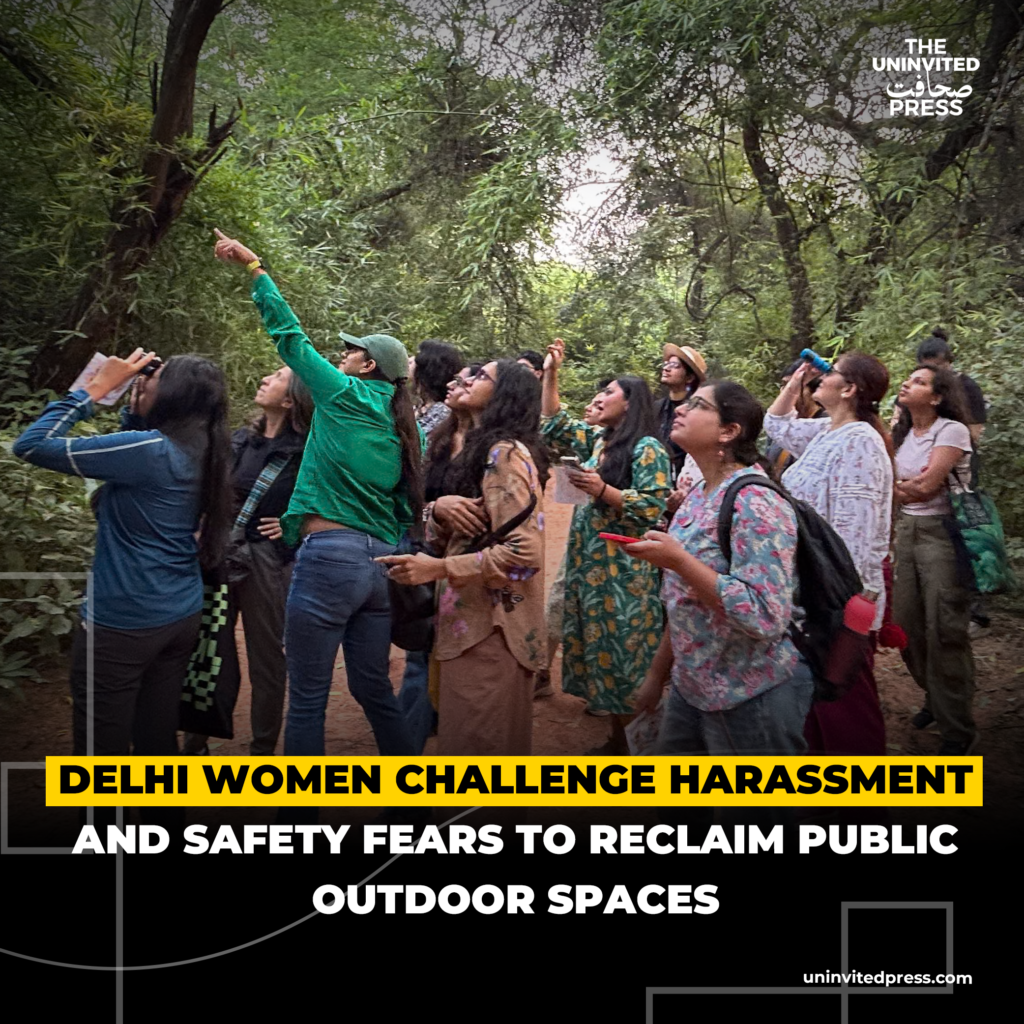
The push extends beyond city streets into Delhi’s parks and urban forests. On a recent Sunday morning, about 20 women joined a guided wildlife walk through Sanjay Van, a sprawling city forest. Led by conservationist and author Neha Sinha, who has organised such group outings for two years, participants shared experiences of harassment that routinely interrupt attempts to enjoy nature. One woman, Vallari Sheel, described being asked intrusive questions about her family when carrying binoculars or a camera, changing routes to evade stalkers, and facing propositions on the street. “Nearly every woman I know has called a cop saying ‘I have a stalker.’ In a culture that tells you not to go out … how do you make nature your own?” she said.
Sinha and others note that the fear is not of wildlife-Delhi’s forests host leopards and other animals-but of men who feel entitled to harass women outdoors. Group walks provide both practical safety and a political statement: nature and public parks should not be spaces women approach only with caution or in limited numbers.
Delhi Women Demand Safer Public Spaces:
Authorities have responded with audits and promises. A Delhi Development Authority review of its 736 parks found that only about 16 had functional CCTV cameras. Nearly 200 parks were classified as high-risk, hundreds needed better lighting, and many had issues with gates, boundary walls and abandoned structures. The Municipal Corporation of Delhi has proposed designating one women-only “Mahila Park” in each of the city’s 250 wards, to be staffed by female guards and equipped with CCTVs, open gyms and separate facilities. Lighting upgrades and increased police visibility, including specialised women patrol teams, have also been ordered.
Yet many women and activists argue that segregating spaces or simply adding cameras does not address the root problem. Past “pink park” initiatives have struggled with maintenance and underuse. Critics say the repeated response of restricting women’s mobility or creating separate zones risks shrinking the city for half its population rather than making all public spaces safer. Surveys and reporting consistently show high rates of everyday harassment-staring, following, verbal abuse and more serious assaults-that force women to calculate routes, timings and companions constantly.
The current movement builds on earlier campaigns such as “Why Loiter?” and the post-2012 Nirbhaya protests that demanded not only justice but the freedom to move through the city without fear. Participants stress that safety cannot mean a smaller world for women. Collective presence-whether walking at midnight or birdwatching in a city forest-is both a practical strategy and a claim to equal citizenship in outdoor public life. As one participant put it during a night walk, the goal is simple and radical: the day is ours, and the night is ours too.