

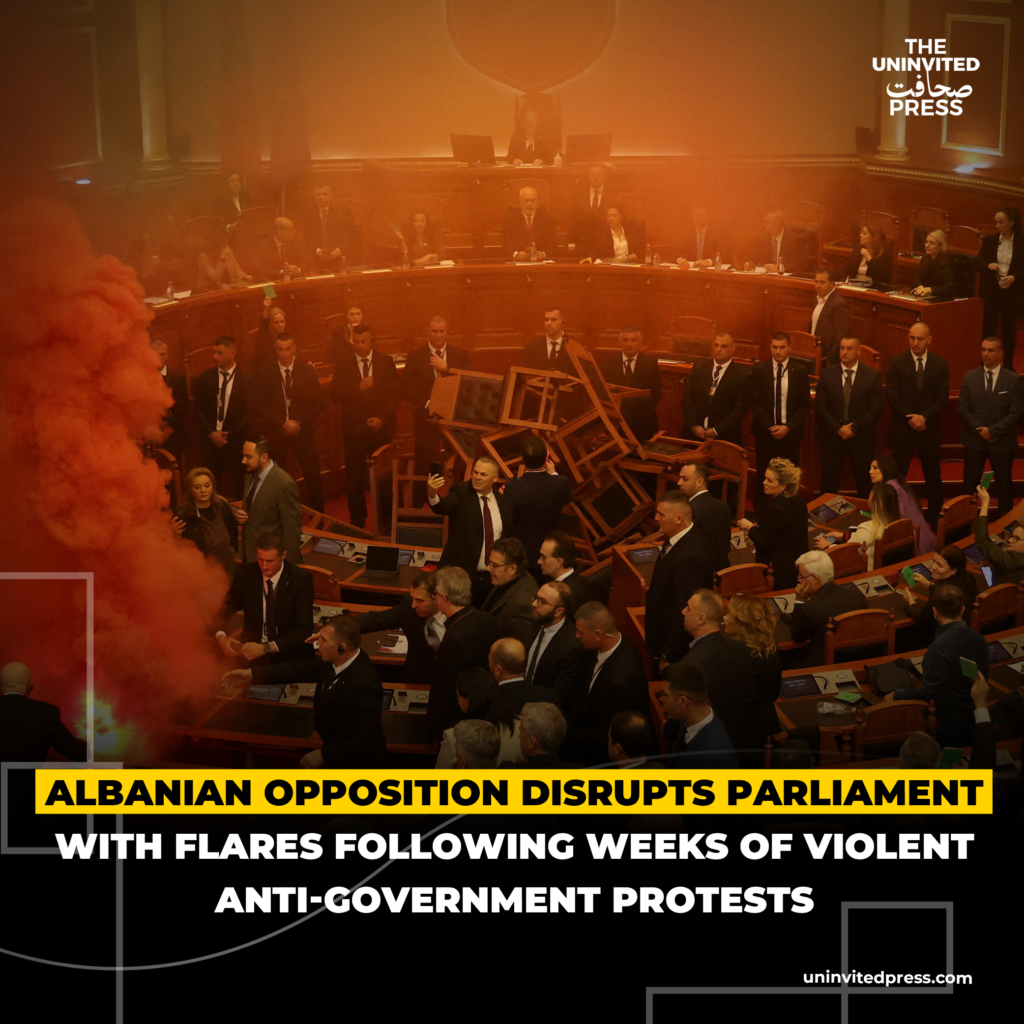
Lawmakers disrupt session and accuse Prime Minister Edi Rama of ignoring weeks of violent student-led anti-government protests demanding his resignation.
Opposition lawmakers filled Albania’s parliament with coloured smoke and lit flares on Thursday, disrupting a session and branding members of the government “criminals” as they sought to halt proceedings in solidarity with ongoing street protests.
Members of the Democratic Party, led by Sali Berisha, blocked access to the podium during a vote on legislation governing the country’s central bank. They banged on desks, threw water bottles and other objects, and held up photographs of protesters they said had been injured by police rubber bullets. Blue flares-the colour of the opposition party-and smoke bombs were set off repeatedly inside the chamber, filling the hall with thick pink, blue and white smoke.
Albania Protests Demand Rama’s Resignation:
“These (ruling lawmakers) are criminals and they deserve tear gas, rubber bullets, cracked skulls and broken bones, not the young people,” Berisha declared as he addressed parliament. His microphone was cut off mid-speech. Fellow opposition MPs surrounded him, some wearing blindfolds in a gesture of solidarity with demonstrators. Speaker Niko Peleshi expelled four opposition lawmakers. Prime Minister Edi Rama attended the session, participated in the vote, and later left. The bill ultimately passed with the minimum required votes.
The parliamentary chaos came after more than two weeks of student-led demonstrations that began in mid-October. Protesters, initially focused on poor education standards, high living costs, unemployment and perceived corruption, have broadened their demands to call for Rama’s resignation. Demonstrations have spread from central Tirana to other cities. Clashes with police have left more than 350 people injured, including many officers, with dozens of protesters detained. Demonstrators have set fire to government buildings and banks, smashed shop windows and thrown paving stones at security forces.
The current wave of unrest followed months of largely peaceful protests that began earlier in the year over a controversial luxury coastal resort development linked to Jared Kushner, son-in-law of US President Donald Trump. Rama, who has governed since 2013 and won a fourth term last year, has refused to step down. He has introduced measures including heavy fines for participation in protests that turn violent, even for those not directly involved in violence. This week’s demonstrations were largely calmer, with another planned for Saturday.
Albania’s Political Crisis Deepens Amid Protests:
Opposition figures, including Democratic Party deputy head Belind Kellici, accused the ruling Socialist Party of pushing ahead with its agenda “as if nothing were happening in Albania” in a deliberate denial of the country’s crisis. Protesters themselves have largely kept distance from both major parties, with some signs accusing both Rama and Berisha of corruption. Dramatic scenes in Albania’s parliament, including the use of flares, are not unprecedented.
The disruption highlights the deepest challenge yet to Rama’s long tenure as Albania continues its path toward European Union membership amid persistent public frustration over governance, the economy and the use of force against demonstrators.