

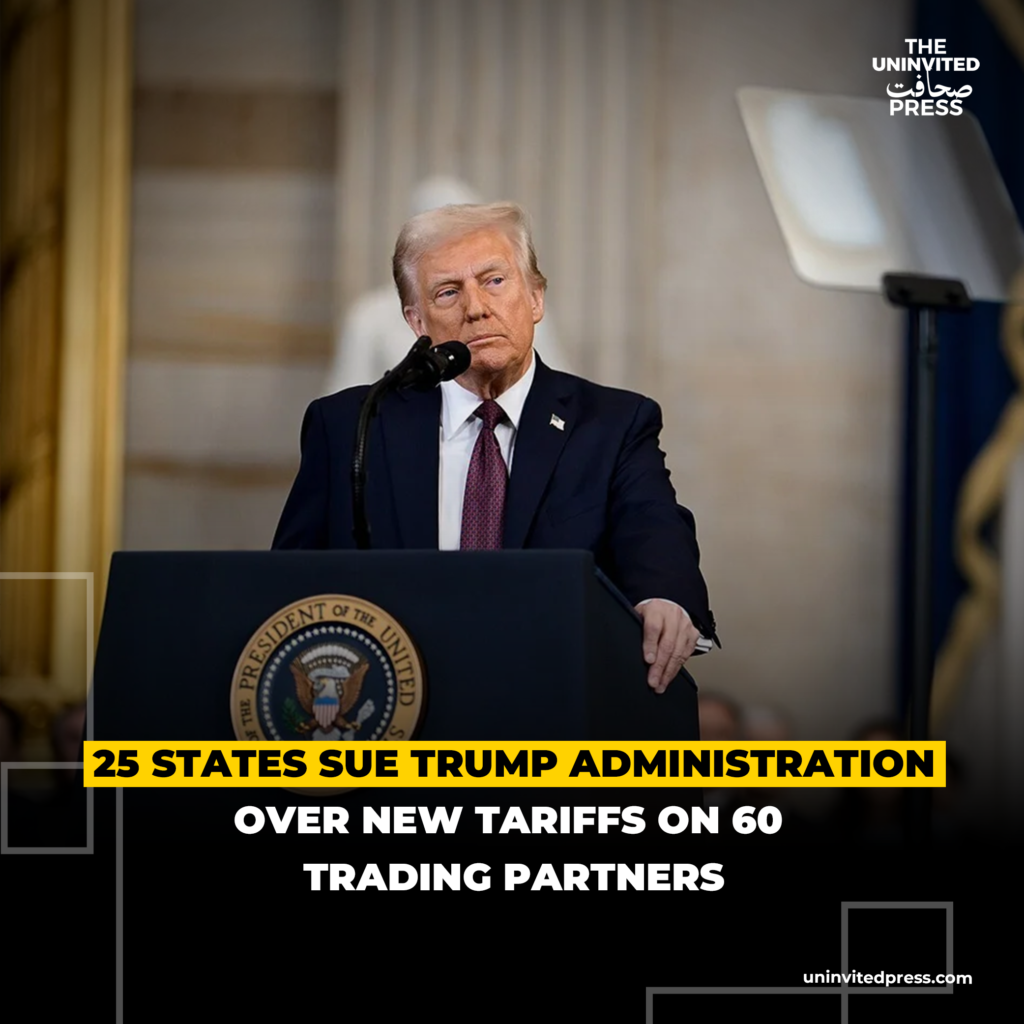
Coalition challenges Section 301 duties as unlawful attempt to revive previously blocked import taxes.
A coalition of 25 US states has filed a lawsuit against the Trump administration, seeking to block new tariffs of 10 to 12.5 percent imposed on goods from 60 trading partners, arguing that the measures exceed presidential authority and serve as a pretext for earlier duties struck down by the courts.
The lawsuit, filed on Monday in the US Court of International Trade in New York, targets tariffs that took effect in late July under Section 301 of the Trade Act of 1974. The administration justified the duties by alleging that the affected economies had failed to adequately ban and enforce prohibitions on goods produced with forced labour.
25 States Challenge Trump Tariffs in Federal Court:
he states contend that the tariffs cover countries and the European Union that together account for 99.4 percent of US imports. They are asking the court to halt the duties, declare them unlawful and order refunds of any payments already collected.
“No matter how the administration tries to justify it, the law and our Constitution are clear that the president does not have the power to impose sweeping tariffs on whatever countries he wants,” New York Attorney General Letitia James said in a statement.
California Attorney General Rob Bonta, one of the lead plaintiffs, described the action as the administration’s third attempt to impose what the states call illegal tariffs. “This is President Trump’s third attempt to illegally impose tariffs that would make life more expensive for American families and small businesses,” Bonta said. “Tariffs are taxes.”
The states involved include Arizona, California, Colorado, Connecticut, Delaware, Hawaii, Illinois, Massachusetts, Maryland, Maine, Michigan, Minnesota, Nevada, New Jersey, New Mexico, New York, North Carolina, Oregon, Rhode Island, Virginia, Vermont, Washington and Wisconsin, along with the governors of Kentucky and Pennsylvania. Most of the plaintiffs are Democratic-led.
States Challenge Trump’s New Tariffs Over Executive Power:
The new tariffs replaced temporary 10 percent worldwide duties that expired on July 24, the same day the Section 301 measures took effect. Those temporary tariffs had been introduced after the US Supreme Court ruled earlier this year that President Donald Trump lacked authority under the International Emergency Economic Powers Act (IEEPA) to impose broad import taxes. A prior attempt using Section 122 of the Trade Act was also challenged in court.
In their complaint, the states argue that the forced-labour rationale is a pretext and that the administration is using Section 301 in a novel and expansive way never previously applied to impose near-universal duties. They claim the action violates the Administrative Procedure Act and exceeds the statute’s intended scope.
The Trump administration has defended its tariff policy as necessary to protect American workers and address unfair trade practices, including forced labour in global supply chains. Officials have argued that the measures fall within the president’s trade authority.
The lawsuit follows a separate legal challenge filed by small businesses that also contend the latest tariffs exceed executive power. Courts have previously ordered refunds related to earlier tariff regimes after finding them unlawful.
The case continues a pattern of legal confrontations over the administration’s trade agenda, which has relied on successive legal justifications to maintain broad import duties despite repeated judicial setbacks.