

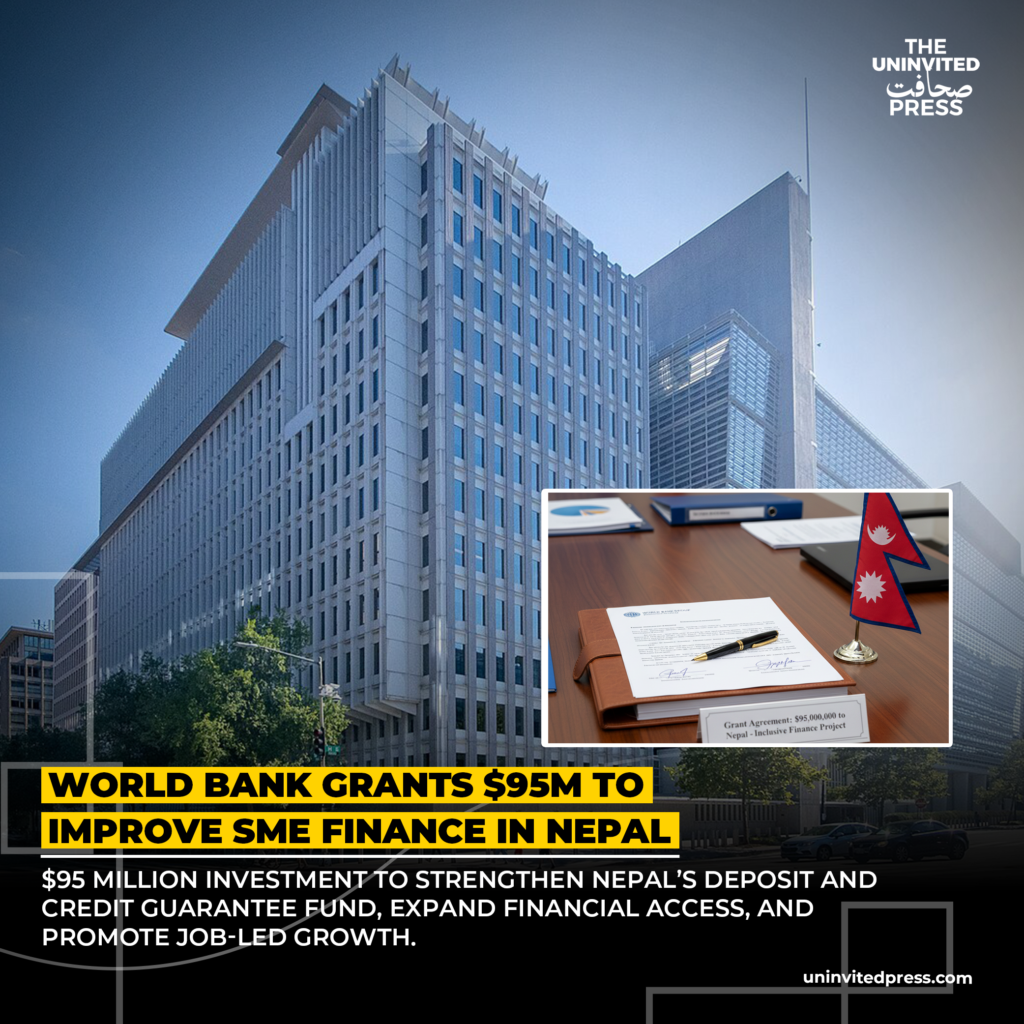
A bold move to unlock credit for over 100,000 small businesses, prioritising women entrepreneurs and job creation in a nation hungry for growth, as the World Bank approves $95 million for Nepal’s SMEs to boost jobs and financial inclusion.
World Bank Drops $95 Million Lifeline to Rescue Nepal’s Cash-Strapped SMEs:
Washington, D.C. In a timely intervention for Nepal’s struggling economy, the World Bank has greenlit a $95 million project to overhaul access to finance for small and medium enterprises (SMEs). This initiative, approved on February 3, 2026, targets deep-rooted barriers like inadequate collateral and limited credit histories, potentially sparking thousands of new jobs and bolstering private sector resilience. As Nepal grapples with slowing growth projections and persistent financing gaps, this could be a critical catalyst for inclusive recovery.
$95M Boost: World Bank Revamps Nepal’s Finance System:
The approval comes at a pivotal moment for Nepal. The World Bank’s Board of Executive Directors endorsed the Sustainable and Inclusive Finance Project, channeling $95 million to fortify the country’s financial infrastructure. The funds will primarily capitalize the DCGF with $85.2 million, enabling it to expand its guarantee portfolio and introduce tailored products for groups often sidelined by traditional lending-such as women-owned businesses and eco-friendly ventures. An additional $2 million will upgrade DCGF’s management information system for faster claims processing and better risk management.
Complementing this, $7.8 million is allocated to modernize the CIBN, Nepal’s credit bureau. This includes developing a centralized Know Your Customer (c-KYC) system to streamline onboarding, incorporate alternative data sources like utility payments, and bolster data security. The International Finance Corporation (IFC), a World Bank Group member, has already provided technical support to CIBN in these areas.
This isn’t starting from scratch. The project extends reforms from the World Bank’s 2024 Development Policy Credit series, which laid groundwork for financial stability and growth-oriented policies . It also syncs with Nepal’s recently approved second Financial Sector Development Strategy, signaling aligned priorities between international donors and local authorities.
99.7% of Firms, $6bn Gap: Nepal’s SME Engine Falters:
Nepal’s SMEs are the lifeblood of its economy, comprising 99.7% of all enterprises and employing around 2.8 million people, mostly in the informal sector. They contribute over 90% of industrial GDP and 70% of exports, yet face a staggering $6 billion financing shortfall. Access to formal credit remains elusive: only 47% of adults borrow from regulated institutions, with women entrepreneurs hit hardest by a $321 million gender-specific gap. High collateral demands, procedural hurdles, and interest rate caps-limited to 15% for microfinance-exacerbate the issue, leaving 40% of SMEs citing finance as their top constraint.
Financial inclusion has improved-77% of Nepalis now use banking services, up from lower figures a decade ago-but disparities persist. Rural areas, low-income households, and women lag behind, with microfinance institutions and cooperatives filling some voids but struggling with non-performing loans at 4.6% as of June 2025. Nepal’s broader economy grew 4.6% in FY2025 but is forecasted to dip to 2.1% in FY2026 due to political unrest, climate shocks, and weakened tourism. Poverty has fallen to 20.3%, but inequality and job scarcity remain acute, making SME-led growth essential for diversification beyond remittances and agriculture.
Institutions like DCGF already guarantee loans for 1.5 million borrowers, but they lack modern tools like risk-based pricing and coverage for green initiatives. CIBN covers just 10% of adults with mostly negative data, hindering accurate risk assessments. This project addresses these gaps, aiming to integrate SMEs into regional value chains and foster resilience against shocks.