

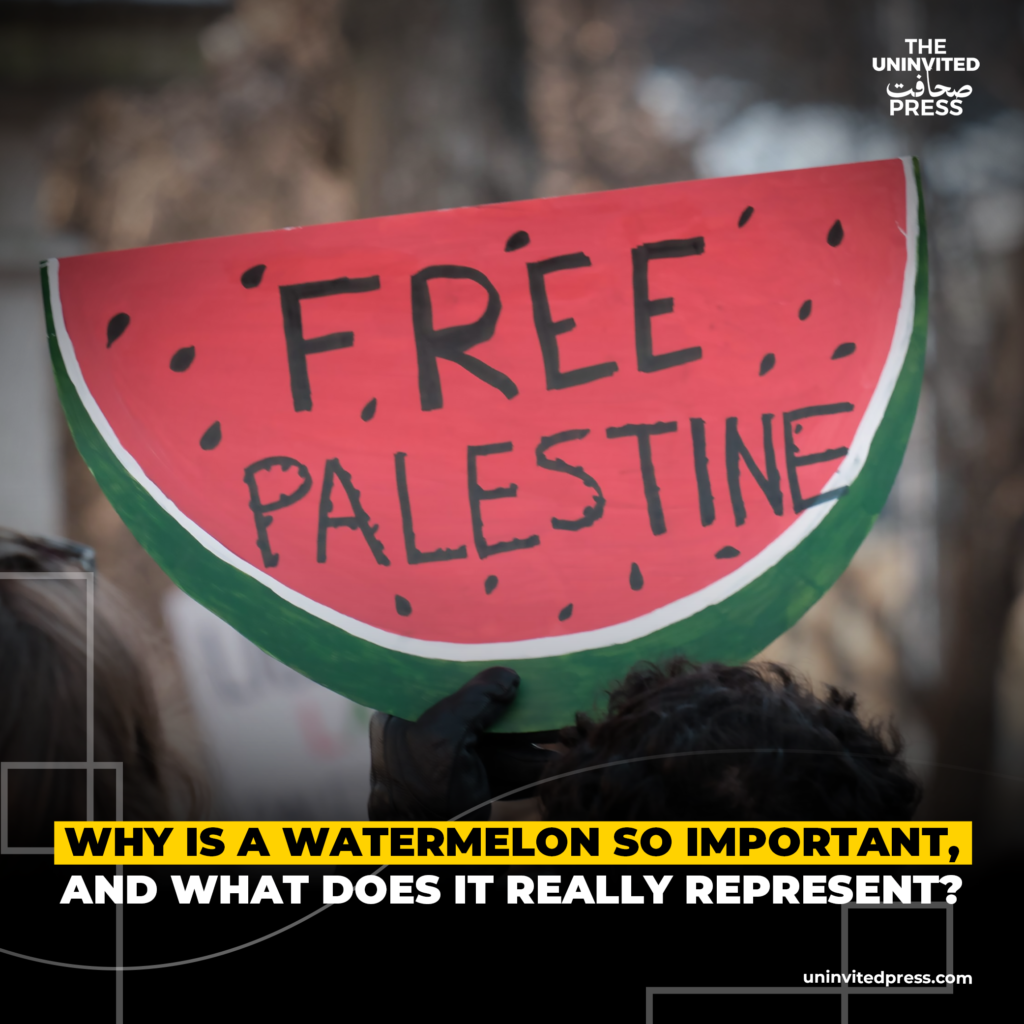
The watermelon has become one of the most recognizable symbols linked to the Palestinian cause in recent years. While it may seem unusual that a fruit carries political meaning, its significance is rooted in history, censorship, identity, and visual symbolism connected to the Israeli-Palestinian conflict.
The Origin of the Symbol:
The connection dates back to 1967, after Israel captured the West Bank, Gaza Strip, and East Jerusalem during the Six-Day War. In the years that followed, public displays of the Palestinian flag were banned in many areas under Israeli control. This included flags at protests, cultural events, and even in artwork.
The Palestinian flag consists of four colors: red, green, white, and black. Palestinians began using indirect ways to express national identity without displaying the flag itself. The watermelon-red flesh, green rind, black seeds, and white inner layer-contains the same four colors.
As a result, the watermelon became a quiet visual substitute for the Palestinian flag when direct symbols were restricted.
Watermelon as a Form of Expression:
Artists, activists, and ordinary citizens began using watermelon imagery in:
Paintings and posters
Clothing and accessories
Protest signs and digital art
Because it did not explicitly show the flag, the watermelon allowed Palestinians to express identity and resistance while navigating restrictions on political symbols.
Modern Resurgence of the Symbol:
The watermelon re-emerged strongly in the 2020s, especially on social media. This followed renewed debates over speech, protest imagery, and online moderation related to Israel and Palestine.
As some platforms removed or restricted Palestinian flag imagery or political slogans, users again turned to the watermelon as a coded, non-verbal symbol of solidarity with Palestinians.
The symbol spread rapidly because:
- It is visually simple and instantly recognizable
- It avoids explicit political slogans
- It carries historical meaning understood by supporters
What the Watermelon Represents?
The watermelon does not represent violence or hostility. Instead, it is commonly used to symbolize:
- Palestinian identity
- Resistance to censorship
- Solidarity with civilians affected by conflict
- Cultural survival under occupation
Why It Is Controversial?
Like many symbols tied to the conflict, the watermelon is viewed differently depending on perspective.
Supporters see it as a harmless, creative form of political expression.
Critics argue it has become politicized and is sometimes used in highly charged contexts.
However, the symbol itself does not promote hatred or violence. Its meaning comes from historical restrictions on expression and the ongoing struggle over visibility and voice.
A Symbol of Adaptation, Not Provocation:
Ultimately, the watermelon reflects how communities adapt when traditional forms of expression are limited. It shows how culture, art, and symbolism evolve under pressure, especially in long-running conflicts where identity is deeply contested.
The watermelon’s power lies not in the fruit itself, but in what it represents: a people finding ways to be seen when visibility is restricted.
How the Watermelon Became Linked to Israel-Palestine?
After the 1967 Six-Day War, Israel took control of the West Bank, Gaza Strip, and East Jerusalem. In the years that followed, displaying the Palestinian flag was restricted or banned in several areas under Israeli military rule, including at protests and cultural events.
The Palestinian flag has four colors:
Red
Green
White
Black
A watermelon naturally contains the same four colors:
- Red flesh
- Green rind
- White inner layer
- Black seeds
Israel’s Role in the Symbol’s Meaning:
The watermelon became meaningful because of Israeli restrictions on Palestinian political symbols, not because Israel adopted or promoted it.
It represents Palestinian identity and resistance to censorship, rather than a direct statement about Israel as a state.
Over time, it evolved into a peaceful, non-verbal form of protest.