

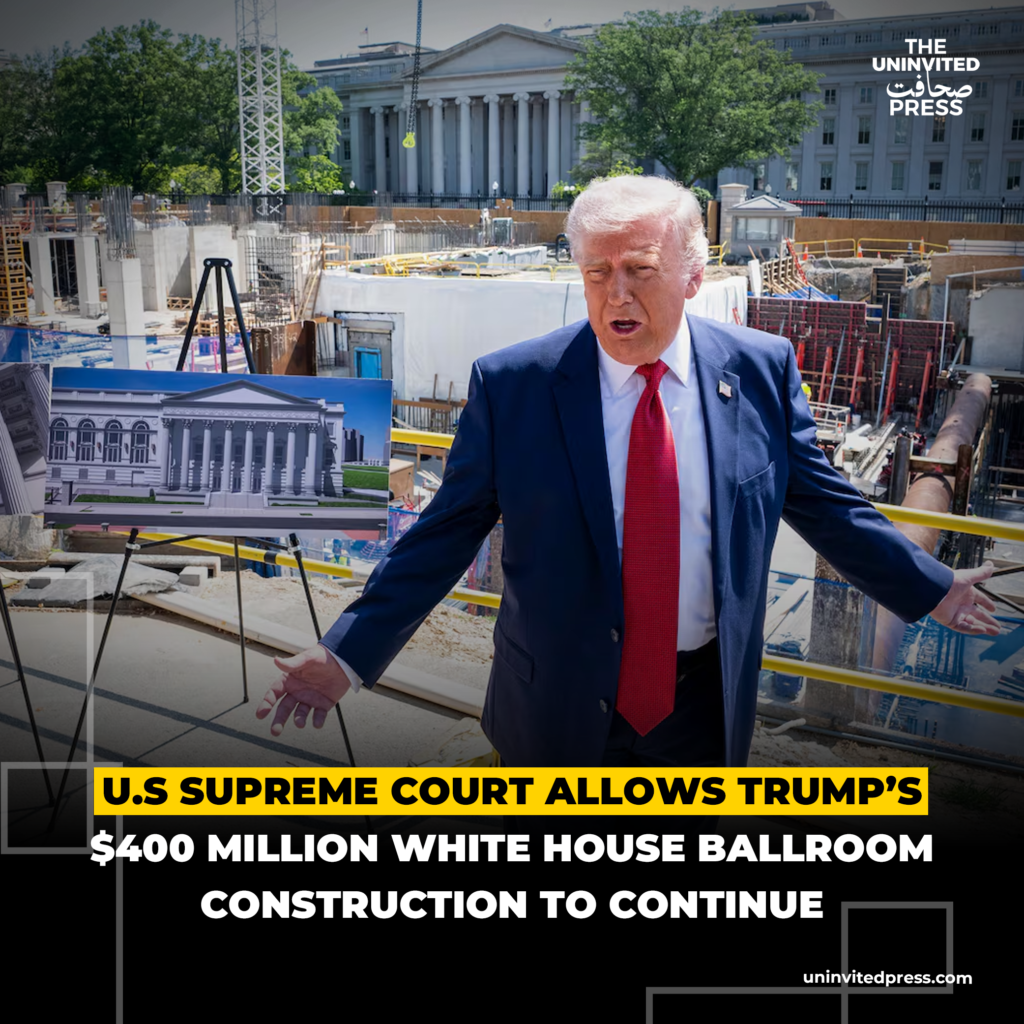
5-4 ruling finds historic preservation group likely lacks standing; Chief Justice Roberts dissents, calling project ‘likely unlawful’.
The US Supreme Court has cleared the way for President Donald Trump to continue building a controversial $400 million ballroom at the White House, granting the administration’s request to block a lower-court order that would have halted above-ground construction.
In a 5-4 decision issued on Monday, the court’s conservative majority ruled that the National Trust for Historic Preservation, which sued to stop the project, likely lacked the legal standing required to challenge it in federal court. The unsigned opinion emphasised that the justices were not deciding whether the construction itself was lawful.
“Today, we do not pass upon the legality of the government’s East Wing project,” the majority wrote. It concluded that the government was likely to succeed in showing the Trust had not suffered a concrete and particularised injury sufficient under the Constitution, and that national security considerations favoured allowing the work to proceed while litigation continues.
Roberts Warns Trump Ballroom Project Is Likely Unlawful:
Chief Justice John Roberts joined the court’s three liberal justices-Elena Kagan, Sonia Sotomayor and Ketanji Brown Jackson-in dissent. Roberts wrote that the construction is “likely unlawful” because Congress has not authorised it. He noted that Congress holds plenary authority over the District of Columbia and federal property, and has prohibited structures from being built on federal grounds without its explicit approval.
“The White House is an iconic American building whose symbolism and history are wrapped up in its architecture,” Roberts wrote. He described the majority’s decision as “no victory for the separation of powers,” arguing that allowing the project to continue risked infringing on Congress’s power of the purse and its authority to regulate federal property.
The ballroom, planned as a nearly 90,000-square-foot structure capable of hosting about 1,000 guests, is being built on the site of the historic East Wing, which was demolished last year. Trump has repeatedly described the project as a “gift” to the American people, funded primarily by private donations, and has linked it to a larger underground military and security complex that includes shelters and other protective features. The administration has cited national security needs in defending the work.
Trump Ballroom Construction Continues:
Construction has advanced significantly. The White House said in mid-August that the overall project was about 65 percent complete, with crews working long hours. Trump welcomed the Supreme Court’s ruling on social media, calling it a victory and declaring that the building would be “one of the Greatest ever constructed in Washington, D.C.”
The legal challenge began after the National Trust argued that the administration lacked authority to proceed without congressional approval. Lower courts had ordered a pause on much of the above-ground work, though those orders never fully took effect due to successive stays. The Supreme Court’s decision keeps construction moving forward as the underlying case continues in the lower courts.
Critics have raised concerns about the project’s cost, its impact on the historic character of the White House, and questions over whether private funding fully covers expenses or whether taxpayers will ultimately share the burden. Supporters, including the administration, maintain that the ballroom addresses long-standing needs for modern event space and enhanced security at the executive residence.
The ruling marks another high-profile intervention by the Supreme Court in a dispute involving presidential authority and the balance of power between the executive and legislative branches.