

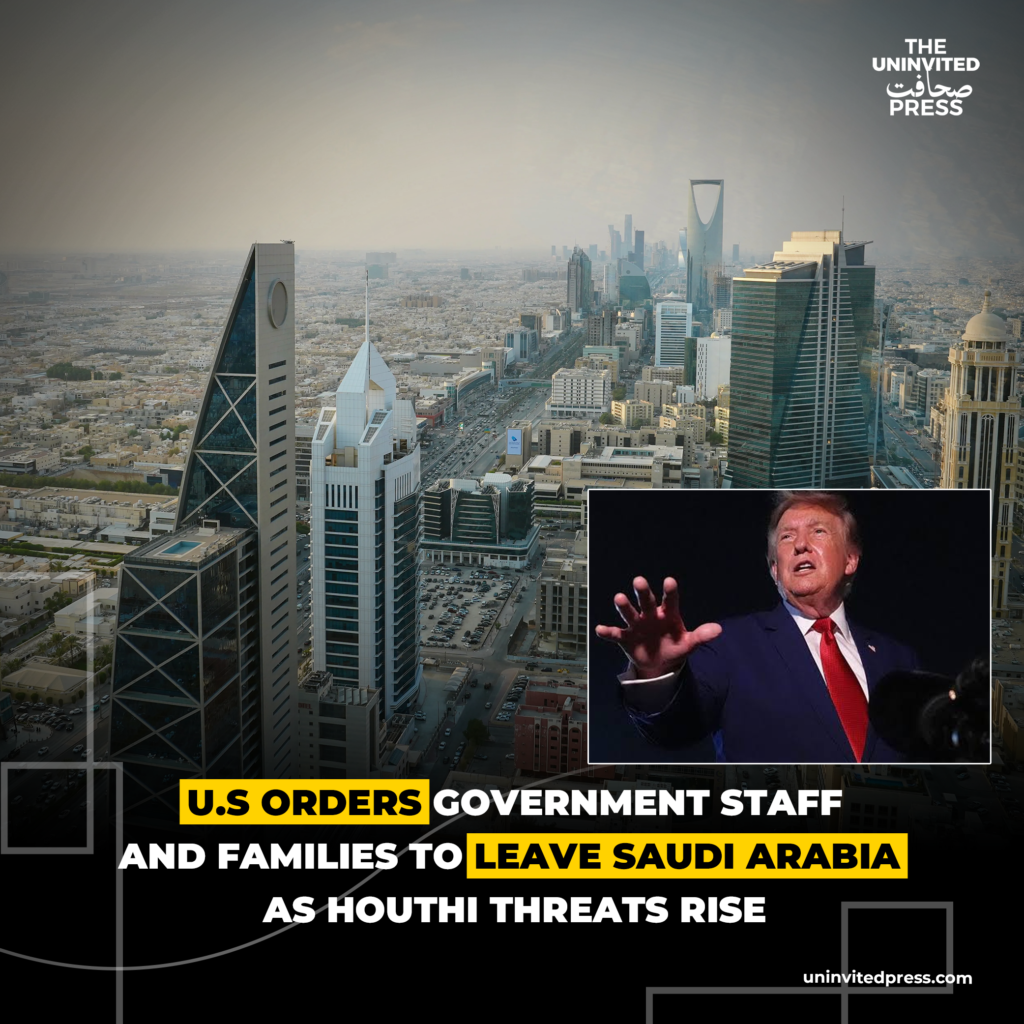
State Department issues ordered departure of non-emergency personnel citing escalating Iran-aligned attacks on civilian airports and critical infrastructure.
The United States has ordered the departure of non-emergency government employees and their family members from its diplomatic missions in Saudi Arabia amid a sharp rise in attacks by Yemen’s Iran-aligned Houthi movement.
State Department spokesperson Tommy Pigott confirmed the measure in a statement on Wednesday, saying the department had issued an “ordered departure for non-emergency US government employees and their family members in Saudi Arabia only.”
“Iranian-supported Houthis have increasingly engaged in hostilities against Saudi Arabia, including attacks on civilian airports and other critical infrastructure resulting in civilian casualties and severe travel disruptions,” Pigott said. “The safety and security of Department personnel and their families remain our highest priority, and we will continue to take all necessary steps to protect and support them.”
Surge in Houthi strikes:
The decision follows a series of deadly Houthi drone and missile attacks across the kingdom in recent weeks. The most severe struck King Khalid International Airport in Riyadh earlier this month, killing at least 13 people-including one American citizen-and wounding hundreds. Other airports in cities including Dammam, Jizan, Najran and Abha have also been targeted, along with oil facilities and military sites.
On Wednesday, Saudi authorities reported further incidents, including falling debris from an intercepted drone that killed two foreign workers at an oil facility and an attack on King Fahd International Airport in Dammam that caused casualties and disrupted operations.
The US Embassy in Riyadh issued a security alert warning American citizens of the potential for additional attacks on airports and widespread travel disruptions. US government employees in the kingdom now require special authorisation from the Chief of Mission to use any Saudi airport.
US Orders Non-Essential Staff to Leave Saudi Arabia Amid Rising Threats:
Pigott stressed that the ordered departure applies solely to Saudi Arabia, rejecting earlier media reports that suggested a broader withdrawal of personnel from US missions across the Gulf. However, some US officials indicated that family members at posts in other Gulf states may also be asked to leave as a precautionary measure, while several embassies have already shifted to “restricted operations” status.
The move comes against the backdrop of heightened regional tensions. Washington had gradually returned some diplomatic staff to the Middle East in recent months after earlier withdrawals linked to wider conflict involving Iran. The latest escalation opens another front in the complex web of hostilities that has disrupted energy markets and travel across the region.
Saudi Arabia and the Houthis have exchanged fire for years as part of the long-running Yemen conflict, but the recent intensity of strikes on civilian infrastructure marks a significant intensification. Analysts note that the Houthis have expanded their capabilities, using longer-range drones and missiles that pose growing risks to major population centres and economic assets.
The ordered departure reduces the US diplomatic footprint in the kingdom at a sensitive moment. Essential personnel will remain to maintain core operations, but the reduction reflects Washington’s assessment that the threat level to non-essential staff and dependents has risen unacceptably.
US embassies in neighbouring countries have issued parallel advisories urging American citizens to exercise heightened caution. The State Department continues to monitor the situation closely, with officials emphasising that further adjustments could follow if the security environment deteriorates.
As Houthi attacks continue and regional powers weigh responses, the US decision underscores the fragility of the current security landscape in the Gulf and the challenges of protecting diplomatic personnel amid expanding asymmetric threats.