

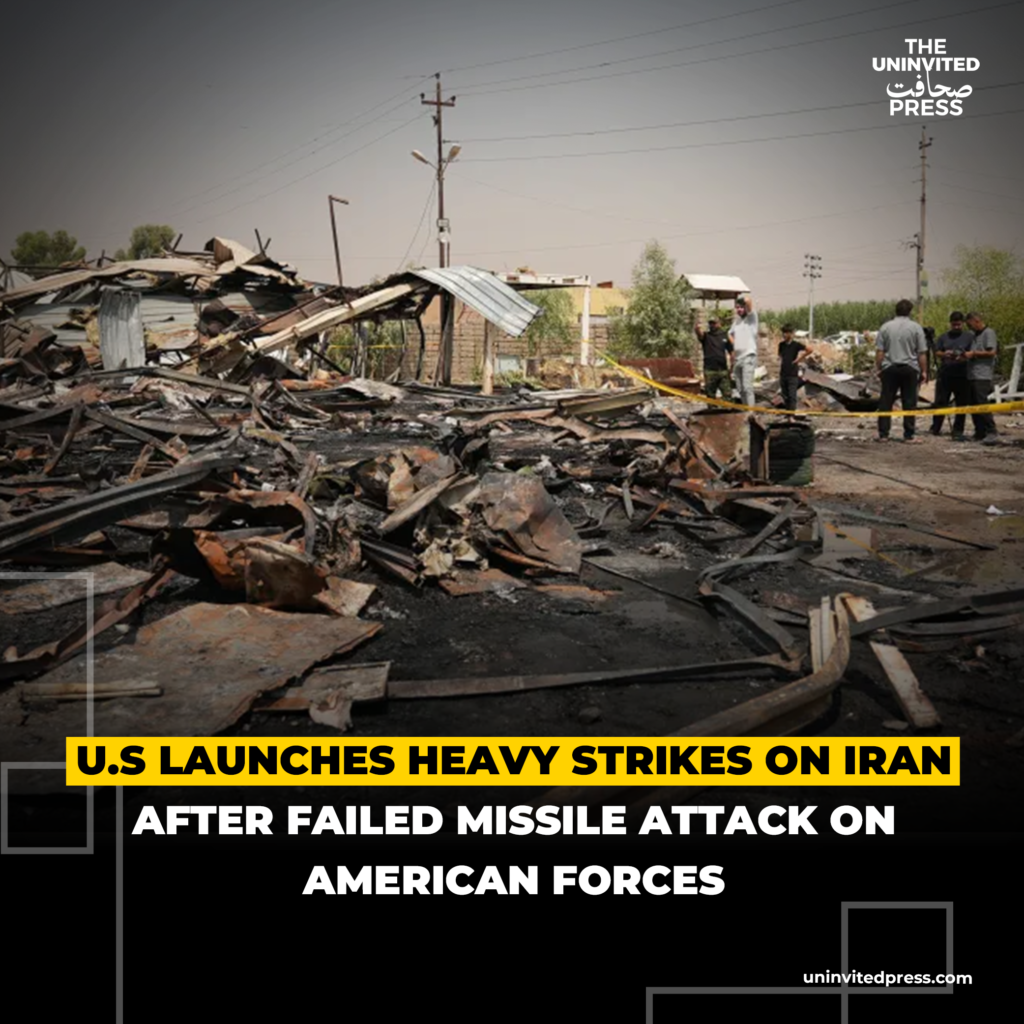
CENTCOM says dozens of IRGC targets hit in response to attempted ballistic missile launches; Iranian media report civilian deaths on Qeshm Island.
The United States carried out a “heavy wave” of airstrikes against Iran early on Thursday, targeting dozens of Islamic Revolutionary Guard Corps (IRGC) sites hours after Iranian forces launched ballistic missiles toward American positions in the Middle East, the US military said.
US Central Command (CENTCOM) announced that the operation, completed around 10pm ET on Wednesday (early Thursday local time in the region), struck military command centres, missile and drone facilities, coastal surveillance and defence sites, and maritime capabilities. The strikes were described as a “powerful response” to what Washington called an “attempted surprise attack” by Iran the previous day. All of the Iranian missiles were successfully intercepted, according to CENTCOM.
More than 50,000 US service members are currently deployed across the Middle East and “remain highly vigilant, focused, lethal, and ready,” the command said in a statement.
US President Donald Trump had earlier vowed to hit Iran “very hard” after the missile launches, which included an attempted strike on a base in Jordan hosting American troops.
Civilian deaths reported on Qeshm Island:
Iranian media reported that the US strikes hit multiple locations in southern Iran, including the strategic Qeshm Island in the Strait of Hormuz. Media, citing the Hormozgan University of Medical Sciences, said a residential home in the Chah Tangu neighbourhood of Qeshm was struck, killing a father, mother and their two-year-old child. Two other children from the same family, aged seven and nine, were rescued from the rubble and taken to hospital.
Explosions were also reported in Bushehr, Kish Island, parts of Khuzestan province and other southern areas. Local officials described power outages on Qeshm and ongoing rescue efforts at the damaged residential site. Iranian state media framed the attacks as aggression against civilian areas, while US officials maintained that the targets were exclusively military.
Escalation risks and the Strait of Hormuz:
The exchange marks a sharp intensification of the long-running US-Iran confrontation that has focused heavily on the security of the Strait of Hormuz, a critical artery for global oil shipments. In recent months, both sides have traded strikes involving drones, missiles and coastal defence systems. Washington has accused Tehran of threatening commercial shipping and US forces; Tehran has accused the United States of violating Iranian sovereignty and endangering civilians.
Qeshm Island has repeatedly featured in these exchanges because of its location and reported military infrastructure. Iranian authorities have long maintained a presence of fast boats, missile systems and surveillance assets in the area.
Oil markets and regional governments are watching the developments closely. Any prolonged disruption in the Strait of Hormuz would have immediate consequences for energy supplies and shipping insurance rates. Neighbouring Gulf states, which host significant US military facilities, have urged restraint while preparing for possible further escalation.
The latest strikes come against the backdrop of earlier phases of fighting that included a major US-Israeli campaign against Iranian targets earlier in 2026 and repeated Iranian responses against American bases in the region. Diplomatic channels remain limited, with neither side showing signs of de-escalation in the immediate aftermath of Thursday’s operation.
As rescue teams continued work on Qeshm and US forces assessed the results of their strikes, the risk of further retaliation hung over the Gulf. Both Washington and Tehran have framed their actions as defensive responses to the other’s aggression, leaving little room for immediate dialogue.