

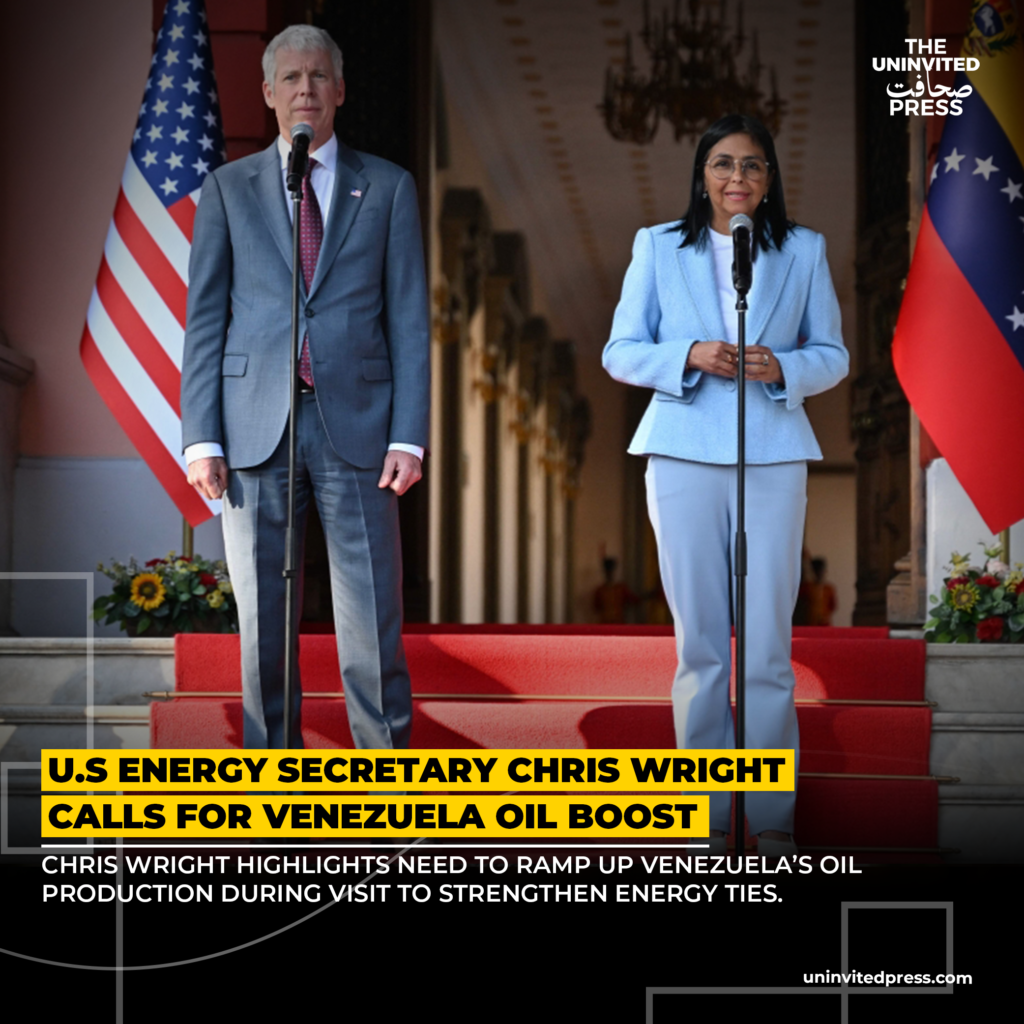
U.S. Energy Secretary Chris Wright urged a “dramatic increase” in Venezuela’s oil production during a landmark visit to Caracas, as Washington and Caracas explore sanctions relief and deeper energy cooperation that could reshape global oil supply and strengthen bilateral ties.
Wright Pushes Venezuelan Oil Boom in Caracas Visit:
US Energy Secretary Chris Wright touched down in Caracas this week, becoming the highest-ranking Trump administration official to visit Venezuela since the dramatic ouster of Nicolás Maduro last month. In high-stakes talks with interim President Delcy Rodríguez, Wright pledged a “dramatic increase” in oil, natural gas, and electricity production to revive the nation’s economy and “make the Americas great again.” This push, amid freshly eased sanctions, could flood global markets with Venezuelan crude but spotlights America’s deepening involvement in the country’s fragile transition, potentially at the cost of sovereignty concerns and geopolitical tensions.
Wright’s Caracas Arrival Sparks High‑Level U.S. Oil Push:
Wright’s arrival on February 11 marked a pivotal moment in US-Venezuela relations. He was greeted at Simón Bolívar International Airport and whisked to the Miraflores Palace for a closed-door meeting with Rodríguez. The pair emerged for a joint press conference, where Wright delivered his message of transformation. “I bring today a message from President Trump. He is passionately committed to absolutely transforming the relationship between the United States and Venezuela,” Wright stated. He emphasized specific plans to drive production surges, noting the blockade on sanctioned tankers is “essentially over.”
The visit’s agenda includes meetings with oil executives from Chevron and Repsol, as well as local firms, and a trip to the Petropiar facility in the Orinoco Belt on February 12. This follows a new US general license issued on February 10, authorizing exploration, production, and related activities in Venezuela. No new contracts were signed during the initial talks, but Wright hinted at forthcoming actions to facilitate investments.
The timeline traces back to Donald Trump’s 2024 election victory and his nomination of Wright, a fracking industry veteran, as Energy Secretary in December 2024. Confirmed in January 2025, Wright has championed fossil fuel expansion. Maduro’s regime faced renewed pressure with a US blockade on oil tankers in December 2025, leading to his capture by US special forces on January 3, 2026. Venezuela’s interim government enacted an oil reform law in January 2026, opening the sector to private control. Wright’s trip, announced February 9, is the first high-level energy-focused visit in nearly 30 years.
From 300 Billion Barrels to Minimal Output-U.S. Pushes Oil Comeback:
Venezuela boasts the world’s largest proven oil reserves, estimated at over 300 billion barrels, but production has plummeted from a peak of 3 million barrels per day in the late 1990s to about 1 million today. Under Hugo Chávez and Maduro, the sector was nationalized, with PDVSA holding a monopoly amid corruption, underinvestment, and US sanctions imposed during Trump’s first term (2017-2021). Sanctions barred PDVSA from global markets, forcing reliance on shadowy tankers and discounted sales to allies like China and Russia.
The economic toll has been severe; hyperinflation, mass migration of over 7 million Venezuelans, and widespread poverty. Trump’s second administration views Venezuela’s revival as key to hemispheric energy security, reducing reliance on Middle Eastern oil and countering Chinese influence. A $2 billion oil supply deal was secured post-Maduro, and Trump has floated a $100 billion reconstruction plan.
The significance is multifaceted. Boosting output could stabilize global prices, create jobs in Venezuela, and generate revenue for infrastructure. However, it risks entrenching US oversight, with critics decrying it as neo-colonialism. The exclusion of Chinese, Iranian, and Russian firms from sanctions relief adds to tensions in an already polarized region.