

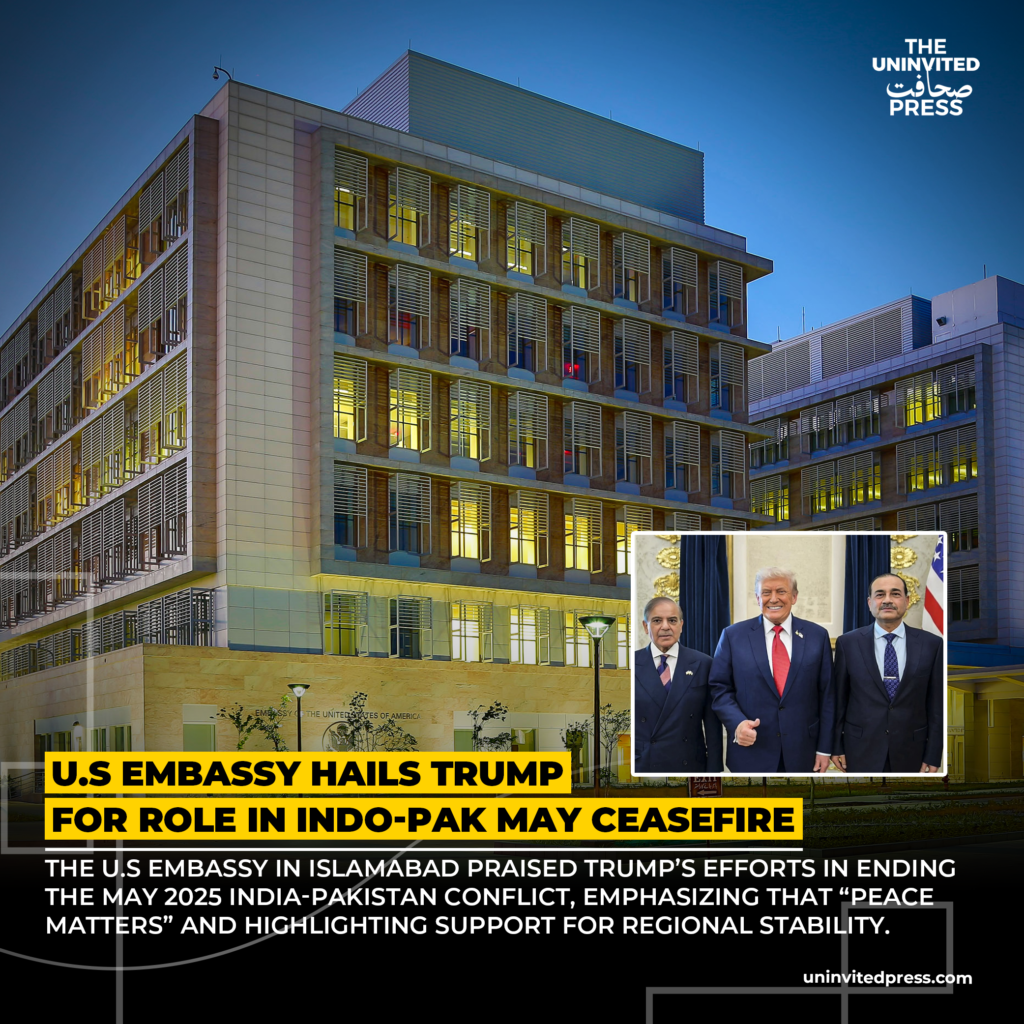
US Embassy in Islamabad praises Trump’s mediation in May 2025 Indo-Pak ceasefire, amid India’s denials. Explore conflict details, diplomatic tensions, and regional implications.
‘Peace Matters’ Post Rekindles Ceasefire Debate: US Embassy Credits Trump for Indo-Pak De-Escalation:
In a pointed social media post, the US Embassy in Islamabad has praised President Donald Trump’s efforts in mediating the May 2025 ceasefire between nuclear-armed rivals India and Pakistan, underscoring that “peace matters” and highlighting ongoing support for regional stability. The statement, issued on January 21, 2026, revives memories of a four-day conflict that risked escalation into broader warfare, claiming dozens of lives and displacing thousands along the Line of Control. This acknowledgment comes amid persistent denials from India about US involvement, fueling debates on Trump’s foreign policy legacy and the fragile détente in South Asia.
With cross-border tensions simmering since the 1947 partition, the embassy’s tribute signals Washington’s commitment to de-escalation in a volatile region. Yet, as both nations grapple with internal pressures and external alliances, the praise risks straining US-India ties at a time when strategic partnerships are crucial against rising Chinese influence.
US Embassy Spotlights Trump's Ceasefire Claim: Embassy Post, Truth Social Announcement, and May 2025's Clashing Narratives:
The US Embassy’s post on X featured a photo of Trump flanked by Pakistani officials, accompanied by the caption: “The United States is proud of its role, under President Trump’s leadership, in brokering peace between Pakistan and India during last May’s conflict-supporting regional stability and saving lives.” This came eight months after the ceasefire, amid Trump’s repeated claims of averting a nuclear crisis.
The conflict erupted on May 6, 2025, following a terrorist attack in Pahalgam, Jammu and Kashmir, killing 26 civilians. India launched Operation Sindoor, striking nine terrorist camps in Pakistan and Pakistan-occupied Kashmir. Pakistan retaliated with missile and artillery fire, leading to four days of intense clashes. Casualties included at least 50 soldiers and civilians, with reports of drone strikes and border skirmishes.
On May 10, Trump posted on Truth Social: “After a night of talks mediated by the United States, I am pleased to announce that India and Pakistan have agreed to a FULL AND IMMEDIATE CEASEFIRE.” Secretary Rubio followed with a statement confirming US engagement with leaders, including Modi and Sharif. The ceasefire took effect midday, halting operations and initiating de-escalation.
Pakistan swiftly thanked Trump, with Sharif calling his intervention “pivotal.” India, however, issued a statement via Foreign Secretary Vikram Misri, asserting the truce resulted from direct Director Generals of Military Operations talks, without third-party mediation.
Since then, Trump has reiterated his role over 80 times, including in speeches and interviews, claiming it saved “millions of lives” and prevented nuclear escalation.
From Kashmir Wars to Crisis Diplomacy: The High-Stakes Politics Behind the 2025 Indo-Pak Ceasefire:
India-Pakistan relations have been fraught since independence in 1947, with four wars and numerous skirmishes over Kashmir. The 2025 flare-up echoed the 2019 Pulwama crisis, where India struck Balakot after a suicide bombing. Operation Sindoor marked India’s first major cross-border action since then, amid domestic elections in both nations amplifying nationalist rhetoric.
Trump’s involvement harks back to his first term, when he offered mediation on Kashmir in 2019-welcomed by Pakistan but rebuffed by India, which views it as bilateral. His 2025 intervention, during his second term, involved threats of trade freezes and promises of deals, per US officials. This aligns with Trump’s “deal-maker” style, seen in Abraham Accords and North Korea talks.
Kashmir’s status revoked by India in 2019 fueled unrest, while Pakistan’s economic woes and internal instability limit escalation. US stakes are high-India as a counter to China via Quad, Pakistan as an ally in Afghanistan post-2021 withdrawal. It averted wider conflict in a nuclear flashpoint, but without addressing root causes like terrorism and water disputes, stability is precarious.