

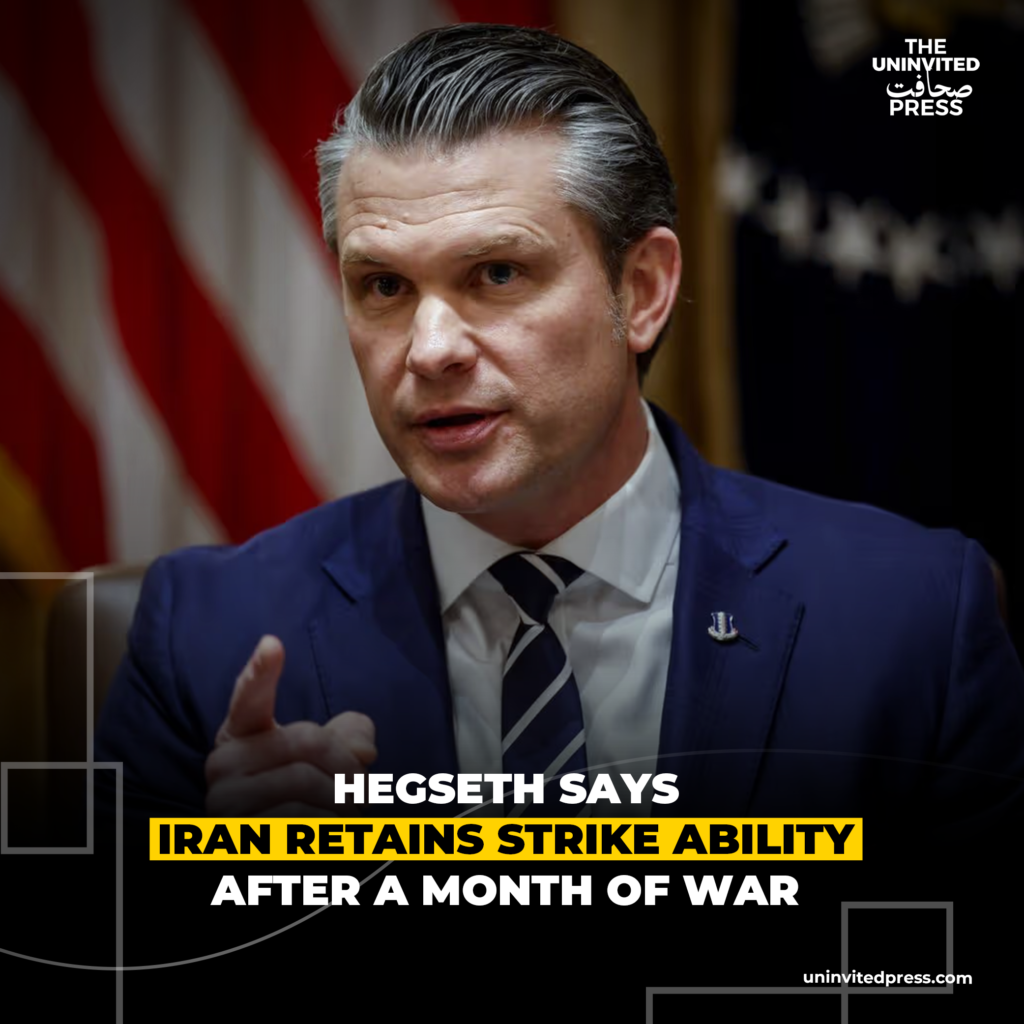
Despite heavy US-Israeli strikes, Tehran can still launch missiles, though at reduced scale, Pentagon chief says.
One month into a sustained US-Israeli military campaign against Iran, US Defence Secretary Pete Hegseth has acknowledged that Tehran still possesses some ability to launch offensive missile strikes, even as Washington claims significant degradation of Iranian military power.
Speaking at a Pentagon briefing on Tuesday, Hegseth conceded that Iran “will still shoot some missiles, but we will shoot them down.” He described the past 24 hours as seeing the lowest number of Iranian missile and drone launches since the conflict began, adding that the coming days would be “decisive.”
The remarks come amid Operation Epic Fury, the US-led campaign launched alongside Israel at the end of February 2026, which has involved thousands of strikes targeting Iranian missile production facilities, air defences, naval assets and command structures.
Limits of Air Strikes on Iran’s Capabilities:
Hegseth insisted that Iran’s broader military capabilities had been severely damaged, pointing to flattened air defences, destroyed production sites and a sharp decline in launch volume. He repeated earlier claims that Iran’s navy had been rendered largely ineffective and that morale within the Iranian regime appeared damaged.
However, the admission that Iran retains residual strike ability highlights the limits of aerial bombardment in fully neutralising a dispersed and hardened missile arsenal. Analysts have long noted that Iran’s ballistic missile programme, much of it stored in underground facilities, is difficult to eliminate completely through air strikes alone.
US and Israeli forces have reported striking key sites such as Khojir, Parchin and other missile-related complexes, yet Iran has continued sporadic launches, albeit on a much smaller scale than in the opening phases of the conflict.
War Escalation and Diplomatic Efforts:
The ongoing war has already caused significant casualties and heightened tensions across the Middle East. Iran has accused the US and Israel of aggression, while Washington maintains the operation is necessary to degrade Tehran’s capacity to threaten the region and pursue nuclear ambitions.
Hegseth signalled that the US remains open to a diplomatic deal to end the fighting but warned that strikes would intensify if Iran does not comply. President Donald Trump has also claimed progress towards negotiations while keeping military options on the table, including the possibility of ground operations, though officials have stressed no such decision has been made.
Gulf allies, including Saudi Arabia and the United Arab Emirates, have reportedly urged the US to press on, arguing that Iran has not yet been weakened sufficiently.
Regional Impact and Escalation Concerns:
The conflict has disrupted regional stability, affected global energy markets and raised fears of wider escalation. Oil prices have fluctuated amid concerns over the Strait of Hormuz, a vital chokepoint for much of the world’s oil supply.
Critics of the campaign argue that prolonged bombing risks entrenching Iranian resolve and could push Tehran further towards asymmetric responses or closer ties with other actors. Supporters, meanwhile, point to the destruction of Iranian naval vessels, air assets and missile infrastructure as major setbacks for the Islamic Republic’s power projection.
Hegseth’s briefing was his first public update on the war in nearly two weeks. He visited US troops in the Middle East over the weekend, underscoring the scale of American involvement.