

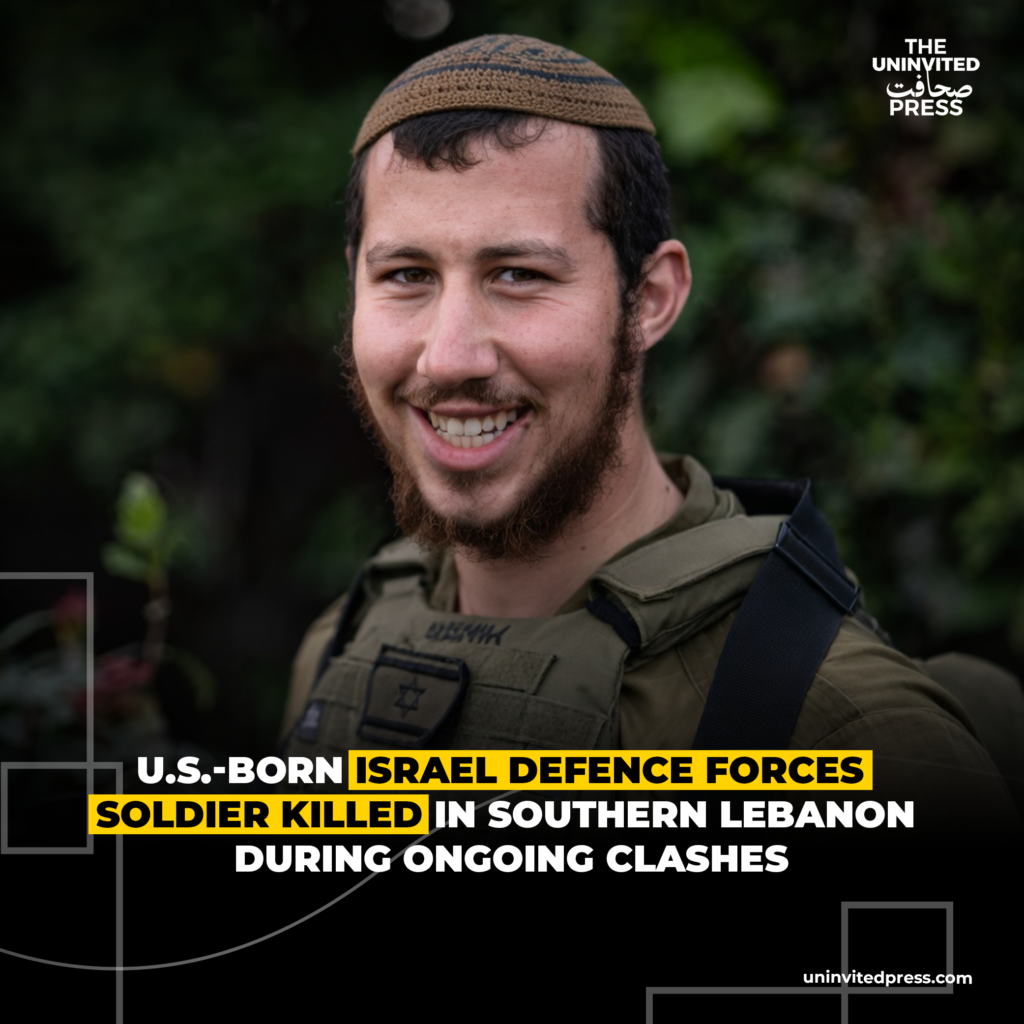
Death of Sgt. Moshe Yitzchak Hacohen Katz highlights human cost of Israel’s ongoing military operations in Lebanon amid regional escalation.
An American-born soldier serving in the Israeli army was killed during combat operations in southern Lebanon on Saturday, the Israeli military announced, as cross-border clashes with Hezbollah continue to claim lives on both sides of the volatile frontier.
The Israel Defense Forces (IDF) identified the soldier as Sergeant Moshe Yitzchak Hacohen Katz, 22, originally from New Haven, Connecticut. Katz had moved to Israel last year and enlisted in the Paratroopers Brigade’s 890th Battalion. He was posthumously promoted from corporal to sergeant, according to the IDF.
Israeli Prime Minister Benjamin Netanyahu offered condolences, describing Katz’s death as a sacrifice in the ongoing fighting. The military did not provide specific details on the circumstances of his death, stating only that he “fell in battle in southern Lebanon.”
Escalating Israel-Hezbollah Conflict in Southern Lebanon:
The incident comes amid renewed and intensified clashes between Israeli forces and the Iran-backed Lebanese group Hezbollah, which have escalated in recent weeks alongside broader regional tensions, including parallel operations involving Iran. Israel has conducted ground incursions and airstrikes in southern Lebanon, claiming to target Hezbollah infrastructure and militants, while the group has responded with rocket fire, anti-tank missiles and ambushes on Israeli positions.
Lebanese authorities and health officials report that Israeli operations have killed more than 1,000 people in Lebanon since the latest surge in violence began earlier this year, displacing nearly a million others and triggering a severe humanitarian crisis. Hezbollah has reported inflicting casualties on Israeli forces, though the group’s claims are difficult to independently verify in the fog of war.
Katz’s death marks another Israeli military fatality in the southern Lebanon theatre, where multiple soldiers have been killed in recent ground operations and exchanges of fire.
A dual identity and the broader conflict:
Katz’s American background adds a layer to the story of foreign fighters in the Israeli military, often referred to as “lone soldiers” who volunteer to serve despite having roots abroad. His family in the United States has not yet issued a public statement, but Israeli media described him as having completed training shortly before deploying to the front.
Critics of Israel’s military campaign in Lebanon argue that such operations, framed by Israel as defensive measures against Hezbollah threats, have disproportionately impacted Lebanese civilians and infrastructure. Humanitarian organisations have repeatedly called for de-escalation and protection of non-combatants, warning that the cycle of violence risks drawing the region into a wider war.
Hezbollah, for its part, portrays its actions as resistance against Israeli aggression and occupation of Lebanese territory, vowing to continue fighting until Israeli forces withdraw.
Rising Regional Tensions and Human Toll:
As fighting persists, concerns are growing over the potential for further escalation, especially given the involvement of multiple actors across the Middle East. The United Nations and several governments have urged restraint, calling for renewed diplomatic efforts to prevent a full-scale war that could engulf Lebanon and beyond.
For many in Lebanon, each reported Israeli incursion deepens the trauma of past conflicts, while families of fallen fighters on both sides mourn losses that show no sign of abating.
The death of Sgt. Katz underscores the personal toll of a conflict that continues to extract a heavy price in blood, even as international attention shifts between multiple flashpoints in the region. With no immediate ceasefire in sight, residents on both sides of the border brace for what may come next.