

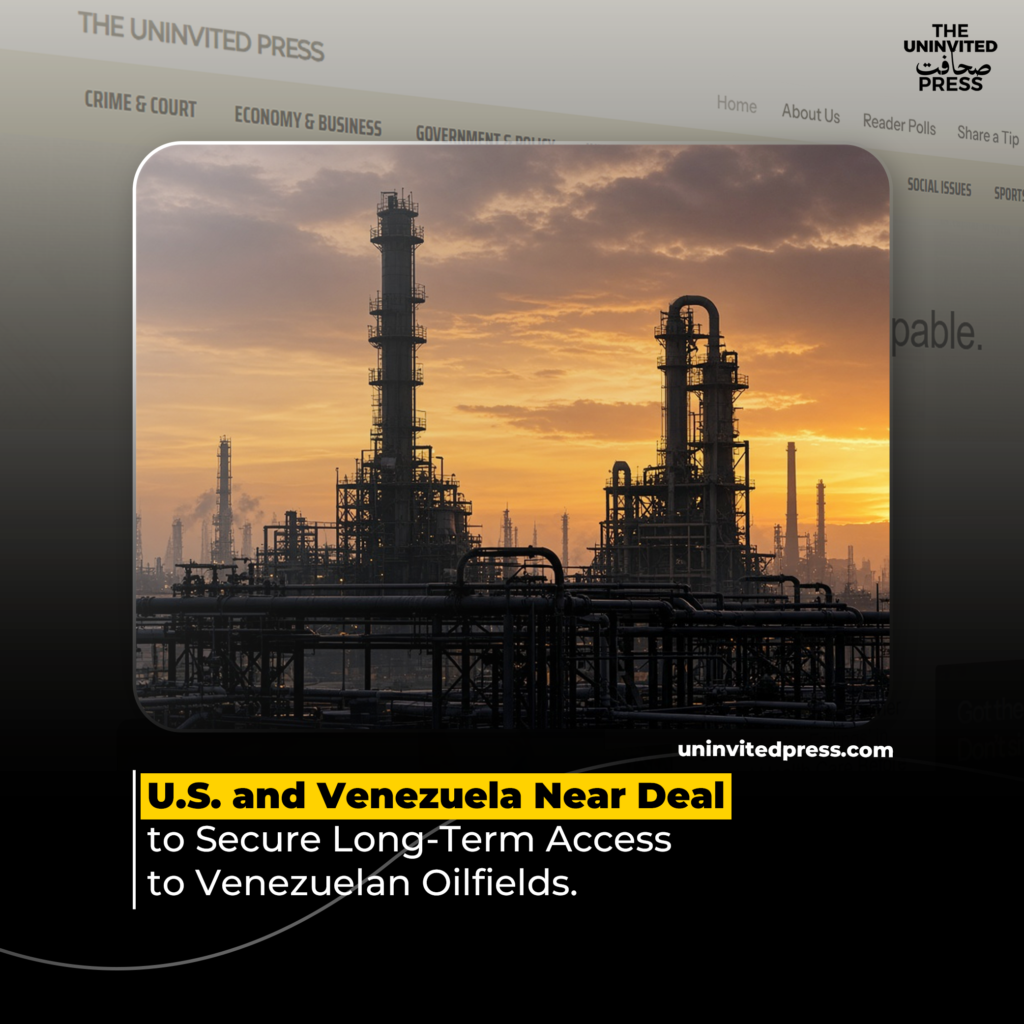
Trump administration seeks to lock in reserves for American companies amid high-level talks in Washington and Caracas.
The United States is close to finalising an agreement that would grant it long-term access to a portion of Venezuela’s vast crude oil reserves, according to sources familiar with the negotiations.
Officials from the Trump administration and Venezuela’s interim government are discussing a framework that would allow the US government to secure a group of oilfields for development by American companies, with the resulting supply guaranteed for the United States. The deal, which could be signed and made public soon, is being negotiated at the highest levels in both capitals.
U.S. Considers 100-Year Leases for Venezuelan Oil Fields:
One legal model under consideration is a long-term “lease” arrangement. Some reports indicate discussions have included leases lasting up to 100 years on selected fields. After the US locks in the assets, an auction or tender process would allocate individual fields among US producers.
A list of 17 fields under negotiation, reviewed by Reuters, includes undeveloped (green) fields in the Orinoco Belt-one of the world’s largest heavy-oil deposits-as well as mature production areas in Lake Maracaibo. Some of the latter had been operated by a small Chinese company under contracts signed during the previous administration of Nicolas Maduro.
The fields in question are said to hold tens of billions of barrels of proven reserves. Venezuela possesses the world’s largest proven oil reserves, estimated at around 300 billion barrels, though production has been severely constrained for years by underinvestment, sanctions and political turmoil.
U.S. and Venezuela Near Major Oil Access Deal:
The talks follow the US military operation in January 2026 that resulted in the capture of then-President Nicolas Maduro and his transfer to the United States to face charges. An interim government led by Delcy Rodriguez has since been in place in Caracas. Washington has assumed oversight of Venezuelan oil exports, with proceeds directed into US-controlled accounts and partially disbursed for the benefit of both countries.
US officials have previously described control over Venezuelan oil sales as a tool to stabilise the country’s economy, rebuild its energy sector and align its policies more closely with American interests. Recent contracts signed between Venezuela’s state oil company PDVSA and US firms such as SLB and Hunt Oil signal a gradual reopening of the sector to American investment.
The proposed long-term access deal comes against a backdrop of global oil market volatility linked to conflicts elsewhere, including disruptions affecting shipping through the Strait of Hormuz. Supporters argue it could help lower the cost of US oil imports and strengthen energy security in the Western Hemisphere.
Analysts have noted that any agreement of this scope could raise constitutional questions inside Venezuela and face legal challenges. Details of the final terms remain subject to change as negotiations continue. Neither the White House nor Venezuelan officials have issued formal public comments on the latest reports.
If concluded, the arrangement would represent one of the most significant US interventions in another country’s energy resources in recent decades and mark a further shift in the post-Maduro relationship between Washington and Caracas.