

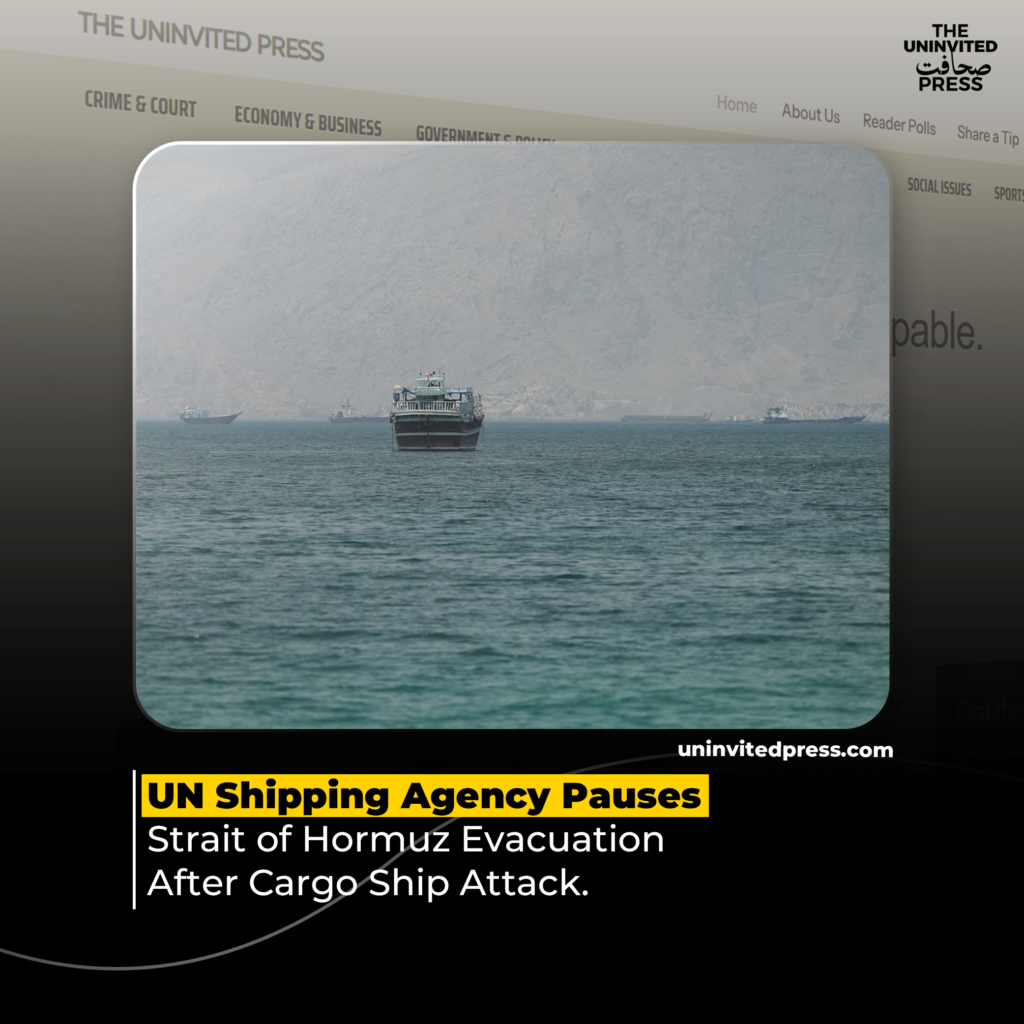
IMO halts operation to evacuate stranded vessels and crews amid renewed security concerns in critical waterway, as Iran warns against unauthorised routes.
The United Nations’ International Maritime Organization (IMO) has temporarily suspended its evacuation plan for hundreds of ships and thousands of seafarers trapped in the Strait of Hormuz following an attack on a cargo vessel in the Gulf of Oman, raising fresh fears over the safety of one of the world’s most vital shipping lanes.
The decision was announced on Thursday after a Singapore-flagged container ship was reportedly struck by a projectile while transiting the area. The vessel, which authorities said was not part of the IMO-coordinated evacuation, was hit near the coast of Oman, prompting the UN agency to pause operations to reassess safety guarantees.
UN Pauses Strait of Hormuz Evacuation After Ship Attack:
The Strait of Hormuz, through which about one-fifth of global oil and gas supplies pass, has been a flashpoint amid ongoing regional conflicts. The IMO launched its evacuation initiative earlier in the week to help safely extract around 600 vessels and more than 11,000 mariners stranded for months due to previous closures and threats in the waterway.
IMO Secretary-General Arsenio Dominguez emphasised that seafarer safety remains the top priority. “I have decided to temporarily pause its implementation in order to reconfirm that the necessary safety guarantees continue to be in place for the ships on our evacuation list and all those in the region,” he stated.
US officials have attributed the attack to Iran’s Islamic Revolutionary Guard Corps (IRGC), though Tehran has not publicly claimed responsibility. Iran has warned vessels against using routes not coordinated with its authorities, insisting on approval via designated channels.
Impact on global trade and seafarers:
The pause comes as shipping companies and maritime associations express deep concern over the vulnerability of merchant vessels. Several ships had already successfully transited under the IMO framework, but the latest incident has disrupted momentum and could prolong the ordeal for crews stuck in the Gulf.
The attack has also contributed to volatility in oil markets, with prices reacting to the renewed uncertainty in energy supply routes. Analysts warn that prolonged disruptions could exacerbate global economic pressures.
Rights groups and the shipping industry have repeatedly called for de-escalation to protect civilian mariners caught in geopolitical tensions. The IMO continues to coordinate with regional and international partners to restore safe passage.