

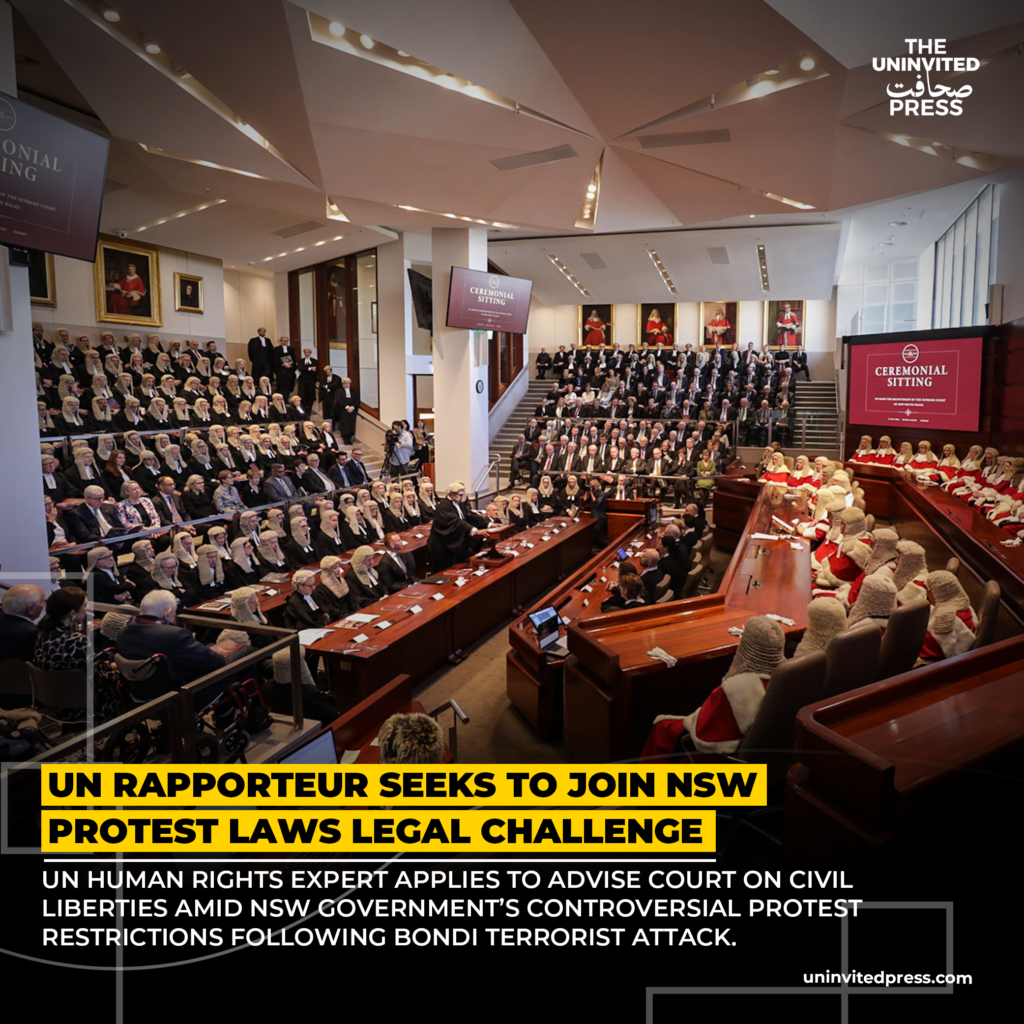
UN rapporteur Ben Saul seeks to intervene in NSW protest laws challenge, advising on human rights after Bondi attack. Groups claim constitutional breach; hearing set for February.
UN Expert Steps Into NSW Protest Law Battle, Spotlighting Rights vs. Security Debate:
A United Nations special rapporteur has moved to join a high-stakes legal fight against New South Wales’ new protest restrictions, enacted in the wake of the deadly Bondi Beach terrorist attack. Ben Saul, an expert on human rights and counterterrorism, wants to guide the court on balancing security with civil liberties-a development that spotlights global scrutiny on Australia’s response to terrorism.
This intervention request escalates a constitutional challenge by activist groups, who argue the laws unduly curb free speech and assembly. With a court date looming, the case could redefine protest rights in NSW and set precedents nationwide, amid ongoing debates over security versus democracy.
Timeline of the Bondi Attack Response and Legal Challenge:
The saga began on December 14, 2025, when a mass shooting at Bondi Beach in Sydney claimed 15 lives during a Hanukkah celebration. The attack, carried out by a gunman inspired by ISIL (Islamic State of Iraq and the Levant), was labeled an anti-Semitic terrorist incident by authorities. It prompted swift legislative action from the NSW government.
Just 10 days later, on December 24, 2025, the Terrorism and Other Legislation Amendment Bill 2025 cleared parliament in the early hours. The bill introduced sweeping powers; police can declare “public assembly restriction declarations” (PARDs), barring protests in designated areas for fortnightly renewable periods up to three months following a terrorism event. It also prohibits public displays of symbols from banned organizations and flags a review of “hate speech,” specifically targeting phrases like “globalise the Intifada.”
By early January 2026, a coalition of groups filed a constitutional challenge in the NSW Supreme Court, arguing the laws infringe on the implied freedom of political communication under the Australian Constitution. The case advanced to the Court of Appeal.
On January 29, 2026, Ben Saul filed his application to intervene. During a directions hearing, his lawyer, Osman Samin, clarified that Saul would not advocate for either side but provide neutral expertise on how such restrictions align with international human rights law. Chief Justice Andrew Bell directed parties to resolve the intervention issue before the full hearing.
No casualties or disruptions from the laws have been reported yet, but a PARD was imposed across three Sydney policing districts from December 24, 2025, extended to January 20, 2026, and potentially renewable until March.
Balancing Security and Freedom: The Legal Fight Over NSW Protests:
NSW has a history of tightening protest laws, often in response to social unrest. In 2022, amendments to the Crimes Act targeted environmental activists blocking major facilities, leading to a 2023 Supreme Court ruling in Kvelde v State of New South Wales that struck down parts as unconstitutional for burdening political communication.
Similarly, a 2025 amendment to the Law Enforcement (Powers and Responsibilities) Act allowed police to disperse protesters near places of worship, but it was invalidated in Lees v State of New South Wales for the same reason.
The Bondi attack-Australia’s deadliest mass shooting in years-intensified these trends. Premier Chris Minns framed the new laws as essential to “calm a combustible situation” amid rising tensions over the Israel-Gaza conflict, which had fueled large pro-Palestine protests in Sydney. Critics, including the challengers, accuse the government of exploiting the tragedy to suppress dissent, particularly criticism of Israel.
Ben Saul, a Sydney University law professor, was appointed UN special rapporteur in November 2023. His mandate focuses on safeguarding human rights during counterterrorism efforts-a role that gained prominence after he criticized Israeli Prime Minister Benjamin Netanyahu’s early linking of the Bondi attack to Australia’s September 2025 recognition of Palestinian statehood.
This case underscores broader Australian debates on civil liberties. The implied freedom of political communication, derived from the Constitution’s requirements for representative democracy, has been pivotal in High Court rulings like Brown v Tasmania (2017), which invalidated anti-forestry protest laws.
The significance lies in potential ripple effects; if successful, the challenge could limit state powers to restrict assemblies post-crisis, influencing other jurisdictions. It also highlights international oversight, as Australia’s human rights record faces UN scrutiny amid global concerns over protest clampdowns.