

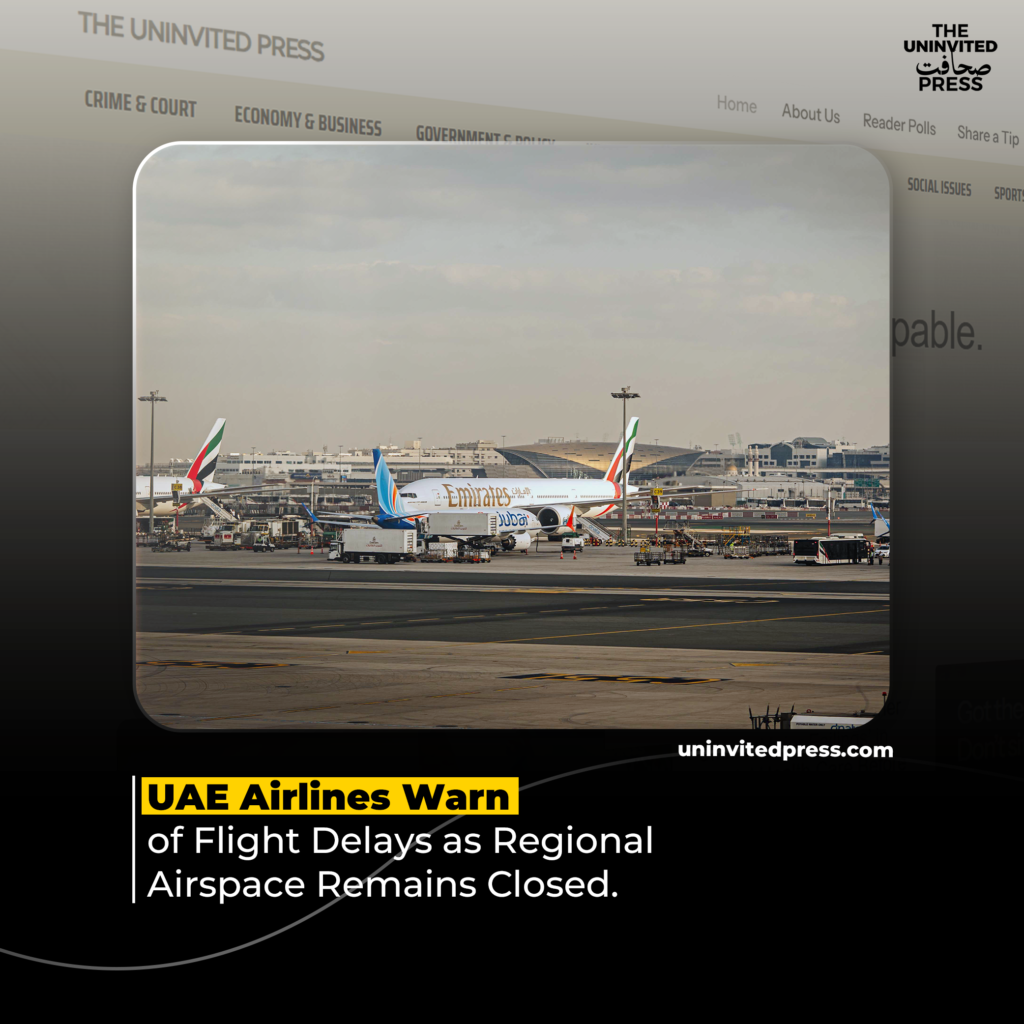
Emirates, Etihad and flydubai issue fresh travel advisories as partial airspace reopenings fail to restore normal operations, leaving thousands of passengers stranded and global routes rerouted.
Major UAE carriers have issued new warnings to passengers about ongoing flight delays, cancellations and extended travel times, as large swathes of regional airspace remain closed or heavily restricted more than a month into the US-Israeli war on Iran.
Emirates, the world’s largest international airline by passenger traffic, along with Etihad Airways and low-cost carrier flydubai, have urged travellers to check flight status before heading to airports, citing persistent safety concerns and limited airspace availability over parts of the Middle East. Many long-haul routes are being forced to take lengthy detours, adding hours to journey times and increasing fuel costs.
Airspace restrictions cause widespread travel disruptions:
Since the outbreak of the conflict on February 28, 2026, following joint US-Israeli airstrikes on Iranian targets that killed Supreme Leader Ali Khamenei, several countries including Iran, Iraq, parts of the Gulf and surrounding areas have imposed airspace restrictions or full closures for civilian flights. Retaliatory Iranian missile and drone strikes on Gulf targets, including damage reported at Dubai International Airport, prompted the UAE to implement temporary and partial closures of its own airspace on multiple occasions.
This has led to the suspension or severe reduction of operations at key hubs in Dubai and Abu Dhabi. In the early days of the war, thousands of flights were cancelled across the region, stranding hundreds of thousands of passengers and disrupting global supply chains. While limited flights have resumed in recent weeks, airlines are operating well below normal capacity, with Dubai Airport functioning at roughly 25 percent of its usual levels at times.
Emirates has been running a reduced schedule to a limited number of destinations, prioritising repatriation and essential travel. Etihad has similarly resumed partial operations from Abu Dhabi, while flydubai has gradually restarted some routes. However, carriers continue to warn that many scheduled flights remain subject to last-minute changes, delays or cancellation due to evolving security conditions and restricted overflight permissions.
Economic and humanitarian consequences:
The disruptions have hit the Gulf’s aviation-dependent economies hard. Dubai and Abu Dhabi serve as critical transit points for millions of passengers annually. Aviation analysts estimate that the three major Gulf carriers-Emirates, Etihad and Qatar Airways-normally handle around 90,000 passengers daily through their hubs, with far more travelling onward to other regional destinations.
Passengers have faced chaotic scenes at airports, with many forced to rebook flights multiple times or seek alternative routes through unaffected corridors, often at significantly higher costs. Some travellers have been left stranded for days, relying on emergency hotel accommodations provided by airlines.
Experts warn that full recovery could take weeks or even months, as airlines adjust to new routing protocols that avoid high-risk zones. Longer flight paths have already driven up operational costs, which may eventually translate into higher ticket prices for consumers.
The conflict has also raised broader concerns about the safety of civilian aviation in the Middle East, a region that has become central to global air travel. Humanitarian organisations have called for safe corridors to allow the evacuation of civilians and the delivery of essential aid.
As diplomatic efforts-including talks hosted by Pakistan-continue to seek de-escalation, the aviation sector remains vulnerable to any further escalation. For now, UAE airlines are advising passengers to monitor official updates closely and prepare for continued uncertainty.