

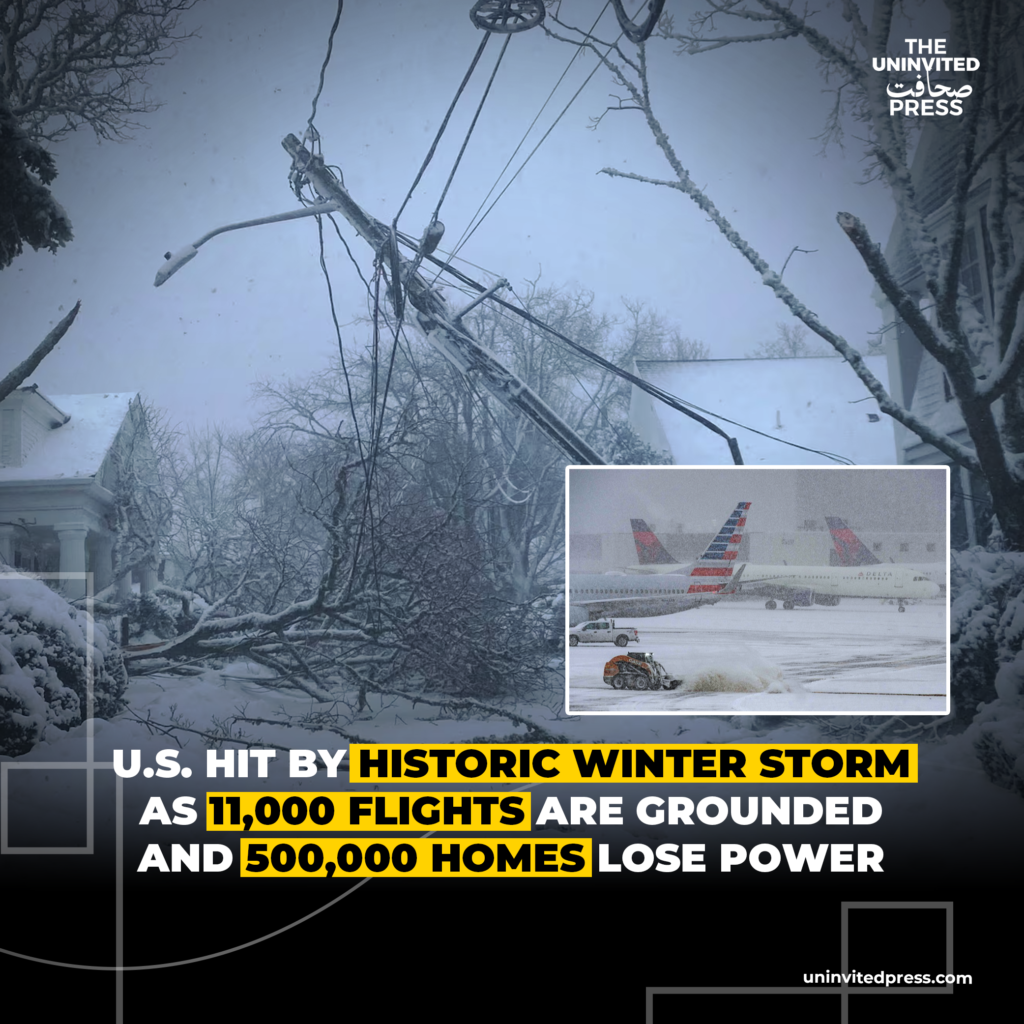
Historic Winter Storm Hernando slams U.S. Northeast Feb 23-24,2026 with record snow, grounding 11,000+ flights and cutting power to 500,000+ homes.
Historic Bomb Cyclone Batters U.S. Northeast, Triggering Widespread Disruptions:
The U.S. Northeast woke up Tuesday to a transformed landscape after a powerful nor’easter intensified into a bomb cyclone, burying communities under historic snowfall, grounding more than 11,000 flights, and leaving over 500,000 homes and businesses in the dark.
From Maryland to Maine, the storm delivered whiteout conditions, hurricane-force gusts, and accumulations that shattered decades-old records in Rhode Island. Millions stayed indoors under blizzard warnings and travel bans, while utility crews and airport teams worked through the night to restore order.
The chaos is far from over. Power restoration could take days in hardest-hit areas, airlines are scrambling to reposition planes and crews, and forecasters warn of additional snow later this week.
Record Snowfall, Flight Chaos, and Massive Power Outages:
The storm began intensifying Sunday night, slamming the densely populated corridor with 2-3 inches of snow per hour in places. By Monday morning, whiteout conditions gripped major cities. Central Park in Manhattan recorded about 20 inches. Islip on Long Island exceeded 22 inches, with some spots in Rhode Island and Massachusetts pushing toward three feet.
Providence, Rhode Island, set a new all-time single-storm record with 37.9 inches (some preliminary reports cited 32.8 inches), eclipsing the mark from the legendary Blizzard of 1978. The National Weather Service confirmed the totals, calling it one of the most significant nor’easters in modern records.
FlightAware data, cross-checked across multiple outlets, shows 11,055 U.S. flights canceled from Sunday through Tuesday-one of the worst stretches in recent years. Major hubs like JFK, Boston Logan, and Newark faced massive disruptions, with Delta and other carriers visible in snow-covered scenes at affected airports. Amtrak suspended service between New York and Boston.
Power outages surged as heavy, wet snow and gusts up to 80 mph in Massachusetts snapped lines and toppled trees. Power Outage U.S tracked peaks above 650,000 customers without electricity Monday, with more than 500,000 still affected into the evening. Massachusetts bore the brunt (over 282,000 at one point, largely Eversource customers on the South Coast and Cape Cod), followed by New Jersey (93,000+). Outages stretched from Virginia to Maine.
Massachusetts Gov. Maura Healey issued strong warnings: “Stay off the roads for the safety of plow drivers and emergency officials.” New York City Mayor Zohran Mamdani lifted most vehicle restrictions by Monday evening and confirmed schools would reopen Tuesday. The Boston Globe skipped print for the first time in its 153-year history due to the storm.
Late-Season Bomb Cyclone Strains Infrastructure and Economy:
This late-February nor’easter arrived after an already active winter, testing infrastructure still recovering from earlier systems. Bomb cyclones like this form when a storm rapidly deepens (at least 24 millibars in 24 hours), fueling explosive intensification-exactly what happened here as it tracked along the East Coast.
The 1978 Blizzard remains a benchmark for many in the Northeast; Tuesday’s record in Providence shows how extreme modern storms can still be, even with improved forecasting. Climate patterns contribute to heavier snow events when cold air collides with moisture from warmer Atlantic waters, though scientists continue to study long-term trends.
The storm’s timing-mid-week-amplified economic disruption. Millions of workers stayed home, schools closed (including New York City’s first traditional snow day in years), and businesses shuttered. Stranded travelers filled hotels near airports, while grocery stores saw last-minute rushes for supplies.
Utilities such as Eversource in Massachusetts and PSE&G in New Jersey deployed thousands of crews, but heavy snow initially slowed efforts. Airlines faced a cascade effect, with crews and aircraft out of position.