

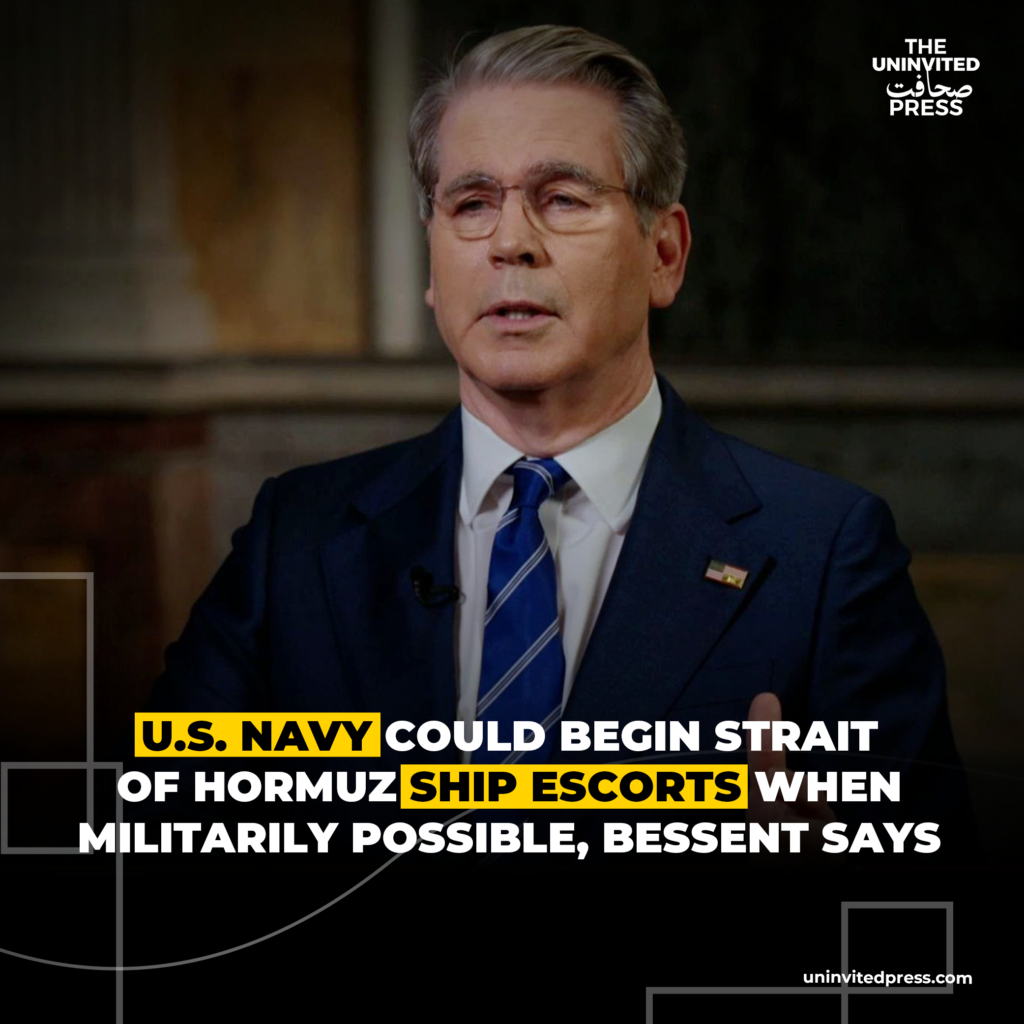
U.S. Treasury Secretary Scott Bessent announces Navy escorts for Strait of Hormuz ships amid Iran war, aiming to ease oil disruptions and global price surges.
Washington Moves to Secure Strait of Hormuz Amid Iran Conflict:
In a high-stakes interview amid the intensifying U.S.-Israeli war with Iran, Treasury Secretary Scott Bessent revealed that the U.S. Navy is prepared to begin escorting commercial vessels through the Strait of Hormuz once military conditions allow. This move aims to reopen the vital waterway, which handles about 20% of the world’s oil supply and has been disrupted by Iranian threats and attacks since late February. With oil prices breaching $100 per barrel and economies worldwide feeling the pinch, Bessent’s statement underscores Washington’s push to stabilize markets while pressuring Tehran.
The announcement comes as Iranian forces continue to harass shipping, leaving over 150 tankers stranded and insurers wary. For global consumers, this could mean relief from skyrocketing fuel costs, but it also risks direct naval confrontations in one of the world’s most volatile regions, potentially prolonging a war that has already claimed thousands of lives.
Bessent Reveals U.S. Navy Escort Plans for the Strait:
Treasury Secretary Scott Bessent dropped the revelation during a March 12 interview with Sky News’ Wilfred Frost, emphasizing that naval escorts were “always in our planning.” “My belief is that as soon as it is militarily possible, the US Navy, perhaps with an international coalition, will be escorting vessels through,” Bessent said. He specified that this would occur once the U.S. gains “complete control of the skies” and degrades Iran’s missile rebuilding capabilities.
Bessent noted that while the strait isn’t mined, Iranian actions have paralyzed most commercial traffic. Iranian and some Chinese-flagged tankers have continued to transit, but broader disruptions have stranded hundreds of vessels. The U.S. has already stepped in with war risk insurance for Gulf shipping, a measure announced earlier in the conflict.
The war erupted on February 28 with U.S.-Israeli strikes dubbed “Operation Epic Fury,” killing Iran’s former Supreme Leader Ali Khamenei. Iran retaliated by targeting U.S. bases and threatening the strait, leading to attacks on tankers and energy infrastructure. By March 12, the conflict had cost the U.S. around $11 billion, with no quick end in sight.
Strait of Hormuz Crisis Sparks Global Energy and Economic Turmoil:
The Strait of Hormuz, a 21-mile-wide passage between Iran and Oman, is the world’s most critical energy artery, funneling oil from Saudi Arabia, Iraq, and other Gulf states. Disruptions here have historically spiked prices, as seen in the 1979 Iranian Revolution and the 1980s Tanker War.
This crisis stems from decades of U.S.-Iran tensions over Tehran’s nuclear program, support for militias, and regional influence. The 2026 war followed a brief 2025 clash and escalated after Iran’s alleged nuclear advancements. Iran’s new Supreme Leader, Mojtaba Khamenei, has vowed to use the strait as leverage, refusing to reopen it until attacks cease.
For the U.S., under President Donald Trump, the stakes include energy security and economic stability. Bessent, a former hedge fund manager nominated by Trump, has focused on mitigating war’s economic fallout, including releasing 400 million barrels from global reserves. However, U.S. planning underestimated Iran’s resolve to close the strait, per sources.
The human toll is mounting: Over 1,800 deaths reported, with Tehran under heavy bombardment. Globally, higher oil prices are fueling inflation, hitting consumers from Australia to Europe.