

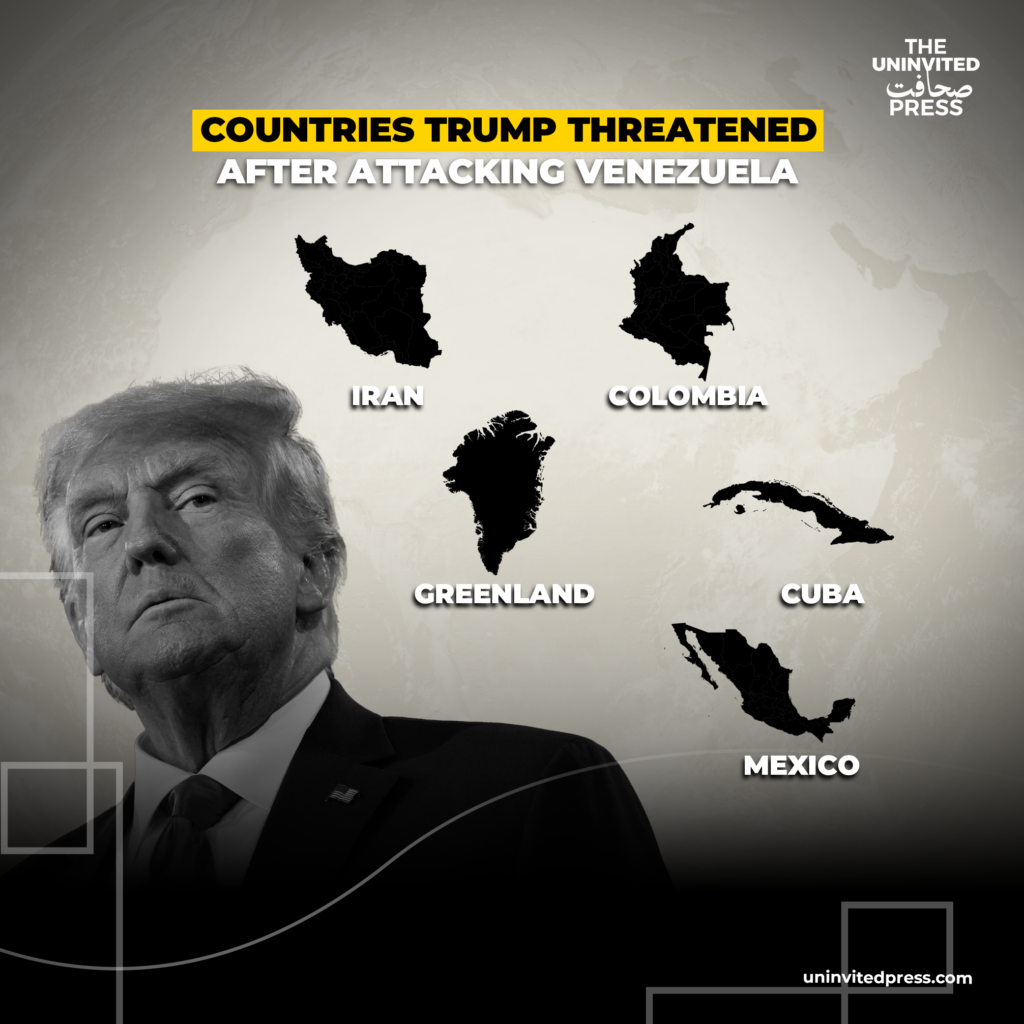
Fresh off Maduro’s capture, the U.S. president signals potential strikes and annexations, sparking fears of a new era of American interventionism.
INCIDENT:
FULL STORY:
The sequence began early on January 3, 2026, when U.S. special forces conducted airstrikes on key Venezuelan sites in Caracas, followed by a ground operation that captured President Nicolás Maduro and his wife, Cilia Flores. Trump announced the success from his Mar-a-Lago resort, posting a photo on Truth Social showing him with CIA Director John Ratcliffe and Secretary of State Marco Rubio monitoring the raid. He declared the U.S. would “run the country until such time as we can do a safe, proper and judicious transition,” emphasizing access to Venezuela’s vast oil reserves.
By January 4, as global reactions poured in, Trump escalated. Speaking to reporters, he addressed Colombia: “Colombia better watch out. Their president is a radical leftist, and they’re letting drugs pour into our country.” He linked this to Venezuelan criminal groups like Tren de Aragua, claiming without evidence that Maduro directed them as an “invasion” of the U.S. On Cuba, Trump stated: “Cuba looks like it’s ready to fall. They got all their income from Venezuelan oil-they’re not getting any of it now.” He dismissed invasion prospects, saying it wasn’t necessary as the regime was collapsing.
The following day, January 5, Trump renewed his long-standing interest in Greenland, telling reporters: “Greenland is a national security issue for us. We need it, and Denmark knows that.” He refused to rule out force, echoing 2019 proposals to purchase the territory. For Mexico, he hinted at cross-border operations against cartels: “Mexico is sending drugs and criminals-we may have to go in and clean it up ourselves.” On Iran, Trump reiterated warnings from his first term: “Iran is watching this closely. If they make a move, we’ll hit them harder than ever.”
CONTEXT & BACKGROUND:
Trump’s actions in Venezuela stem from years of escalating rhetoric. During his first term (2017-2021), he considered military options against Maduro, as revealed in John Bolton’s 2020 memoir, where Trump called invasion “cool” and viewed Venezuela as “part of the United States.” Sanctions intensified under Biden, but Trump’s 2024 reelection campaign promised decisive action, framing Maduro as a drug enabler and election thief after the disputed 2024 Venezuelan vote.
The January 3 raid, authorized under national security pretexts, marks the first U.S. capture of a sitting foreign leader since Manuel Noriega in Panama in 1989. It invokes the Monroe Doctrine-America’s 1823 policy against European interference in the Americas-but critics argue it perverts it into unilateral aggression.
For the threatened countries:
Colombia: Ties to Venezuela include shared borders and refugee crises; Petro’s leftist government has normalized relations with Maduro, drawing U.S. ire over drug flows.
Cuba: Longstanding U.S. embargo; Cuba’s support for Maduro included security personnel, funded by oil subsidies.
Mexico: Border security and cartels dominate; Trump imposed tariffs in 2019 and threatened invasion in 2023 speeches.
Greenland: Strategic Arctic location for U.S. bases; Trump’s 2019 buy offer was rebuffed by Denmark, a NATO ally.
Iran: Nuclear tensions; Iran supplied drones and oil to Venezuela, prompting U.S. sanctions.
These threats could erode international law, embolden rivals like Russia and China, and strain NATO-Denmark hosts U.S. forces in Greenland. Economically, controlling Venezuelan oil (world’s largest reserves) could lower U.S. prices but invite sanctions backlash. Human impact includes Venezuelan chaos, with protests reported in Caracas, and fears of refugee surges in neighboring countries.