

Trump Warns Mexico to ‘Get Its Act Together’ After U.S. Seizes Venezuela’s Maduro in Bold Military Raid
Share This:
background
President signals potential U.S. intervention against cartels as regional tensions boil over.
In a dramatic turn that has reshaped Latin American geopolitics, U.S. forces executed a high-stakes military operation on January 3, 2026, capturing Venezuelan President Nicolás Maduro and his wife, Cilia Flores, from their compound in Caracas. Maduro, now detained in New York facing narco-terrorism charges, was swiftly extradited as part of a broader U.S. push against drug trafficking. President Donald Trump followed with pointed warnings to Mexico, Colombia, and Cuba, urging them to intensify efforts against powerful cartels or risk direct U.S. involvement-a move that has ignited global condemnation and fears of cascading instability in the Western Hemisphere.
The operation began late on January 2, 2026, when President Trump gave the green light at 11:46 p.m. Caracas time. After months of intelligence gathering and rehearsals on a replica of Maduro’s compound, U.S. forces disabled Venezuela’s air defenses, plunging parts of Caracas into darkness. Helicopters descended on the target at 2:01 a.m. on January 3, extracting Maduro and Flores in under 30 minutes. By 4:29 a.m., they were aboard the USS Iwo Jima en route to New York, landing at Stewart Air National Guard Base around 4:30 p.m. that day.
Trump announced the capture in a press conference, posting a photo of a blindfolded Maduro on Truth Social. Maduro arrived in New York by helicopter, processed at a DEA office where he wished agents a “Happy New Year,” and was transferred to detention. On January 5, in shackles and prison attire, he entered a not guilty plea, claiming he was “kidnapped” and insisting he remains Venezuela’s legitimate president.
The raid followed a timeline of U.S. escalation: missile strikes on alleged drug boats in prior months killed over 100 people, and a $50 million bounty had been on Maduro since 2020 indictments. Strikes hit Caracas and surrounding states like Miranda, Aragua, and La Guaira, with witnesses describing explosions mistaken for fireworks, forcing families to flee in panic.In the aftermath, Venezuela’s Supreme Court directed Rodríguez to take over, ensuring “administrative continuity.” Opposition leader María Corina Machado called for a transition, but Trump dismissed her involvement, citing her lack of domestic support.
Sana was known for sharing aspects of Chitrali culture and advocating for girls’ education. Her death has sparked widespread sorrow and anger online, bringing up issues of gender violence, harassment, and the safety of young women expressing the
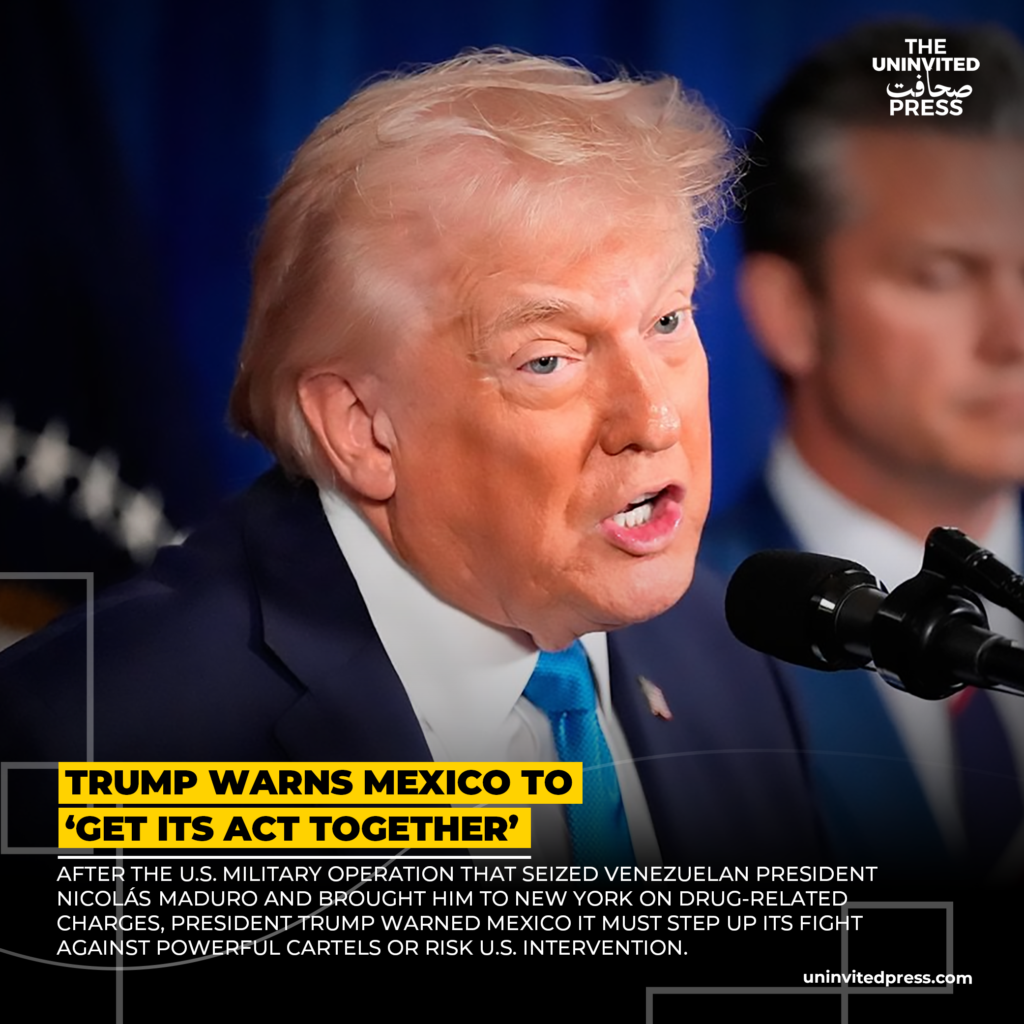
In the aftermath, Venezuela’s Supreme Court directed Rodríguez to take over, ensuring “administrative continuity.” Opposition leader María Corina Machado called for a transition, but Trump dismissed her involvement, citing her lack of domestic support. Trump’s warnings came swiftly. In a Fox News interview and subsequent statements, he targeted Mexico, saying President Claudia Sheinbaum must “get her act together” against cartels or face U.S. “help.” He extended similar threats to Colombia’s Gustavo Petro, warning he “won’t be doing it for very long” if cartels persist, and hinted at actions in Cuba, stating the U.S. is asserting “dominance in the Western Hemisphere.”
Maduro’s regime has been under U.S. scrutiny since he assumed power in 2013 after Hugo Chávez’s death. Accused of rigging elections, suppressing dissent, and colluding with cartels, Maduro faced U.S. indictments in 2020 for narco-terrorism, alleging he flooded the U.S. with cocaine via the “Cartel of the Suns.” Venezuela’s economy collapsed under sanctions, shrinking 80% over a decade, with oil production plummeting from 3.2 million barrels daily in 2000 to about 1 million now-despite holding the world’s largest reserves .The operation revives echoes of the Monroe Doctrine, rebranded by some as the “Donroe Doctrine,” emphasizing U.S. influence in the Americas. Trump justified it as combating drugs and migration, promising to rebuild Venezuelan oil infrastructure through U.S. companies without “nation building.” Analysts note this aligns with Trump’s second-term focus on resource security and border issues, but it risks repeating failures like Iraq, where quick military wins led to prolonged chaos. Based on reports from CNN, Reuters, Al Jazeera, and Brookings, we confirmed the operation’s date, assets, and casualties through cross-checked accounts. Maduro’s charges and plea are verified via court records, but the full extent of Venezuelan civilian deaths remains unclear, with estimates varying by source. Trump’s warnings to Mexico are directly quoted from interviews, though no formal U.S. intervention plans have been announced.
Sources
- Brookings Institution: https://www.brookings.edu/articles/making-sense-of-the-us-military-operation-in-venezuela/
- CNN: https://www.cnn.com/world/live-news/venezuela-explosions-caracas-intl-hnk-01-03-26
- Al Jazeera: https://www.aljazeera.com/news/2026/1/4/how-the-us-attack-on-venezuela-abduction-of-maduro-unfolded
- Reuters: https://www.reuters.com/world/americas/venezuelas-maduro-appear-us-court-trump-says-further-strikes-possible-2026-01-05/
- Politico: https://www.politico.com/news/2026/01/03/trump-venezela-mexico-00710063
- PBS: https://www.pbs.org/newshour/world/a-timeline-of-u-s-military-escalation-against-venezuela-leading-to-maduros-capture
- U.S. Department of Defense: https://www.war.gov/News/News-Stories/Article/Article/4370431/trump-announces-us-militarys-capture-of-maduro/