

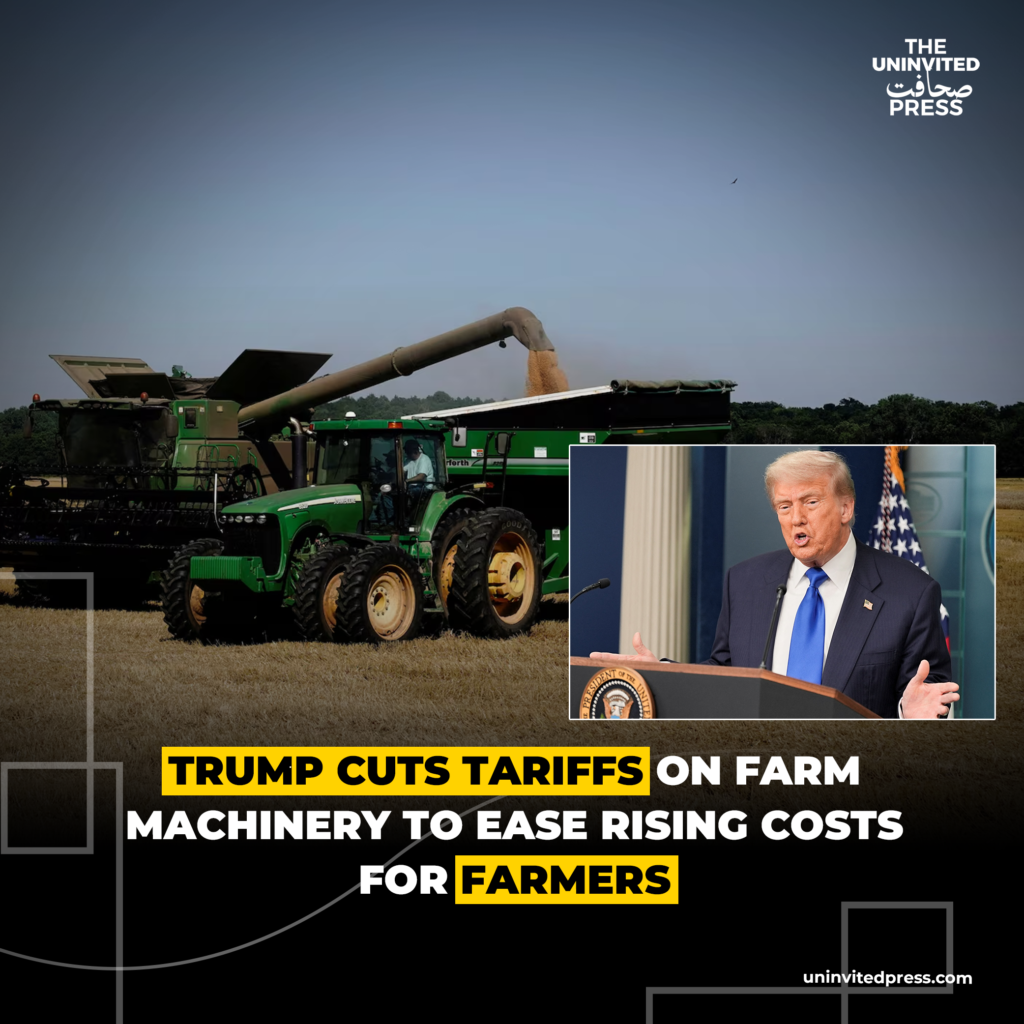
Policy shift offers temporary relief on imported equipment as American agriculture grapples with high input prices and global trade tensions.
US President Donald Trump has announced a significant reduction in tariffs on agricultural machinery and related industrial equipment, lowering duties from 25 percent to 15 percent in a bid to ease financial pressures on American farmers facing rising operational costs.
The move, outlined in a presidential proclamation issued on Monday, targets key items such as combines, harvesters, tractors, and other heavy farm equipment, many of which incorporate substantial amounts of steel, aluminum, and copper. The tariff cuts will take effect on June 8 and remain in place through the end of 2027.
Finding Middle Ground on Trade and Growth:
The decision represents a notable adjustment to the Trump administration’s broader tariff strategy, which has emphasised protecting domestic manufacturing and addressing trade imbalances, particularly with countries like China. While the administration has maintained higher tariffs on many imports as part of a national security and economic leverage approach, officials framed this targeted relief as essential to support farmers and boost investment in the industrial base.
According to a White House fact sheet, the reductions aim to “spur near-term investments that will rebuild the Nation’s industrial base.” Foreign manufacturers using at least 85 percent US-sourced metals could qualify for an even lower 10 percent tariff rate.
Farm groups have welcomed the announcement. With commodity prices under pressure and expenses for fuel, fertiliser, and equipment climbing, many producers have struggled in recent years. Industry representatives noted that lower equipment costs could help improve margins at a critical time.
Farm Sector Gains Temporary Tariff Break:
US agriculture remains a vital sector, contributing significantly to the national economy and feeding both domestic and international demand. Equipment costs represent a major capital expense for farmers, particularly those operating large-scale operations in the Midwest and Great Plains.
The temporary nature of the relief-set to expire at the end of 2027-leaves uncertainty about future policy direction. Industry observers will be watching closely to see whether this signals a more flexible approach to tariffs or remains an isolated measure tailored to politically important rural constituencies.
As the US navigates its complex trade relationships, this latest development underscores the delicate balance between protecting domestic industries and ensuring the competitiveness of key economic sectors like farming.
Critics, however, view the tariff cut as an implicit acknowledgment of the challenges posed by the administration’s wider trade policies. Some analysts argue that broad tariffs on metals and components have contributed to higher costs for downstream industries, including agriculture, forcing this partial rollback.
The policy arrives against a backdrop of ongoing global trade frictions. Many US trading partners have imposed retaliatory measures on American agricultural exports in response to earlier tariffs, adding another layer of difficulty for farmers who rely heavily on international markets.