

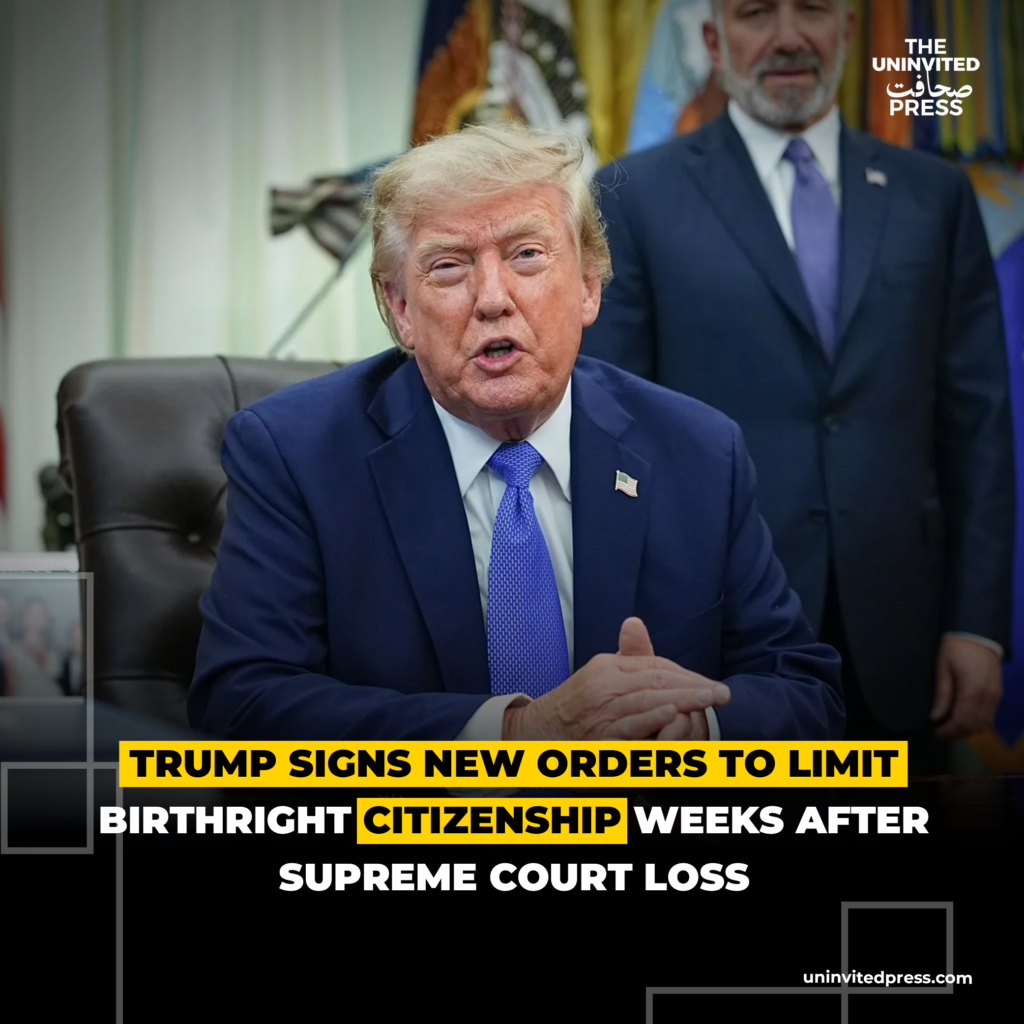
Narrower directives target ‘birth tourism’, children of certain foreign officials and others weeks after Supreme Court struck down broader attempt.
United States President Donald Trump has signed two executive orders aimed at limiting birthright citizenship, weeks after the Supreme Court rejected his earlier, more sweeping effort to restrict the constitutional guarantee.
The orders, signed on Thursday in the Oval Office, instruct federal agencies not to recognise US citizenship in certain narrow categories of children born on American soil and direct officials to crack down on so-called birth tourism. Trump described the Supreme Court’s June 30 ruling as a “very unfortunate decision” and said his administration was “making adjustments.”
White House Narrows Birthright Citizenship Policy:
The high court, in a 6-3 decision in Trump v. Barbara, held that the 14th Amendment’s Citizenship Clause confers citizenship on nearly all children born in the United States, including those whose parents are present unlawfully or temporarily. Chief Justice John Roberts wrote that such children “are citizens at birth.” The ruling invalidated an executive order Trump signed on the first day of his second term that sought to deny automatic citizenship to babies born to parents without permanent legal status.
The new directives are significantly narrower. One order, titled “Continuing to Protect the Meaning and Value of American Citizenship,” directs agencies not to issue or accept documents recognising citizenship for children born to two non-citizen parents in specific circumstances. These include cases where a parent is deemed an “alien enemy”-defined to cover members of designated foreign terrorist organisations or specially designated global terrorists-or is a foreign government employee, including certain embassy, consular or international organisation staff. It also covers situations involving commercial transactions intended to secure a birth in the United States, such as birth tourism or surrogacy arrangements, and potentially births in US territories if Congress changes relevant statutes.
A second order, “Ending Birth Tourism,” delegates authority to the secretaries of state and homeland security to deny visas, revoke travel authorisations, bar entry and take other measures against foreign nationals who travel to the United States primarily to give birth so their children can obtain citizenship.
White House aide Stephen Miller, a key architect of the administration’s immigration policies, said at the signing ceremony that birth tourism was “hereby banned” and described the orders as protecting the value of American citizenship. The administration argues the new measures fall outside the scope of the Supreme Court’s ruling by focusing on historical exceptions and specific practices rather than broadly reinterpreting the 14th Amendment.
Trump’s Birthright Orders Face Legal Challenges:
Legal experts and immigrant rights advocates have indicated the orders are likely to face court challenges. Birthright citizenship has been a settled feature of US law for more than a century, rooted in the 14th Amendment ratified after the Civil War and affirmed in the 1898 Supreme Court case United States v. Wong Kim Ark.
Trump has long criticised the practice, arguing it encourages illegal immigration and “birth tourism.” Supporters of the new orders say they close loopholes without violating the Constitution. Critics contend they represent another attempt to undermine a core constitutional protection through executive action and could create uncertainty for families and government agencies.
The moves form part of the administration’s broader immigration agenda. Congress has so far not passed legislation to alter birthright citizenship, despite Trump’s earlier calls for lawmakers to act following the Supreme Court defeat.
As the orders take effect, attention is expected to turn to how federal agencies implement them and whether lower courts will intervene, potentially setting up further legal tests of presidential authority over citizenship rules.