

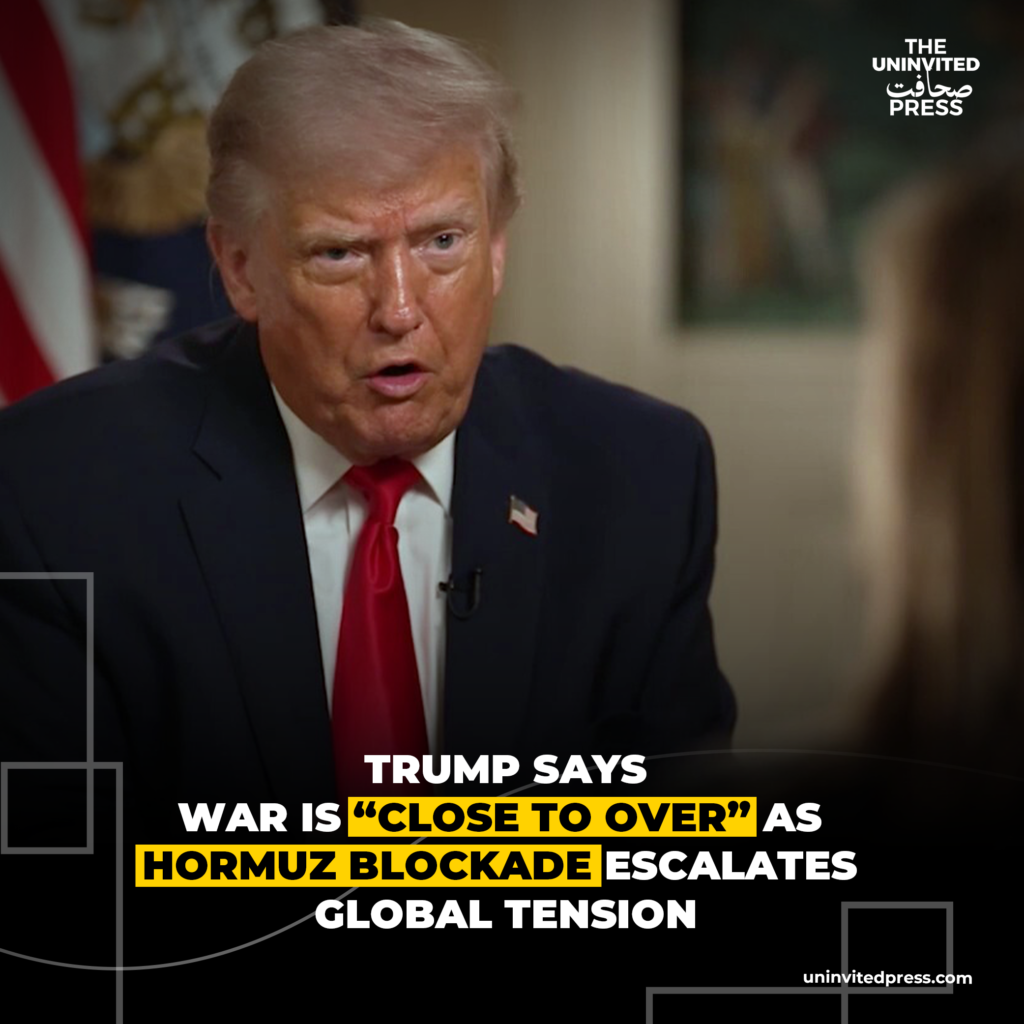
US president signals optimism for renewed talks with Tehran while military claims it has ‘completely halted’ Iranian sea trade amid escalating global concerns over oil supplies.
US President Donald Trump has declared that the war with Iran is “very close to over”, even as the American naval blockade of Iranian ports and the Strait of Hormuz continues into its second day, tightening economic pressure on Tehran.
Trump told anchor Maria Bartiromo: “I think it’s close to over, yeah. I view it as very close to being over.” He added that Iran “wants to make a deal very badly”, claiming that US actions have left Tehran with little choice but to negotiate.
The comments come shortly after peace talks between US and Iranian negotiators in Islamabad broke down over the weekend, prompting Trump to order the blockade of all ships entering or leaving Iranian ports.
US Tightens Control Over Hormuz Shipping:
US Central Command (CENTCOM) reported that no vessels have successfully passed through the US-enforced blockade in the first 24 hours of full implementation. Six merchant ships reportedly turned back after being ordered to do so by US forces.
“An estimated 90 percent of Iran’s economy is fuelled by international trade by sea. In less than 36 hours since the blockade was implemented, US forces have completely halted economic trade going into and out of Iran by sea,” CENTCOM stated, describing the operation as having established “maritime superiority” in the region.
The Strait of Hormuz, through which roughly one-fifth of global oil supplies normally pass, has been a flashpoint since the outbreak of the US-Israel war with Iran in late February. Iran had previously restricted traffic in the waterway; the US move now mirrors and counters that pressure.
President Trump has warned that any Iranian vessels attempting to challenge the blockade will be “immediately eliminated”.
Trump Signals Possible Iran Talks Amid Ceasefire:
Despite the military escalation, Trump hinted at a possible second round of direct talks with Iran, potentially resuming in Pakistan within days. Pakistani officials have been engaged in shuttle diplomacy, including visits to Saudi Arabia and Türkiye, in an apparent bid to facilitate dialogue.
The current two-week ceasefire between the parties is due to expire soon, adding urgency to diplomatic efforts.
Trump also claimed that continued US pressure has prevented Iran from advancing its nuclear programme and severely damaged its infrastructure. “If I pulled up stakes right now, it would take them 20 years to rebuild that country,” he said.
Global Response and Escalating Risks:
The blockade has raised alarm over potential disruptions to global energy markets, with oil prices fluctuating sharply in recent days. China described the US action as “dangerous and irresponsible”, while shipping companies have warned vessels to avoid the area due to heightened risks.
Critics argue the move risks further escalation in an already volatile region, potentially drawing in other actors and causing broader economic fallout. Supporters of the policy, however, view it as necessary leverage to force Iran back to the negotiating table on US terms.
The US has deployed more than 10,000 personnel, multiple warships and aircraft in support of the operation.
As the blockade continues and diplomatic channels remain active, the coming days are expected to determine whether Trump’s assessment of the conflict being “close to over” proves accurate, or if the naval standoff leads to renewed confrontation.