

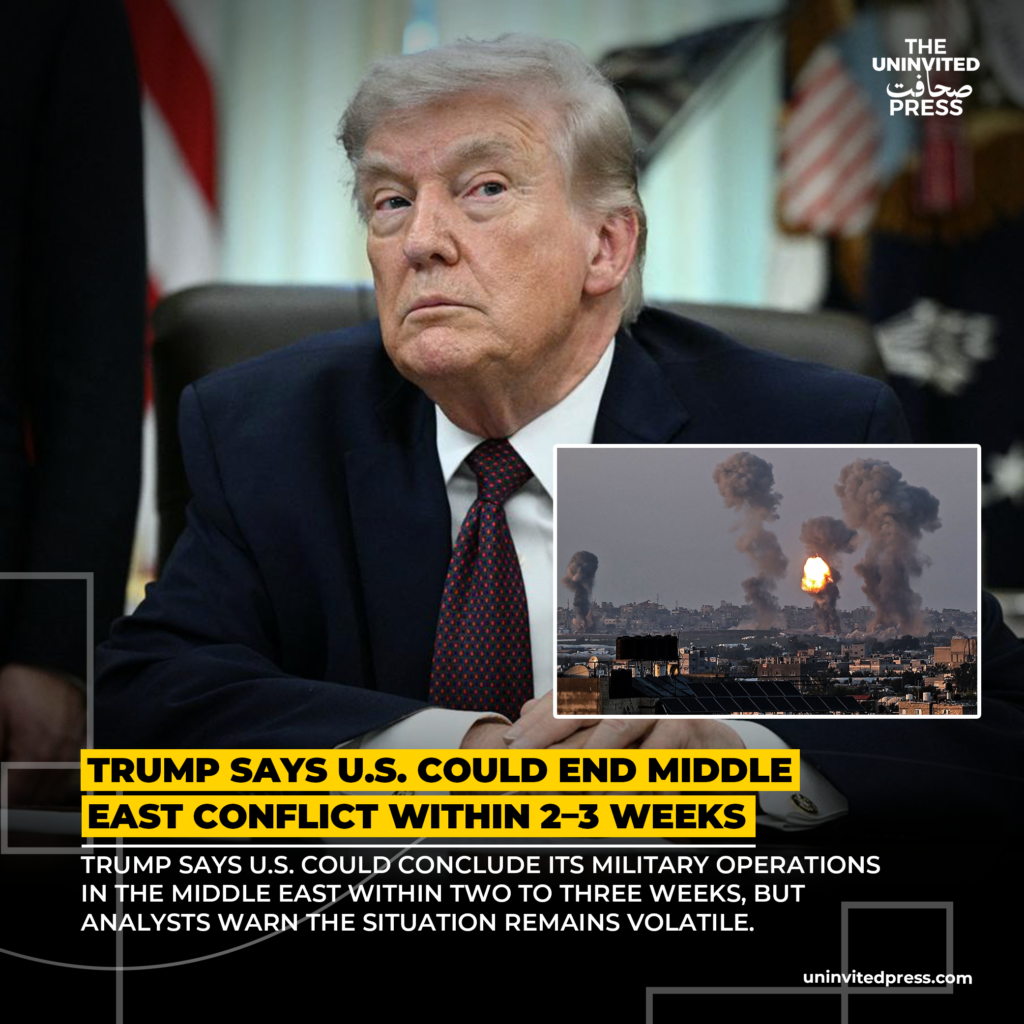
President claims Washington will leave ‘very soon’ whether or not a deal is reached, but analysts caution that the conflict remains volatile and far from resolved.
US President Donald Trump has stated that American military operations against Iran could conclude within the next two to three weeks, even without a formal agreement with Tehran. Speaking to reporters in the Oval Office on Tuesday, Trump said the United States would be “leaving very soon” and suggested the timeline could be “two weeks, maybe three.”
“We’ll be leaving very soon,” Trump told reporters. “I would say that within two weeks, maybe two weeks, maybe three.” He added that the US would exit once it was satisfied that Iran could not develop a nuclear weapon “for years,” regardless of whether negotiations produced a deal.
The remarks come as the US-Israel military campaign against Iran, dubbed Operation Epic Fury, enters its second month. The operation, launched at the end of February 2026, has involved extensive airstrikes on Iranian missile facilities, air defences, nuclear-related sites and other military infrastructure.
Completing the Mission:
Trump indicated that the United States had largely achieved its primary objectives, including significant degradation of Iran’s nuclear programme and military capabilities. He claimed the US now “dominates Iranian skies” and described recent strikes, including one near Isfahan, as highly effective.
The president also addressed rising global energy concerns caused by disruptions in the Strait of Hormuz, telling allies they would have to secure the vital shipping route themselves. “We will have nothing to do with it,” he said, urging other countries to “go get your own oil.”
Trump is expected to deliver a primetime national address on the conflict on Wednesday evening, which the White House described as an “important update.”
Defence Secretary’s assessment:
On the same day, Defence Secretary Pete Hegseth told a Pentagon briefing that the past 24 hours had seen the lowest number of Iranian missile and drone launches since the conflict began. He described the coming days as “decisive” while repeating that the US remained open to a diplomatic solution but was prepared to intensify strikes if Iran did not comply.
Hegseth had earlier acknowledged that Iran retained some residual strike capability, though at a significantly reduced scale.
Analyst Doubts and Regional Impact:
While Trump projected confidence in a swift conclusion, many analysts and regional observers expressed caution. The conflict has already caused widespread disruption across the Middle East, pushed global oil prices higher and led to civilian casualties and infrastructure damage in Iran.
Iran has vowed to continue resisting what it calls aggression, with officials stating Tehran has the “necessary will” to prolong the fight if needed. Sporadic Iranian attacks, including reported strikes on targets in Israel, Kuwait and elsewhere, continue despite the decline in volume.
The war has strained relations with some US allies, particularly over energy security and the future of the Strait of Hormuz, through which a significant portion of the world’s oil passes. Gulf states and European countries have expressed concern over prolonged instability and rising fuel costs.