

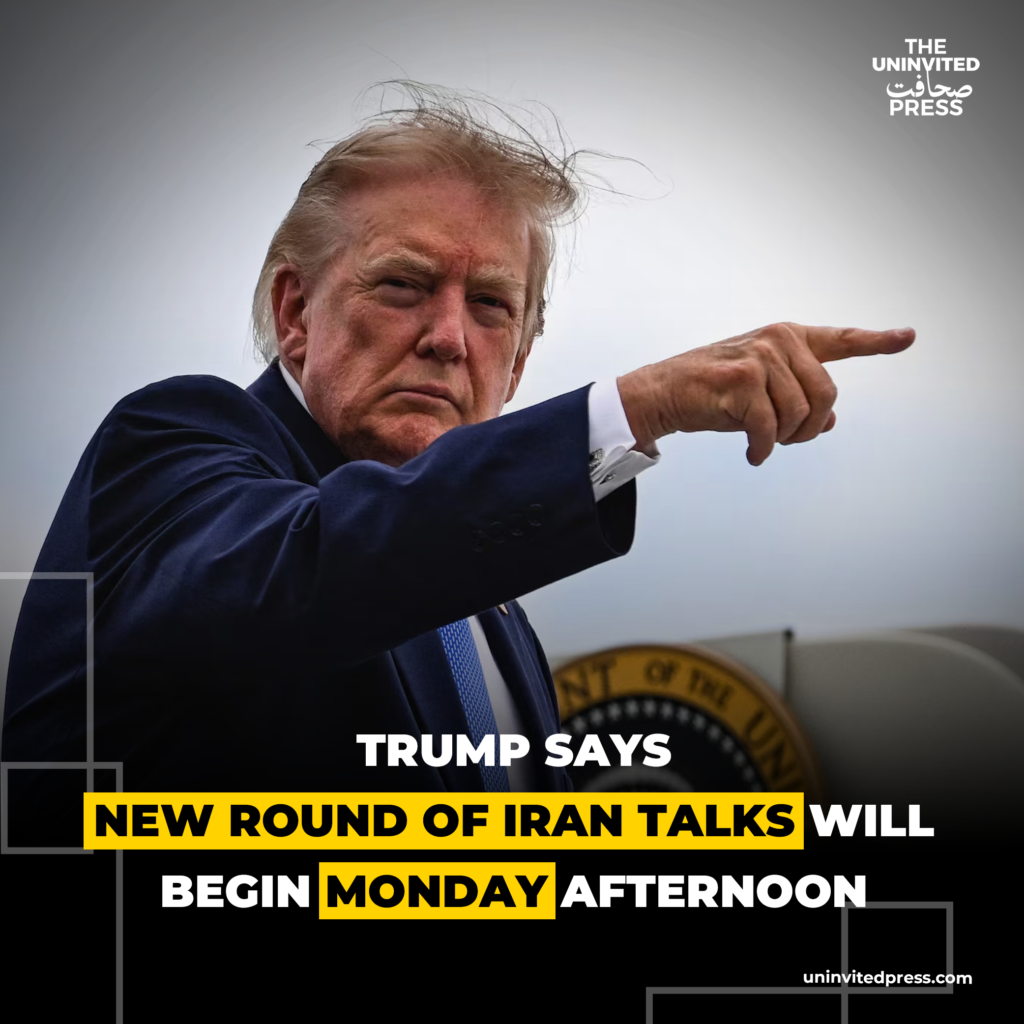
U.S president claims he shelved plans for ‘biggest attack since World War II’ after appeals from Gulf allies and Tehran, as regional diplomacy intensifies amid ongoing war.
United States President Donald Trump has announced that a new round of negotiations with Iran will begin on Monday afternoon, saying he decided to hold off on what he described as a planned large-scale military strike in pursuit of a diplomatic breakthrough.
Speaking to reporters on Sunday while returning to Washington from New Jersey, Trump said the United States had been prepared to launch “the biggest attack since World War II” against Iran but paused the operation after appeals from regional actors. “Obviously, they don’t want to be attacked. They knew the extent of the attack because they saw it forming,” he said. “Now what we’re doing is talking to them in the form of a negotiation. It begins tomorrow afternoon.”
Trump provided no details about the venue, format, or participants in the talks. He indicated the discussions would address the reopening of the Strait of Hormuz-a critical chokepoint for global energy supplies-and progress toward what he called the “denuclearisation of Iran.” When asked whether Iran faced a deadline to reach an agreement, Trump declined to set one, stating a preference for a negotiated outcome. “I’d rather make a deal. I’m not looking to kill people because people die, a lot of people die, and we don’t want that,” he said.
Trump Delays Iran Action as Hormuz Deal Talks Advance:
The announcement followed a Truth Social post on Saturday in which Trump said the US military was “locked and loaded” but that he had agreed to delay action after Iran and several Middle Eastern countries requested more time to finalise an agreement. He claimed the emerging deal would ensure the “immediate, complete and total” reopening of the Strait of Hormuz and address concerns over Iran’s nuclear programme.
In his comments on Sunday, Trump named Saudi Arabia, the United Arab Emirates, Qatar, and Iran as having urged him to hold off. “I was asked to by Saudi Arabia, by UAE, and by Qatar, and by Iran,” he said. “We were all set to go, but when the allies ask to call it off, you gotta sort of say ‘well let’s see.’ And the reason they ask is they think there’s a deal. There’s a deal on Hormuz, and then there will be a deal on the nuclear.” He also referenced a conversation with Saudi Crown Prince Mohammed bin Salman, who he said had warned of possible unintended consequences, including refugee flows and broader regional instability.
Iran-Hormuz Talks Intensify as Regional Tensions Persist:
Trump’s comments came amid heightened diplomatic activity. Iranian Foreign Minister Abbas Araghchi held a second phone call with Saudi Foreign Minister Prince Faisal bin Farhan Al Saud, joined by Pakistan’s army chief Asim Munir, to discuss recent efforts. The officials exchanged views on the situation and initiatives aimed at maintaining security and stability in the region, stressing the need for regional cooperation and political solutions, according to Araghchi.
Earlier on Sunday, Iran’s official news agency IRNA reported that negotiations between Tehran and Oman over the Strait of Hormuz were in their final stages, citing Araghchi. Iranian Foreign Ministry spokesperson Esmaeil Baghaei said the talks focused on agreeing a new route through the strait, adding that this had “no link to the Strait of Hormuz being opened or closed. That is a separate discussion.”
The conflict, which began on 28 February when the United States and Israel launched strikes against Iran, has seen periods of relative calm interrupted by renewed fighting. A previous ceasefire arrangement that included the reopening of the Strait of Hormuz collapsed, after which Iran tightened control over the waterway. Attacks have at times spread across the Gulf, the Red Sea, and beyond, disrupting energy markets and raising global economic concerns.
Oil prices fell sharply in early trading following Trump’s announcement that he was abandoning plans for a new military operation. Brent futures dropped more than 4 percent, reversing part of the previous month’s surge driven by fears of further disruption to Gulf energy supplies.
Trump has repeatedly threatened escalation while also leaving space for diplomacy throughout the months-long conflict. Analysts and regional observers note that previous announcements of pauses or potential deals have not always produced lasting results, leaving the outcome of the Monday talks uncertain. Israeli officials have meanwhile emphasised continued security coordination with the United States and warned they would act if Iran sought to advance its nuclear or ballistic missile programmes.
As the new round of talks approaches, both the possibility of a diplomatic breakthrough on the strategic waterway and Iran’s nuclear programme, and the risk of renewed military action, remain in focus for the region and global energy markets.