

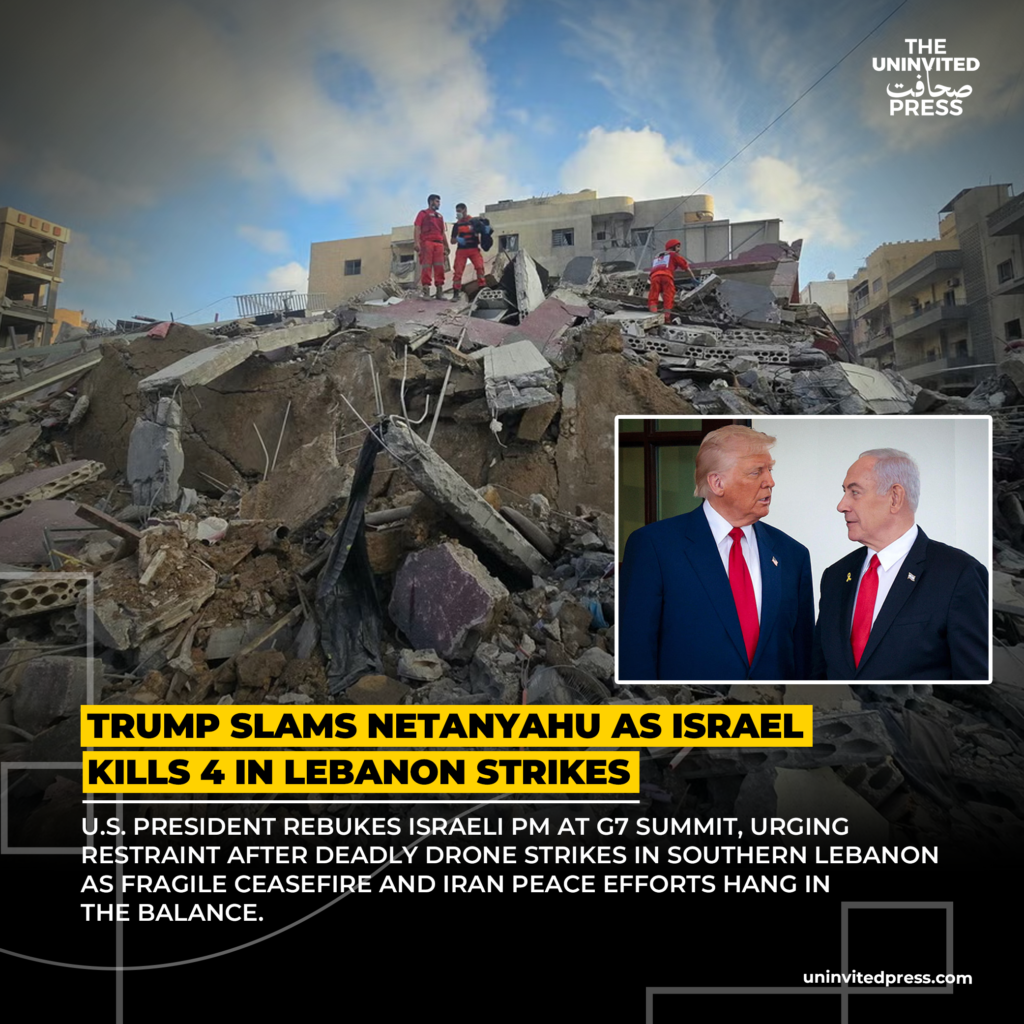
US president urges restraint as Israeli drone attacks continue in southern Lebanon, raising fears for US-Iran peace efforts.
US President Donald Trump has publicly criticised Israeli Prime Minister Benjamin Netanyahu, telling reporters at the G7 summit in France that the Israeli leader “needs to be more responsible with respect to Lebanon.”
Trump’s remarks come as Israeli drone strikes and other attacks in southern Lebanon have killed several people in recent days, including incidents reported on or around June 15-16 that left at least four dead in some accounts. The strikes have occurred despite a fragile US-brokered ceasefire framework and ongoing efforts to stabilise the region following a preliminary US-Iran agreement.
Trump Criticises Israel Strikes:
Trump expressed frustration with Israel’s continued military actions against Hezbollah targets in Lebanon, which he said risked undermining broader diplomatic initiatives. He reportedly told reporters that he has a “great relationship” with Netanyahu but added that the Israeli prime minister must exercise greater caution.
In earlier private exchanges, Trump is said to have used strong language to pressure Netanyahu, warning that escalations could jeopardise the recent US-Iran understanding. Some reports described the US president as “furious” over strikes that came close to the timing of key diplomatic announcements.
Lebanese officials and security sources reported multiple Israeli drone strikes in areas such as Nabatieh, Sidon, and surrounding villages. Casualties included civilians and, in some cases, individuals in vehicles targeted by the Israeli military. Lebanon’s state-run National News Agency and other outlets documented deaths ranging from one to several in individual incidents over the past week.
Israel has justified the operations as responses to perceived threats from Hezbollah, while accusing the group of ceasefire violations. Hezbollah, for its part, has vowed retaliation and continues to operate in southern Lebanon.
US-Israel Tensions Grow:
The friction highlights growing strains in the US-Israel relationship as Trump prioritises de-escalation with Iran. The recent US-Iran memorandum, which includes elements of sanctions relief and efforts to reopen the Strait of Hormuz, remains delicate. Trump has emphasised that he wants the deal to hold and has warned against actions that could unravel it.
Analysts note that Trump’s unusually blunt public criticism of Netanyahu-including references to Israel’s dependence on US support-marks a shift in tone, even as military aid to Israel continues.
For many in the region, the latest violence in Lebanon underscores the fragility of ceasefires across multiple fronts. Residents in affected areas continue to face displacement threats and fear renewed escalation, even as international diplomacy moves forward.