

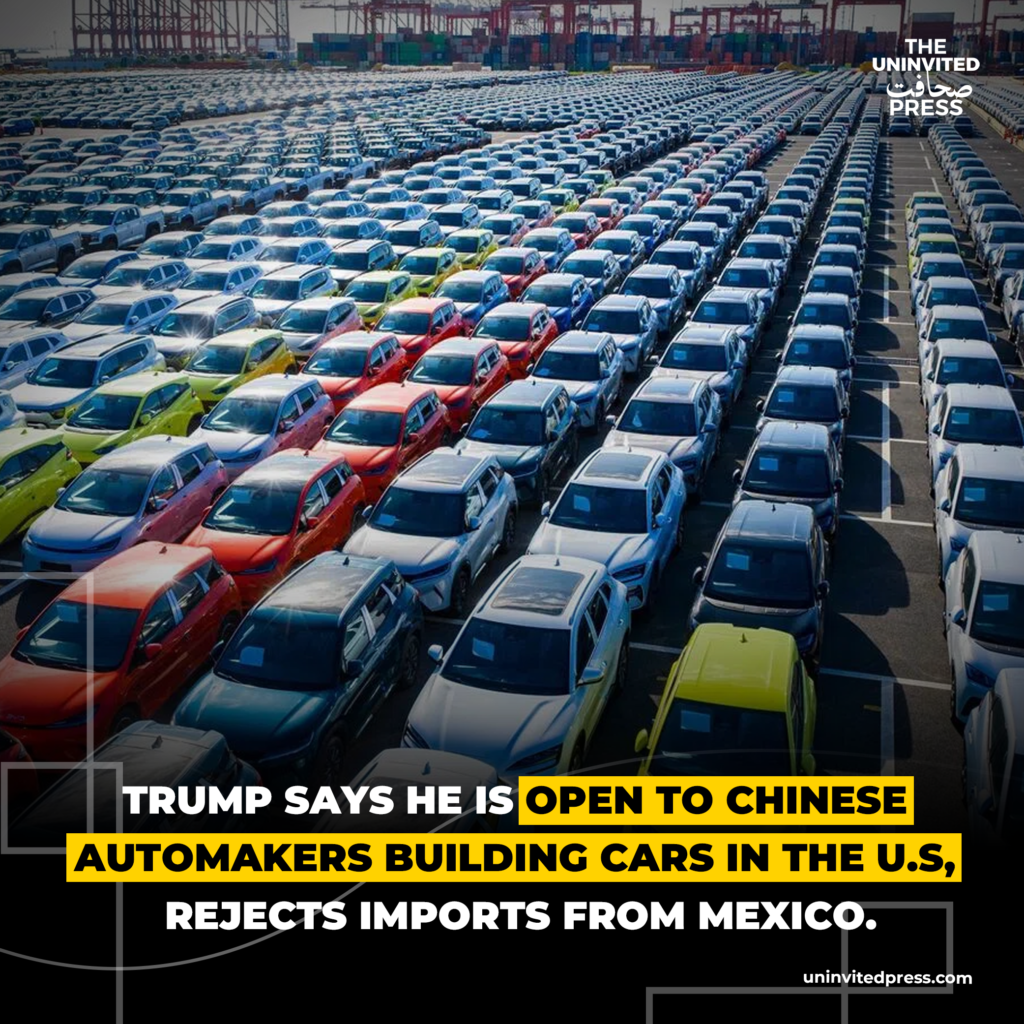
US president says Chinese automakers can build factories on American soil if they hire local workers, while rejecting any production in Mexico for export north of the border, as Xi Jinping visit approaches.
US President Donald Trump has said he would not oppose Chinese automakers establishing manufacturing plants in the United States, provided they employ American workers, while firmly rejecting the idea of those companies building vehicles in Mexico for shipment into the US market.
Speaking on Friday in an interview, Trump stated: “If China wanted to come in and open a plant to build their cars here, I’d be okay with that. Japan does it, but they hire our people. The big thing is they hire our people.”
He drew a clear distinction with production south of the border. Trump said he does not want Chinese firms to manufacture cars in Mexico and then send them into the United States, emphasising that the priority is domestic job creation rather than low-cost imports that could undercut American industry.
“I’m not knocking Chinese cars,” he added, while insisting that imported Chinese vehicles remain barred from the US market. “We don’t allow his cars into the United States, and we never did,” Trump said, referring to Chinese President Xi Jinping, warning that without such restrictions the American auto market would be “overrun.”
Chinese Automakers Face US Market Barriers:
Chinese automakers currently face steep obstacles to entering the US market. A regulation introduced under the previous Biden administration in early 2025 effectively prohibits Chinese companies from selling or building passenger vehicles in the United States. Washington also maintains tariffs exceeding 100 percent on Chinese electric vehicles.
US automakers and some lawmakers have voiced strong opposition to any opening that could give Chinese competitors a foothold. The Alliance for Automotive Innovation, representing major manufacturers including General Motors, Ford, Toyota, Volkswagen, Hyundai, Honda and Stellantis, has urged Congress to pass legislation permanently blocking Chinese vehicles from the US market.
Michigan Democratic Senator Elissa Slotkin recently warned of “rumors that Trump is planning to allow Chinese cars to be sold in the US, as part of a larger deal he’s putting together,” calling such a move “a strategic mistake.” Trump dismissed the claim as a “total phony rumor,” insisting his policies have kept Chinese vehicles out.
Trump Draws Red Line on Chinese Auto Plants in Mexico:
Trump’s position echoes earlier remarks, including comments at the Detroit Economic Club in January, where he suggested Chinese firms could build plants and hire American workers. The idea of foreign investment creating US jobs aligns with his broader “America First” trade agenda, which has already prompted several automakers to shift production back to the United States from Mexico and elsewhere in response to tariffs.
Japanese and other foreign manufacturers have long operated plants across the American South and Midwest, employing tens of thousands of US workers. Trump presented Chinese investment along similar lines as potentially beneficial, provided the work stays inside US borders.
Critics, however, argue that Chinese companies benefit from substantial state support, advanced battery technology and lower production costs, which could pose a long-term competitive threat to the traditional US auto industry even if factories are built domestically. Concerns also persist over data security and supply-chain dependence in an era of heightened US-China geopolitical rivalry.
Trump’s rejection of Mexican production reflects long-standing anxiety in Washington that Mexico could serve as a back door for Chinese goods into the North American market under the US-Mexico-Canada Agreement (USMCA). Chinese vehicle sales have grown in Mexico, and some Chinese firms have explored assembly operations there, prompting US pressure and Mexican tariff responses on Chinese cars.
By insisting that any Chinese manufacturing for the American market must occur on US soil with American labour, Trump is seeking to close that potential route while keeping the door theoretically open for direct investment that creates domestic jobs.
As the Xi summit approaches, the remarks signal both flexibility and firm red lines in the complex US-China economic relationship. Whether Chinese automakers will pursue US plants under these conditions-or whether domestic political and industry resistance will keep the door closed-remains to be tested in the coming months.