

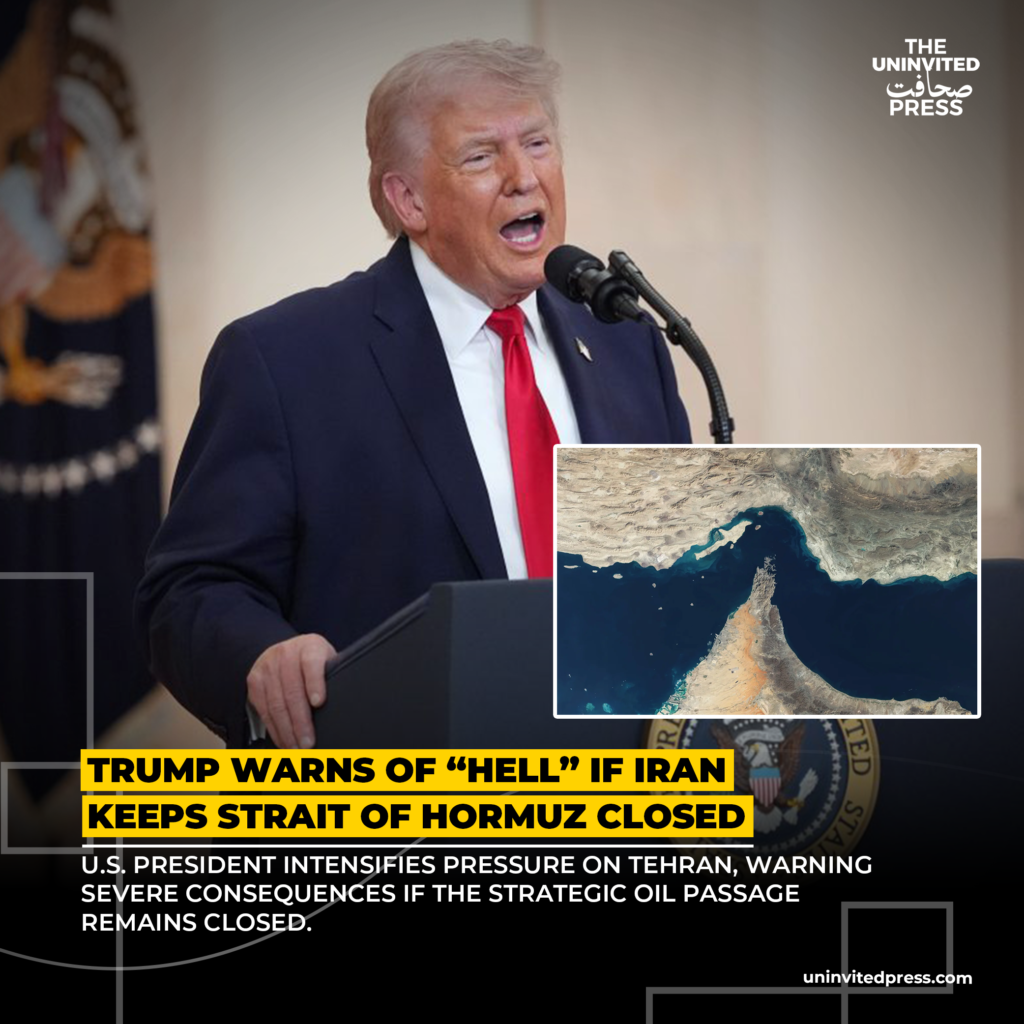
US president threatens strikes on power plants and bridges as deadline looms, warning Tehran will face ‘hell’ if strategic waterway remains blocked.
US President Donald Trump has escalated his rhetoric against Iran, issuing a fresh ultimatum demanding the reopening of the Strait of Hormuz or face devastating military consequences, including attacks on the country’s energy infrastructure and transport links.
In a series of social media posts on Sunday, Trump warned that Iran has until Tuesday evening to allow unrestricted shipping through the critical chokepoint, threatening that failure to comply would result in strikes described as “Power Plant Day, and Bridge Day, all wrapped up in one.” He wrote that the Strait must be opened or there would be severe consequences, adding that “all Hell will reign down” on Iran if the waterway is not reopened.
The Strait of Hormuz, through which approximately one-fifth of the world’s oil and significant volumes of liquefied natural gas pass, has been effectively closed or heavily disrupted since the escalation of the US-Israel-Iran conflict in late February. Iran has maintained control over the passage, citing security concerns and demanding compensation for damages incurred during the war.
Deadline during ongoing conflict and recent rescue efforts:
Trump’s latest warning comes shortly after US special forces rescued a wounded airman whose F-15E Strike Eagle was shot down over Iranian territory last week. The successful extraction, which Trump described as an “Easter miracle,” has heightened tensions while demonstrating US operational reach deep inside Iran.
The president initially set a 10-day deadline for Iran to either reach a broader deal or reopen the strait, later extending it. With the current Tuesday deadline approaching, Trump has signalled that US forces are prepared to target Iranian power plants, bridges and other infrastructure if demands are not met.
Iranian officials have rejected the ultimatum, with Tehran’s mission to the United Nations describing the threats as “a direct and public incitement to terrorise civilians” and potential evidence of intent to commit war crimes. Iranian leaders have vowed retaliatory actions and stated that the strait will remain closed until compensation for war damages is provided.
Global economic implications and regional responses:
The closure of the Strait of Hormuz has already driven up global oil prices, raising concerns about energy security and inflation worldwide. Analysts warn that prolonged disruption could push crude prices significantly higher, affecting economies far beyond the Middle East.
Gulf states, including the UAE, have emphasised that freedom of navigation through the strait must be guaranteed in any future settlement. Regional mediators, including Pakistan, are reportedly involved in backchannel talks, with some reports suggesting discussions for a potential short-term ceasefire.
Iran has also stepped up missile and drone attacks on Israeli and Gulf targets in recent days, while Israeli strikes continue inside Iranian territory. The death toll from the broader conflict has risen, with civilian casualties reported on multiple sides.
Diplomatic efforts vs military escalation:
Despite the aggressive tone, Trump told US media there remains “a good chance” of reaching a deal with Iran in the coming days. However, Iranian Supreme Leader Mojtaba Khamenei and other officials have insisted that shipping through the strait will not return to its previous state without addressing Tehran’s demands.
Critics of the US approach, including some international observers, have raised alarms that targeting civilian energy infrastructure could constitute violations of international humanitarian law.