

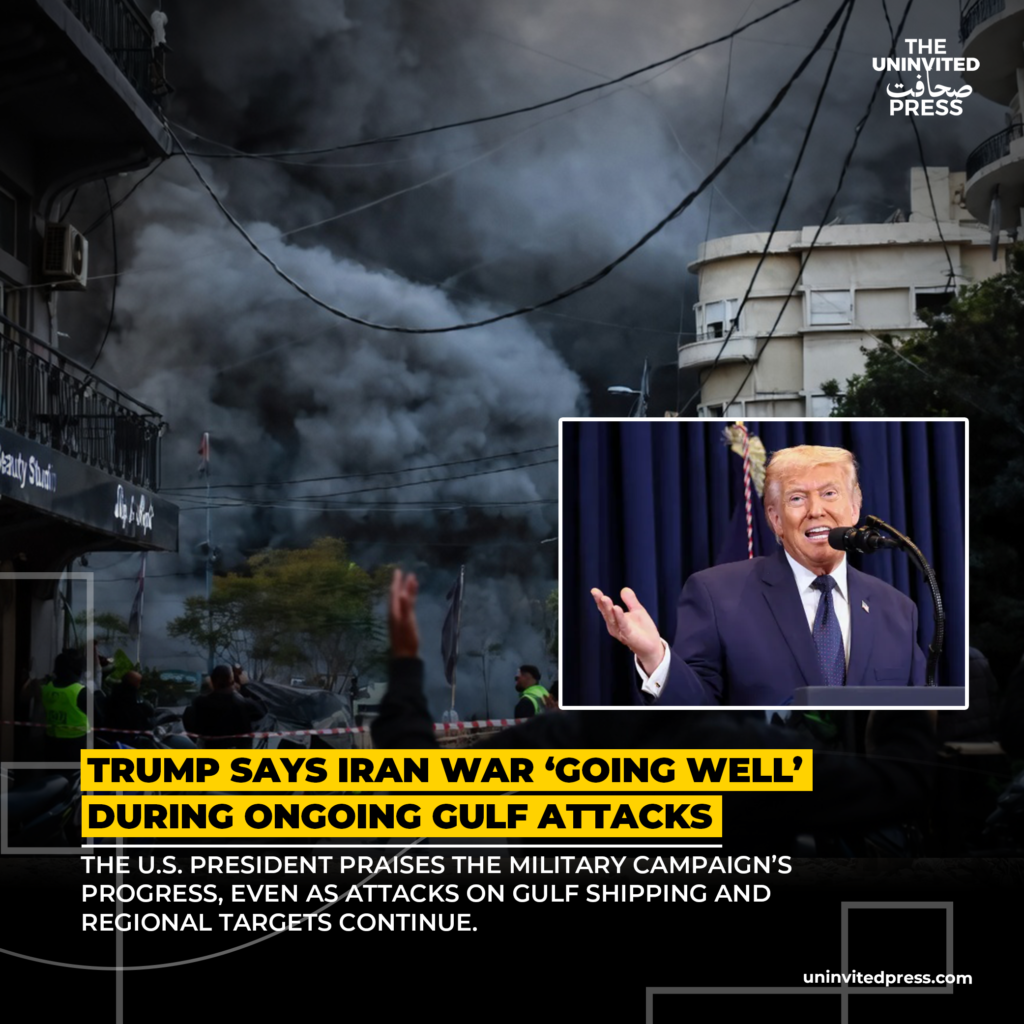
President Trump calls Iran war “going well” amid Gulf attacks, praising U.S. military as oil prices surge and regional tensions escalate in the 2026 conflict.
Trump Optimistic on Iran War Amid Rising Oil Prices and Regional Attacks:
President Donald Trump struck an optimistic tone on March 12, declaring the two-week-old war against Iran “coming along very well” during a White House event, despite fresh reports of Iranian drone and missile assaults on Gulf states and oil tankers. This bold assessment arrives as global oil prices hover above $100 per barrel, stranding over 150 vessels and threatening economic turmoil for import-dependent nations. Trump’s words aim to project confidence in the U.S.-Israeli campaign, but they clash with the reality of a widening conflict that has killed thousands and disrupted 20% of the world’s oil supply.
The statement underscores the high-wire act of Trump’s administration: balancing domestic reassurances with the harsh facts of a war showing no signs of quick resolution. For everyday Americans facing higher gas prices and global markets in flux, it raises questions about the true cost of “victory” in a region already scarred by decades of tension.
Trump's Optimism Clashes with Escalating Attacks:
During a White House event on March 12 honoring Women’s History Month, Trump declared the Iran war “going very well”, praising U.S. military actions and downplaying oil price concerns. Days earlier, he claimed Iran’s navy, air force, and communications had been largely destroyed, though he acknowledged the conflict isn’t fully over.
Meanwhile, on March 13, Iranian forces launched new drone and missile attacks across Gulf states, disrupting commercial traffic in the Strait of Hormuz and leaving hundreds of vessels stranded. The conflict has cost an estimated $11 billion so far, with daily operations around $60 million, and casualties surpass 1,800, including civilians in Tehran under heavy bombardment.
Deep Roots and High Stakes of the Conflict:
The war, codenamed “Operation Epic Fury,” launched on February 28 with U.S.-Israeli airstrikes targeting Iranian leadership, military sites, and nuclear facilities. The opening salvo killed Supreme Leader Ali Khamenei, prompting Iran to appoint his son, Mojtaba Khamenei, who has vowed unyielding resistance.
Roots trace to longstanding U.S.-Iran frictions: Tehran’s nuclear ambitions, support for proxies like Hezbollah, and prior clashes, including a 2025 skirmish. Trump, in his second term, framed the assault as essential to neutralize threats, initially predicting a four- to five-week duration.
The Strait of Hormuz chokepoint carries 21 million barrels of oil daily-20% of global supply. Disruptions have driven Brent crude above $100, with forecasts up to $200 if escalations persist. This fuels inflation worldwide, from U.S. gas pumps to Australian farms. Geopolitically, it risks drawing in NATO if strikes hit allies like Turkey, and pushes China closer to Russia.
Human impact is stark: Tehran residents endure blackouts and bombings, while Gulf evacuations displace thousands. Trump’s optimism echoes his 2020 handling of COVID-19, where early victory claims met prolonged crises.