

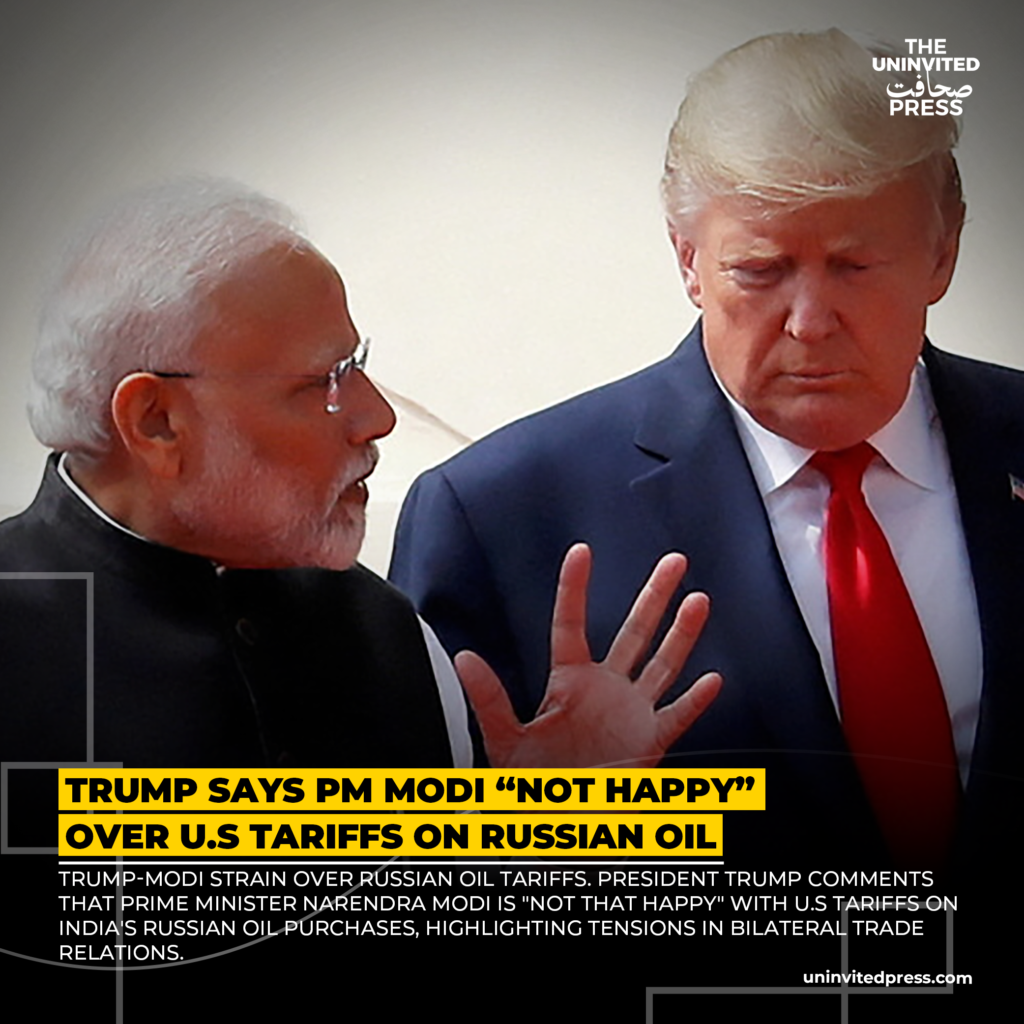
President’s blunt remarks expose cracks in US-India ties as tariffs bite into energy trade and spark warnings of escalation.
INCIDENT:
In a candid address on January 6, 2026, US President Donald Trump revealed that Indian Prime Minister Narendra Modi is personally unhappy with him over hefty tariffs imposed on India for continuing to purchase Russian oil. Speaking at a Republican retreat, Trump boasted of a strong rapport with Modi but highlighted the strain caused by 50% duties, which he linked to pressuring New Delhi away from Moscow’s energy amid the Ukraine war. As India slashes imports to avert further penalties, the comments signal potential trade war risks, threatening billions in bilateral commerce and forcing refiners to scramble for alternatives.
FULL STORY:
President Trump’s January 6 comments came during a wide-ranging speech at the House GOP Member Retreat, where he recounted personal interactions with Modi. “Prime Minister Modi came to see me, ‘Sir, may I see you please’. Yes,” Trump said, before adding, “I have a very good relationship with him. He’s not that happy with me because you know they’re paying a lot of tariffs now because they’re not doing the oil.” He clarified that India has “reduced it very substantially,” referring to Russian oil buys, and emphasized the tariffs’ role in this shift.
The day prior, on January 5, Trump had warned Reuters that the US could “raise tariffs on them very quickly” if India fails to address concerns over Russian energy imports. This followed his backing of the Graham-Blumenthal bill, which authorizes up to 500% tariffs on nations knowingly purchasing Russian oil or uranium, explicitly targeting India, China, and Brazil.
Data shows India’s Russian oil imports peaked but have since declined. In November-December 2025, volumes hit 1.77-1.85 million barrels per day (bpd), with Russia supplying 35%, but arrivals halted in late December, and January 2026 projections are below 1 million bpd. Major refiner Reliance Industries confirmed no Russian crude deliveries expected in January.
The tariffs, doubled to 50% in 2025 (with 25% tied to Russian oil), have already impacted Indian exports, which fell over 20% from May to November 2025, though November saw a rebound. Indian IT stocks dropped 2.5% following the warnings, hitting a monthly low.
CONTEXT & BACKGROUND:
US-India relations have warmed since Modi’s 2014 rise, with Trump and Modi sharing public displays of camaraderie, like the 2020 “Namaste Trump” rally in Ahmedabad. But trade frictions persist. India became Russia’s top oil buyer post-2022 Ukraine invasion, snapping up discounted crude to save billions amid global price spikes-estimated $5.1 billion in savings in 2023 alone.
Washington views this as indirectly funding Putin’s war machine, leading to sanctions on Russian entities and pressure on buyers. Trump, in his first term, imposed tariffs on Indian steel and aluminum; now, re-elected, he’s amplified this with energy-focused penalties. The Graham-Blumenthal bill builds on 2025 sanctions, aiming to choke Russian revenues.
India’s pivot: From negligible pre-2022 levels, Russian oil hit 40% of imports by mid-2025, but US threats prompted diversification to US, UAE, and Saudi sources. This shift costs more-Russian crude is $10-15/barrel cheaper-but averts broader trade hits. Significance: Bilateral trade topped $190 billion in 2025, with US as India’s top partner; escalation could disrupt pharma, IT, and gems exports, affecting millions of jobs.