

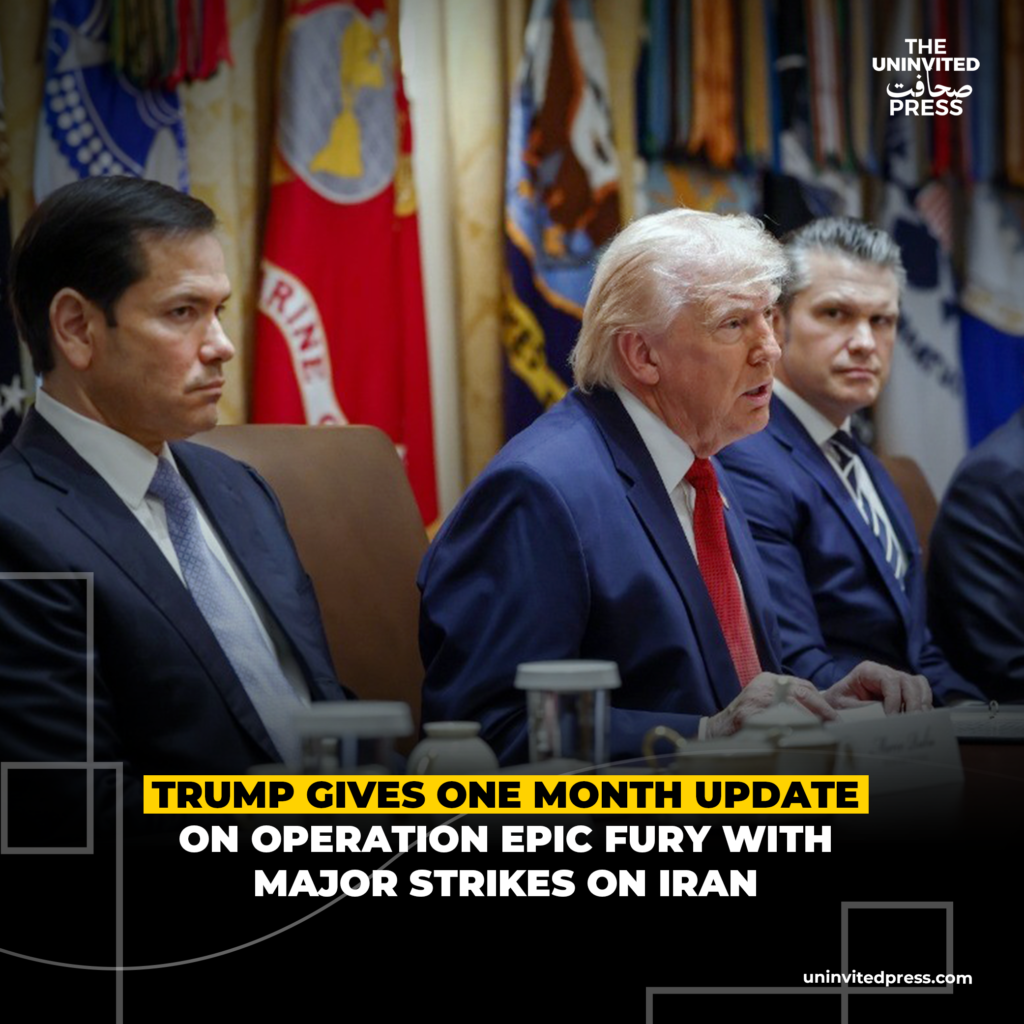
US president says military objectives ‘nearing completion’ but vows intense strikes for two to three more weeks, amid rising global oil prices and regional instability.
US President Donald Trump has declared that America’s military campaign against Iran is delivering “swift, decisive, overwhelming victories,” as he delivered a primetime address marking one month since the launch of Operation Epic Fury.
Trump said the US had largely achieved its core objectives of degrading Iran’s nuclear capabilities, destroying much of its ballistic missile arsenal, crippling its navy and air force, and weakening its support for regional proxy groups.“
The Iranian air force is gone. The navy is gone. Many ships sunk. Total obliteration,” Trump stated, describing the Iranian regime as “decimated” and no longer posing the same level of threat to the United States or its allies.
Operation Epic Fury began in late February 2026 with a series of large-scale US and Israeli strikes aimed at eliminating what the Trump administration called an “imminent nuclear threat” from Iran, along with its ballistic missile programme and terror networks.
Conflicting signals regarding the timeline and escalation:
While claiming significant success after 32 days of operations, Trump signalled that the campaign was not yet over. He warned that US forces would continue “hitting them extremely hard” over the next two to three weeks, threatening to push Iran “back to the Stone Ages” if Tehran failed to meet US demands, including reopening the strategically vital Strait of Hormuz.
The narrow waterway, through which a significant portion of the world’s oil passes, has been heavily disrupted since the conflict began, contributing to sharp rises in global energy prices and economic concerns in Europe, Asia and beyond.
Trump suggested the US could wind down major combat operations “very shortly” and shift responsibility for securing the Strait to other nations that rely on it for energy imports, while criticising allies for insufficient support.
Humanitarian impact and regional consequences:
The conflict has already caused significant casualties and destruction inside Iran, with reports of strikes hitting military sites, leadership targets and infrastructure in and around Tehran. Iranian officials have accused the US and Israel of aggression and causing civilian deaths, though independent verification remains limited amid ongoing hostilities.
The war has also triggered retaliatory actions, including Iranian missile and drone attacks on Israel and Gulf states, as well as heightened tensions across the Middle East.
Critics, including some analysts and opposition voices in the US, have questioned the clarity of the administration’s strategy, the legal basis for the operation, and the lack of a clear exit plan or post-conflict vision for Iran.
Rights groups have raised alarms over the potential for a wider humanitarian crisis, displacement, and long-term instability in a region already scarred by decades of conflict.
Trump, flanked by senior officials including Secretary of State Marco Rubio during related appearances, framed the operation as a necessary correction to decades of perceived US weakness toward Iran, insisting it would ultimately make the world safer by preventing Tehran from acquiring nuclear weapons.
As the one-month mark passed, questions remain over whether the intense air and naval campaign will lead to regime change in Iran, a negotiated settlement, or further escalation. Trump has left open the possibility of additional “spot hits” even after major operations wind down.
The address came as global markets continued to watch developments closely, with oil prices remaining elevated and concerns growing over the broader economic impact of prolonged disruption in the Gulf.