

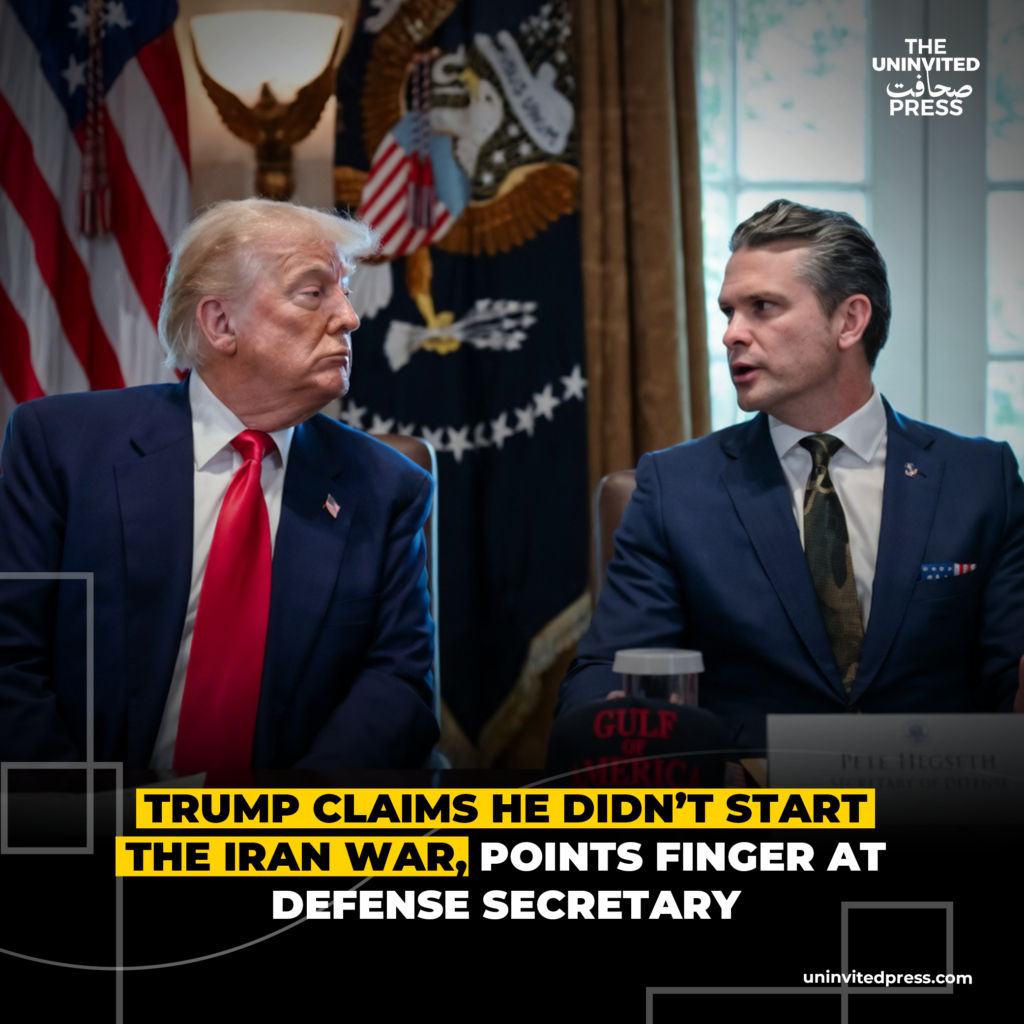
President Trump publicly stated that Defense Secretary Pete Hegseth was the first to urge strikes on Iran, claiming “Pete said, let’s do it.” The remarks, made with Hegseth seated nearby, come as the US-Israel war against Iran enters its fourth week amid rising casualties and domestic pressure.
Trump Shifts Blame to Hegseth Over Iran Strike Decision:
President Donald Trump has openly suggested that Defense Secretary Pete Hegseth drove the decision to launch strikes on Iran, telling a room of military and law enforcement leaders that Hegseth was the first senior official to say “let’s do it.”
The comments, delivered March 23 in Memphis, Tennessee, with Hegseth sitting directly beside him, mark the most explicit attempt yet by the president to distance himself from the origins of a war that has now entered its fourth week.
As U.S. and Israeli forces continue operations that have already killed Iran’s supreme leader and triggered widespread regional retaliation, Trump’s remarks have ignited fresh questions about accountability inside the administration.
Trump Points Finger at Hegseth: “You Were First to Say ‘Let’s Do It’ on Iran”:
The exchange unfolded during a roundtable discussion on public safety involving national military and law enforcement figures at a Tennessee Air National Guard base. Trump recounted calling senior officials to discuss “a problem in the Middle East” and a potential “little journey” to eliminate it. Turning to Hegseth, he said: “Pete, I think you were the first one to speak up and you said, ‘Let’s do it because you can’t let them have a nuclear weapon.’”
Hegseth remained silent during the moment. Trump went on to claim the administration had been caught off guard by the scale of Iran’s retaliation against Gulf nations, stating, “Look at the way they attacked, unexpectedly, all of those countries. Nobody was even thinking about it.”
The following day in the Oval Office, after a swearing-in ceremony, Trump doubled down, telling reporters that both Hegseth and Joint Chiefs Chairman Gen. Dan Caine appeared “disappointed” by the prospect of a negotiated ceasefire. “I think this thing’s going to be settled very soon and they go, ‘Oh, that’s too bad.’ Pete didn’t want it to be settled,” he said. “They were not interested in settlement. They were interested in just winning this thing.”
US-Iran War Escalates With No End in Sight:
The war began on Feb. 28, 2026, when U.S. and Israeli forces launched surprise airstrikes on Iranian targets under Operation Epic Fury. The strikes killed Supreme Leader Ali Khamenei and other top officials, with the stated goals of eliminating Iran’s nuclear and ballistic-missile programs, destroying its navy and preventing attacks on U.S. forces by the “Axis of Resistance.” Iran responded with missile barrages across the region, closing the Strait of Hormuz and drawing in other Gulf states.
Pete Hegseth, a former Army National Guard veteran and Fox News host, was confirmed as defense secretary earlier in the administration. On March 2 he told reporters, “We didn’t start this war but under President Trump we’re finishing it.” Hegseth has since briefed regularly on strike packages, describing operations as “on target and on plan” and refusing to set any end-date timeframe.
The conflict has already claimed American service members’ lives, disrupted global oil markets and strained household budgets inside Iran-as evidenced by the viral “take now, pay after the war” supermarket sign reported last week. Public support in the U.S. has softened as the war approaches its one-month mark with no quick victory in sight.