

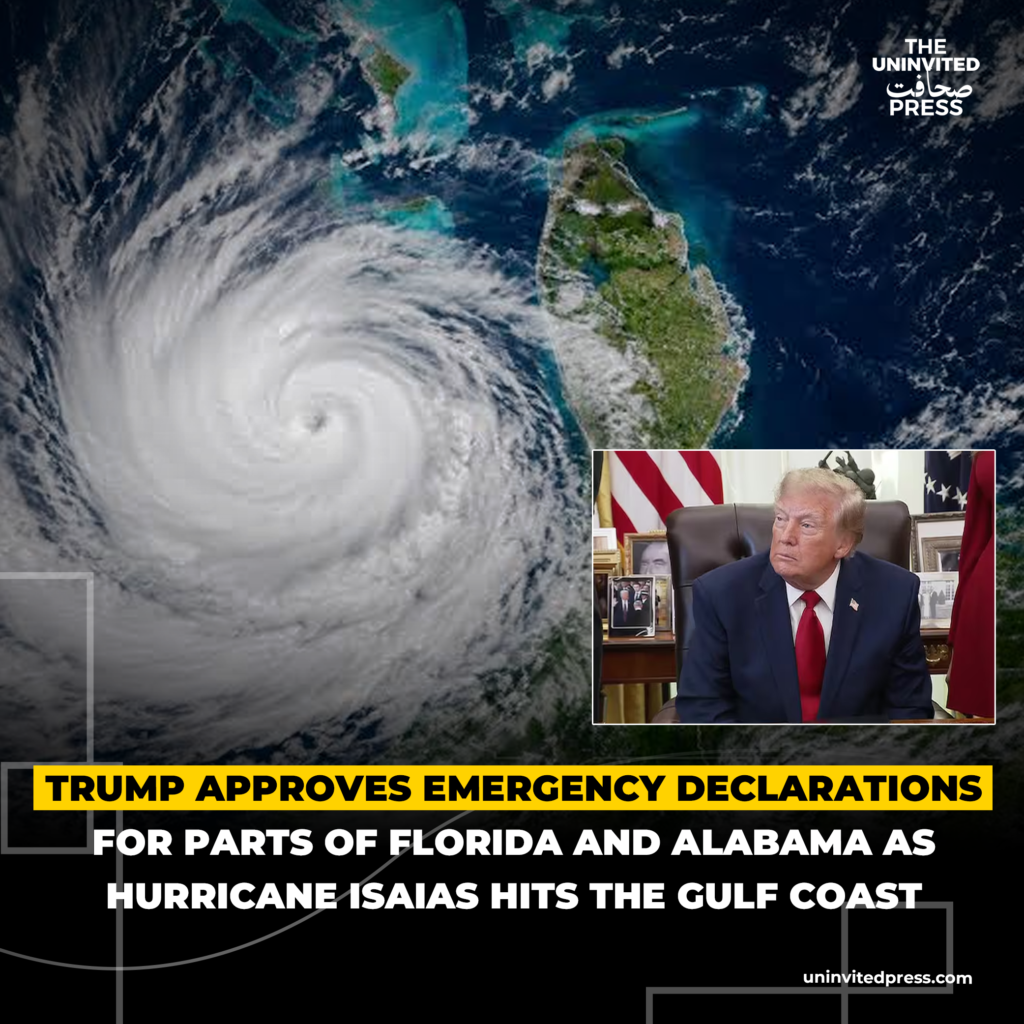
Federal aid authorised after Category 2 storm makes landfall near Destin, leaving hundreds of thousands without power.
US President Donald Trump has approved emergency declarations for parts of Florida and Alabama, enabling federal disaster assistance as Hurricane Isaias struck the Gulf Coast and moved inland, officials said.
The Federal Emergency Management Agency (FEMA) announced that the declarations authorise it to coordinate relief efforts and provide direct federal assistance to support state, tribal and local responses. Emergency protective measures will be funded at 75 percent by the federal government. The declarations cover multiple counties in Florida’s Panhandle and Big Bend region, as well as affected areas in Alabama.
Hurricane Isaias Hits Florida, Leaving 600,000 Without Power:
Hurricane Isaias, the first hurricane of the 2026 Atlantic season, made landfall near Destin, Florida, late on Friday as a Category 2 storm with maximum sustained winds of about 105 mph (169 km/h). It had briefly reached Category 3 intensity earlier with winds of 120 mph before weakening. By early Saturday, the system had been downgraded to a post-tropical cyclone as it moved north through southern Alabama, with sustained winds around 65 mph.
The storm brought life-threatening storm surge, destructive winds, heavy rainfall and the risk of tornadoes to coastal communities. More than 600,000 customers in Florida and Alabama lost power, according to outage trackers, with numbers rising as the system pushed inland. Flooded roads, downed trees and power lines were reported in areas including Destin, Pensacola and parts of southern Alabama. Some roads in Houston County, Alabama, were closed.
Florida Governor Ron DeSantis had earlier declared a state of emergency for more than two dozen northern counties, while Alabama Governor Kay Ivey issued a similar declaration covering dozens of counties and ordered evacuations for non-residents and tourists in coastal zones such as Gulf Shores, Orange Beach and Dauphin Island.
FEMA said the Florida declaration covers counties including Escambia, Santa Rosa, Okaloosa, Walton, Bay, Leon and others across the Panhandle and Big Bend. Brett H. Howard was named Federal Coordinating Officer for the response in Florida. A parallel declaration for Alabama was also approved to ensure federal resources are available.
Officials Warn of Continued Flooding Risks as Isaias Weakens:
Homeland Security Secretary Markwayne Mullin confirmed that the emergency declarations had been authorised “to ensure federal resources are available to respond to Isaias.” President Trump told reporters the situation was being watched “very closely” and described preparations as “under control.” He cancelled plans to attend a college football game in Alabama to avoid disrupting emergency response efforts.
The National Hurricane Center warned of continued risks of flash flooding, with rainfall totals of 4 to 8 inches (10 to 20 cm) expected across parts of the region and locally higher amounts possible. Storm surge warnings remained in effect for sections of the Florida coast even as the system weakened.
Isaias formed over the southwestern Gulf of Mexico earlier in the week and intensified rapidly, becoming the latest first hurricane of an Atlantic season in more than a century. It is the first US hurricane landfall since Hurricane Milton struck Florida in 2024. As recovery operations begin along the Gulf Coast, officials continue to urge residents to remain cautious of flooding and debris while power restoration and damage assessments get under way.