

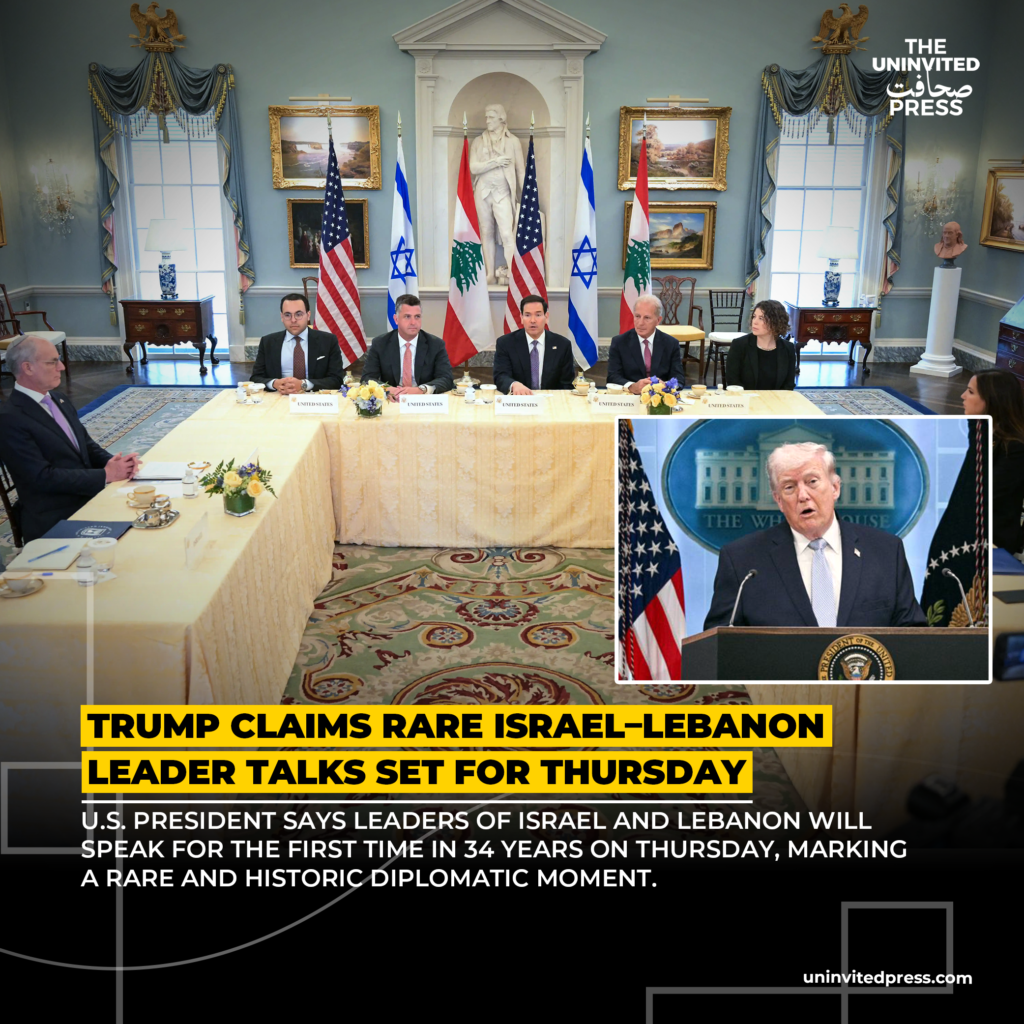
US president says conversation will mark first contact between the two countries’ leaders in 34 years, as Washington pushes for de-escalation amid ongoing regional tensions.
US President Donald Trump has announced that the leaders of Israel and Lebanon will speak directly on Thursday, describing the planned conversation as a rare diplomatic opening after more than three decades without high-level contact between the two nations.
In a post on Truth Social late on Wednesday, Trump wrote: “Trying to get a little breathing room between Israel and Lebanon. It has been a long time since the two leaders have spoken, like 34 years. It will happen tomorrow. Nice!”
The announcement follows a high-level meeting on Tuesday at the US State Department, where Israeli and Lebanese ambassadors held the first direct face-to-face negotiations between the two countries in decades. The talks were hosted by Secretary of State Marco Rubio.
Historic but limited breakthrough:
The Tuesday meeting, described by US officials as “productive,” marked the first such diplomatic engagement since 1993. It came against the backdrop of heightened regional instability, including recent escalations involving Hezbollah in southern Lebanon and broader tensions linked to the Iran file.
Trump did not specify which leaders would participate in Thursday’s conversation, though reports suggest it may involve Israeli Prime Minister Benjamin Netanyahu and Lebanese President Joseph Aoun.
Lebanese officials have emphasised the need for an immediate ceasefire, the withdrawal of Israeli forces from southern Lebanon, and measures to address the country’s severe humanitarian crisis. Israel, for its part, has focused on security concerns, particularly the disarmament of Hezbollah and guarantees against future attacks.
Fragile backdrop as US pushes mediation efforts:
The developments reflect a concerted US push to create space for dialogue between the two neighbours, who technically remain in a state of war. Analysts note that while the talks represent a symbolic milestone, deep mistrust and unresolved core issues-including border disputes, Hezbollah’s role, and Lebanese sovereignty-make any rapid breakthrough unlikely.
A senior US official told Haaretz that President Trump would welcome an end to hostilities in Lebanon as part of a broader peace agreement, even if it is not formally tied to ongoing US-Iran negotiations.
The initiative comes as Israel continues military operations in parts of southern Lebanon, and Lebanon grapples with massive displacement and infrastructure damage from prolonged conflict.
Cautious Outlook Ahead of Potential Israel-Lebanon Talks:
Neither Israel nor Lebanon has confirmed the planned leader-level call. Lebanese sources say any progress must focus on ending civilian suffering and restoring stability.
The US State Department called Tuesday’s ambassadorial meeting the beginning of a longer process to address both countries’ security concerns.
However, observers remain cautious. Hezbollah has rejected the idea of talks, while hardline voices in Israel question any deal that does not significantly weaken the group.
With regional tensions still high, including wider Iran-related developments, Thursday’s expected conversation-if it takes place-will be closely monitored for signs of de-escalation.