

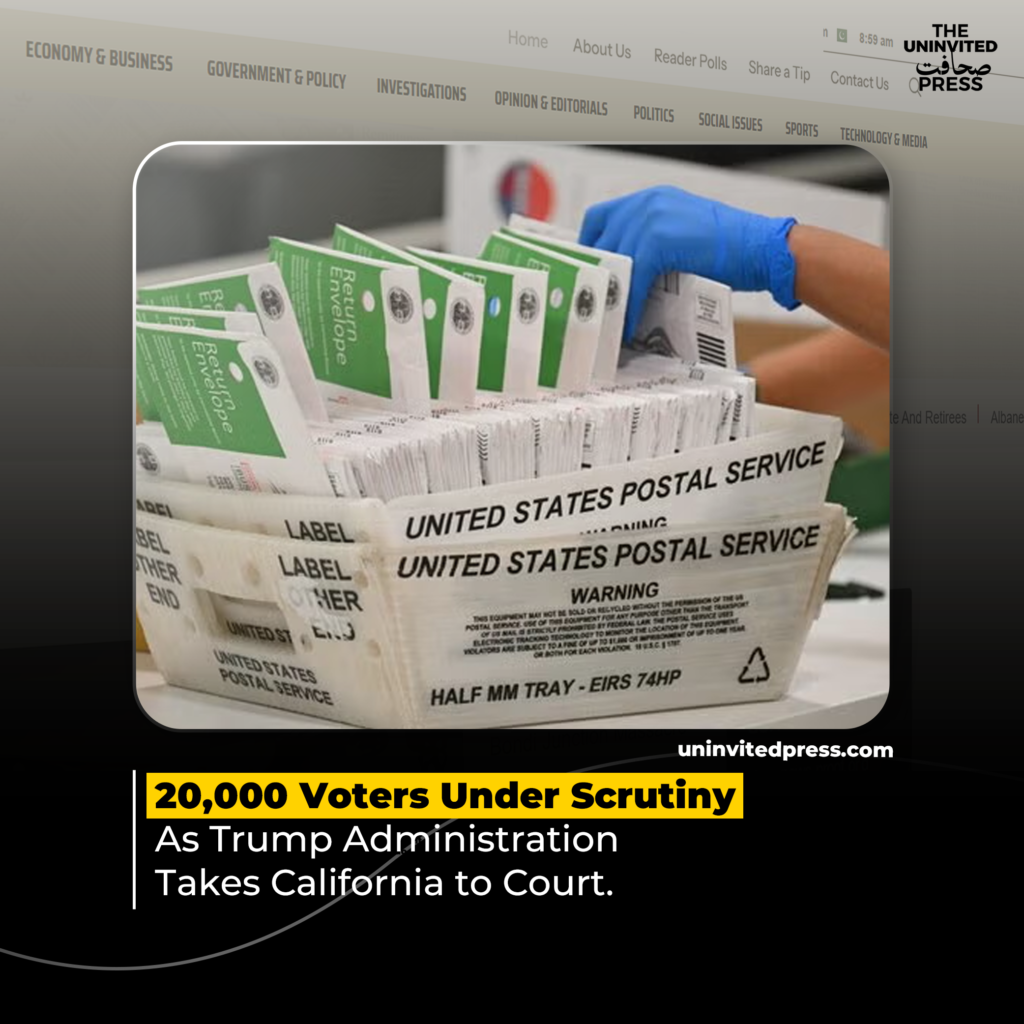
Justice Department seeks court order to halt counting of mail ballots weeks before midterms, escalating federal-state clash over election integrity.
The administration of United States President Donald Trump has sued California, asking a federal court to block the state from counting mail-in ballots from more than 20,000 registered voters whom federal officials allege are “likely noncitizens,” just weeks before the November midterm elections.
The lawsuit, filed on Thursday in the US District Court for the Central District of California, names California Secretary of State Shirley Weber and Los Angeles County Registrar-Recorder Dean Logan as defendants. It seeks a preliminary and permanent injunction preventing the tabulation of vote-by-mail ballots from the flagged individuals until their citizenship status can be independently verified.
US Sues California Over Alleged Noncitizen Voter Registrations:
According to the Justice Department, the list of more than 20,000 names emerged from a multiagency review involving US Citizenship and Immigration Services (USCIS) and Homeland Security Investigations (HSI). Officials said the process included database matching against federal records and other checks, leading HSI to conclude that it “reasonably believes that around 20,000 noncitizens are registered to vote in California.”
The suit followed a 48-hour ultimatum issued on Tuesday. Acting Deputy Attorney General Trent McCotter sent letters to Weber and Logan, accompanied by a password-protected thumb drive containing the names, demanding that officials review the list, confirm citizenship status where possible, and segregate any unverified ballots. California officials did not comply by the deadline.
Weber responded that no list had been provided directly to her office and described the demand as “an emergency of the DOJ’s creation.” She noted the impracticality of reviewing approximately 20,000 individuals within such a short window on the eve of an election and said the federal government had failed to provide supporting evidence or methodology. Los Angeles County officials cited data privacy and information security protocols in declining to access the unsecured drive.
California mails ballots automatically to all registered voters. Ballots began going out in early October, and voting was already under way when the lawsuit was filed. State Attorney General Rob Bonta and Governor Gavin Newsom rejected the federal demands. Newsom called the lawsuit “a sad, desperate attempt by Trump to use his politicized Justice Department to try to suppress California voters just three weeks before Election Day,” arguing that courts have repeatedly affirmed that the federal government has no role in running state elections.
California Voter Roll Lawsuit Fuels Election Security Debate:
The 20,000 figure represents a significant reduction from earlier Department of Homeland Security claims in July that as many as 190,000 noncitizens might be on California’s voter rolls. State officials have long disputed those broader allegations, noting that noncitizen voting is rare and that California maintains rigorous registration processes.
The Justice Department maintains that it sought collaboration and that California “made no serious effort” to address the concerns. Attorney General Todd Blanche said the state was given an opportunity to “self-correct its records” and segregate suspected ballots.
Legal experts have described the request as highly unusual and a long shot, noting that election administration is primarily a state responsibility under the US Constitution. Similar federal efforts in other states have faced strong judicial pushback.
The case, captioned United States of America v. State of California, arrives amid heightened national debate over election security, mail voting and claims of noncitizen participation-claims that independent audits and past investigations have largely failed to substantiate at scale. As California continues processing early votes for the November 3 midterms, the lawsuit intensifies an already polarised confrontation between the Trump administration and Democratic-led states over the conduct of elections.