

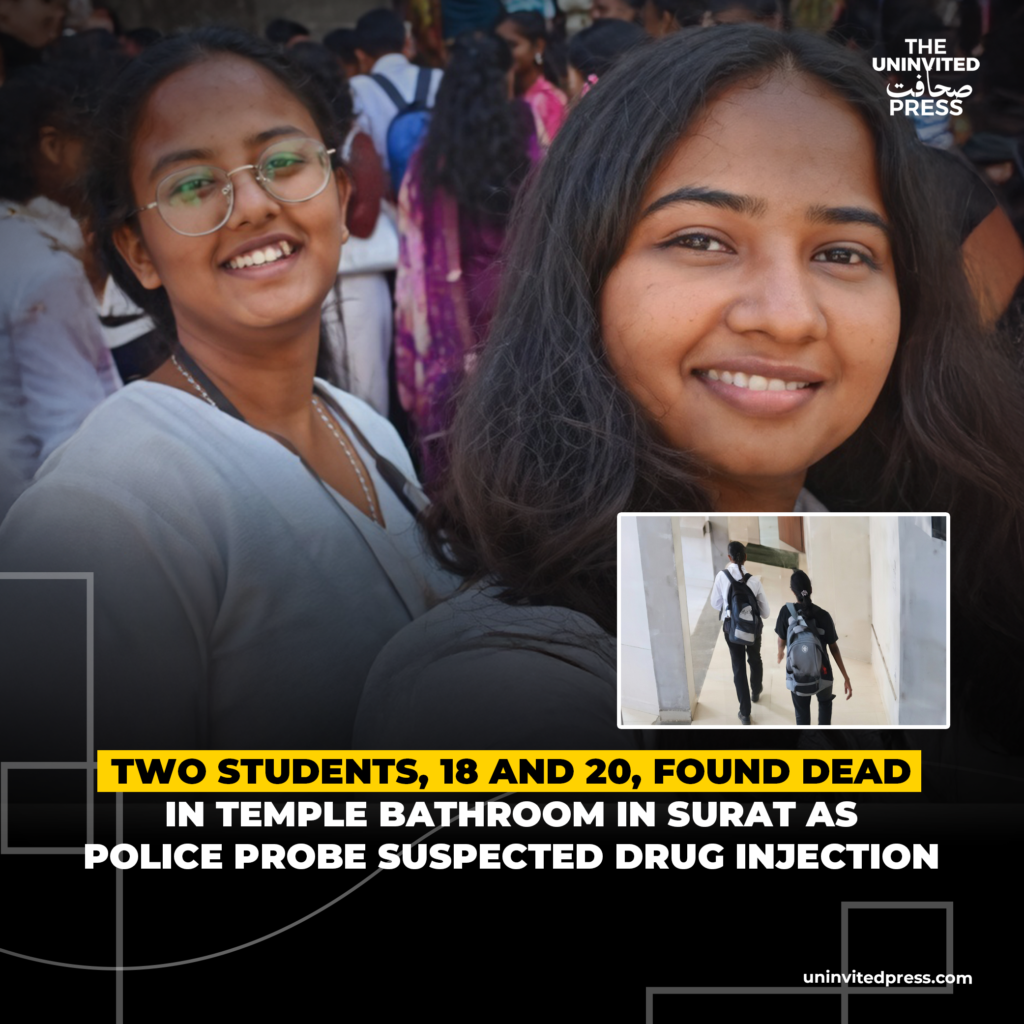
Two college students in Surat, India, found dead in temple bathroom after AI searches on suicide methods; police suspect anaesthetic drug injection in pact.
Tragic Discovery at Surat Temple: Lifelong Friends Found Dead in Apparent Suicide Pact:
In a heartbreaking incident that has shaken Surat, two young college students and lifelong friends were found dead inside a locked bathroom at a local temple, with authorities suspecting they took their own lives by injecting anaesthetic substances. The discovery highlights the growing crisis of youth mental health in India, where student suicides continue to rise amid academic and personal pressures.
The bodies of 18-year-old Roshni Sharad Shirsath and 20-year-old Jyotsna Atul Chaudhary were discovered late Friday evening at the Atmiya Sanskar Dham Swaminarayan Temple in Saniya village on the outskirts of Surat, Gujarat. Preliminary investigations reveal the pair had used an AI tool to search for suicide methods, underscoring the potential dangers of unchecked online information. As families grieve and police delve deeper, the case raises urgent questions about access to harmful content and support for vulnerable young people.
From Morning Departure to Evening Discovery:
On March 6, Shirsath and Chaudhary began their day as usual, telling their families they were heading to college. By afternoon, when they hadn’t returned or answered calls, concern grew. Relatives contacted local police, who traced the women’s active mobile phones to a temple complex in Saniya village.
Around 9:30 p.m., family members found one of their scooters outside the temple and began searching the premises. Security footage showed the two entering the bathroom around 7:44 a.m., meaning they had been inside for over 13 hours. The door was locked from the inside, forcing relatives to break it open. Emergency responders transported Shirsath to New Civil Hospital and Chaudhary to SMIMER Hospital, where both were pronounced dead on arrival.
Police recovered syringes and vials suspected to contain anaesthetic drugs, one of which was empty. No signs of foul play were present, and the locked door supported the theory of a deliberate act.
Investigators examined the women’s mobile phones and found a troubling digital trail: searches on ChatGPT about suicide methods and drugs, as well as saved news articles, including one depicting a woman who died from an anaesthetic injection. Assistant Commissioner of Police N.P. Gohil confirmed that while evidence points to suicide, forensic and autopsy results are still awaited to determine the exact cause.
Family members could not identify any immediate triggers such as academic, financial, or relationship issues. The absence of a note leaves the motive unclear, though the coordinated nature of the act indicates a possible pact between the close friends.
Student Suicide Crisis in India & Gujarat: Trends and Risks:
This incident unfolds against a backdrop of escalating student suicides in India, where young people face intense academic competition, societal expectations, and limited mental health resources. According to the National Crime Records Bureau’s 2022 data-the most recent comprehensive figures available-over 13,000 students died by suicide nationwide, marking a rise from previous years. Gujarat alone accounted for more than 800 of these cases, with the state’s overall suicide rate standing at 11.6 per 100,000 people as of 2020.
In Gujarat, student suicides increased by 21% between 2020-21 and 2022-23, with 495 cases reported in that period, including 246 females. Factors like exam pressure, family distress, and the lingering effects of the COVID-19 lockdowns have been cited in reports. Surat, a bustling industrial hub known for its diamond and textile sectors, has seen its share of such tragedies, often linked to the stresses of urban life and higher education.
The involvement of AI tools like ChatGPT adds a modern twist, sparking debates on technology’s role in mental health crises. While AI platforms can provide helpful information, unrestricted access to sensitive queries has raised concerns globally. In India, where internet penetration is high among youth but digital literacy varies, this case may prompt calls for better safeguards on harmful content.
Broader trends show female students are particularly vulnerable, comprising nearly half of Gujarat’s recent student suicide cases. Mental health experts point to stigma around seeking help, inadequate counseling in colleges, and the pressure to succeed in a competitive job market as key contributors.