

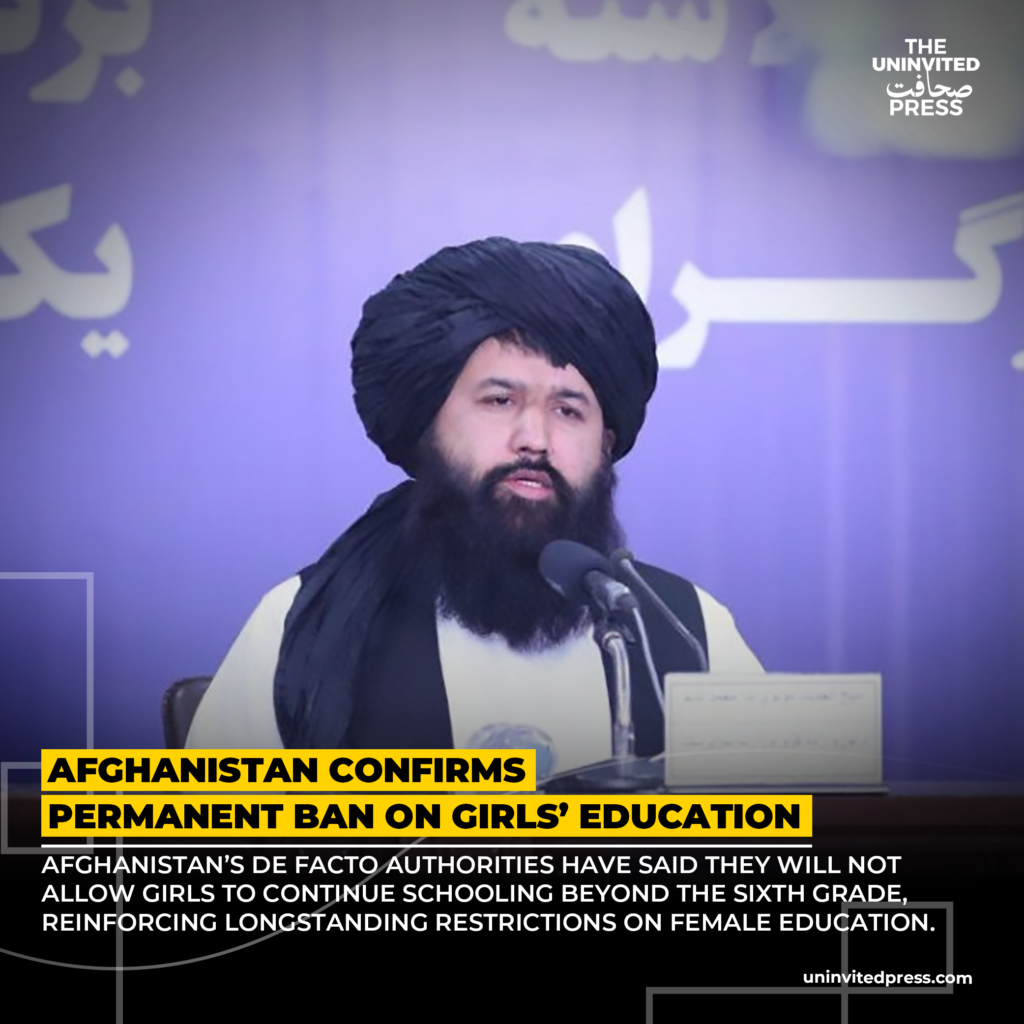
Taliban confirms permanent ban on girls’ education beyond sixth grade in Afghanistan, impacting 2.2 million and sparking global outcry over rights and future impacts.
Taliban Make Girls’ Education Ban Permanent, Isolating Afghanistan Further:
Afghanistan’s Taliban authorities have officially confirmed that the ban on girls attending school beyond the sixth grade will be permanent, a decision announced by the Ministry of Education in January 2026. This move, which also extends to universities and recent closures of private medical training for women, affects over 2.2 million adolescent girls and has drawn sharp global condemnation. As the only country in the world enforcing such a nationwide prohibition, Afghanistan’s policy risks deepening poverty, increasing child marriages, and undermining long-term stability, with experts warning of irreversible harm to society.
From “Temporary” to Total: How the Taliban Locked Afghan Girls Out of Education?
The confirmation came in early January 2026, when the Taliban-run Ministry of Education stated that restrictions on female education, initially described as temporary, would not be lifted. Minister Habibullah Agha, in public remarks reported by multiple outlets, emphasized that “everything is closed for now” and dismissed further discussions as futile, a stance echoed from earlier statements in 2024. This followed the shutdown of private medical institutes for women in late 2025 and early 2026, eliminating one of the few remaining avenues for female professional training.
The timeline traces back to August 2021, when the Taliban seized power after U.S. forces withdrew. By March 2022, secondary schools for girls were abruptly closed just days after a promised reopening, affecting classes from seventh grade onward. In December 2022, universities followed suit, barring women entirely. Despite international appeals, the bans persisted through 2023 and 2024, with incremental tightenings, such as prohibitions on women studying abroad or attending private courses.By December 2025, notices were distributed to sixth-grade students informing them of no progression, leading to widespread emotional distress in classrooms.
As of January 28, 2026, the policy remains unchanged, with reports of girls turning to clandestine online classes or religious madrassas, though these offer limited curricula and face risks of Taliban raids.
A Return to Darkness: Taliban Rule Repeats a Grim History for Afghan Women:
The Taliban’s approach to women’s rights echoes their rule from 1996 to 2001, when similar bans isolated Afghanistan globally and contributed to economic collapse. Upon regaining control in 2021, the group promised moderation but swiftly imposed over 80 edicts restricting women, including bans on public parks, gyms, and most employment. Education restrictions form the core of this “gender apartheid,” as described by UN experts, denying girls basic rights and perpetuating cycles of dependency.
Historically, Afghanistan made strides in female education post-2001, with enrollment rising from near zero to over 3.5 million girls by 2021.The reversal has erased these gains, leaving the country with the world’s second-largest gender gap. Significance lies in the human cost; psychologists report rising depression, anxiety, and suicides among affected girls, while economically, the policies cost Afghanistan over $1 billion annually in lost productivity. UN projections warn of a 25% spike in child marriages and 50% higher maternal mortality by mid-2026 if unchanged.
This decision comes amid broader isolation, with no country recognizing the Taliban government and aid cuts exacerbating a humanitarian crisis where 23 million Afghans face hunger.