

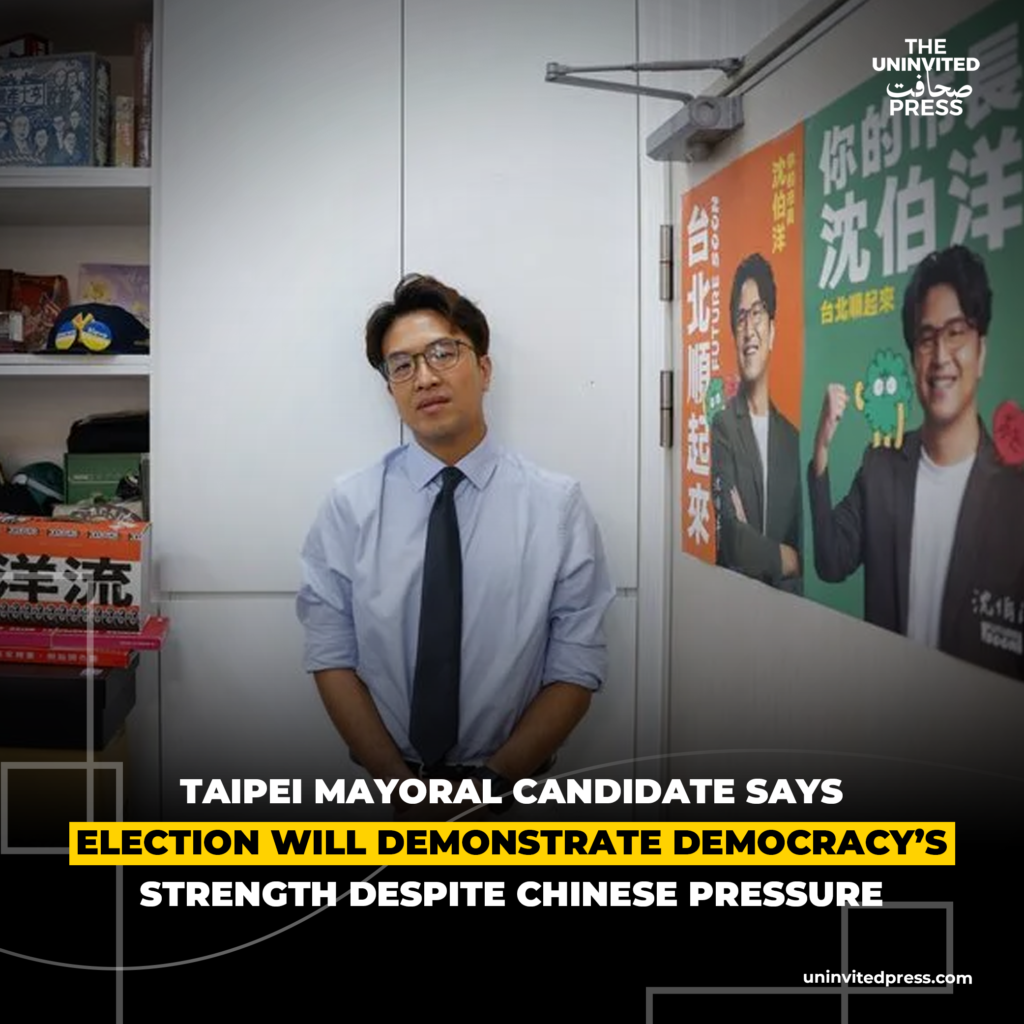
DPP hopeful Puma Shen, targeted by Beijing as a ‘separatist’, says November 28 vote will prove Taiwan’s system works despite interference attempts.
The race for mayor of Taiwan’s capital will demonstrate the strength of the island’s democracy no matter who wins, according to the ruling party’s candidate, who has been labelled a “die-hard separatist” by Beijing and is under investigation by Chinese authorities.
Puma Shen, the Democratic Progressive Party (DPP) contender and an expert on Chinese disinformation campaigns, made the remarks in an interview as Taiwan prepares for local elections on 28 November. Shen is locked in a tight contest with incumbent Mayor Chiang Wan-an of the opposition Kuomintang (KMT), a race that has drawn unusual attention because of its potential implications for cross-strait relations and Taiwan’s domestic politics.
“For me, even if Chiang Wan-an got elected, it’s also a slap to China. Because we proved that democracy works here in Taiwan and we’re not interfered with by China,” Shen told Media. “If I got elected, I don’t think it’s even a slap: it’s because of democracy.”
Taipei Election Candidate Faces Chinese Pressure:
Shen, a former academic and lawmaker who founded organisations focused on countering Beijing’s information operations and training civilians for potential crises, is seeking to deliver the DPP its first mayoral victory in Taipei in three decades. The capital has long been considered a stronghold of the KMT, the party that historically favoured closer ties with China.
Beijing, which claims Taiwan as its own territory-a claim Taipei firmly rejects-has repeatedly criticised Shen. Chinese police in Chongqing opened a probe into him last year on suspicion of “separatism,” and he remains on a list of individuals Beijing designates as hardline independence advocates. China has no legal jurisdiction in Taiwan, but such moves form part of a broader pattern of pressure that includes sanctions on Taiwanese officials and efforts to influence public opinion through disinformation and economic coercion.
Chiang’s campaign team responded by stressing that the election itself is “a concrete expression of the democratic system” and that “no external force should exert political pressure on Taiwan’s democratic elections.”
Polls in recent weeks have shown the race tightening or even tilting toward Shen in some surveys, a surprising development in a city where the KMT has traditionally held an advantage. Shen’s campaign has focused heavily on local governance issues such as urban greenery, education and housing, while downplaying cross-strait tensions in public messaging. Supporters have described a surge of enthusiasm around his candidacy, sometimes referred to as the “ocean current”-a play on his Chinese name.
Taipei Election Tests Taiwan’s Democracy and China Ties:
The Taipei contest is part of island-wide local elections that will elect mayors, magistrates and councillors. While China is not formally on the ballot, the vote is widely viewed as a test of public sentiment toward President Lai Ching-te’s administration and its approach to Beijing. Analysts note that a strong performance by the DPP in the capital could bolster the ruling party ahead of the next presidential election in 2028, while a KMT hold would reinforce the opposition’s position.
Taiwanese officials have repeatedly warned of Chinese interference tactics ahead of the polls, including online disinformation, cognitive warfare and attempts to shape narratives through proxies. Shen’s background in studying and countering such operations has made him a particular target, with Beijing’s actions against him and associates-including economic pressure on family-linked businesses and backlash against public figures who appeared at his events-drawing scrutiny.
As campaigning intensifies in the final weeks, both sides are emphasising democratic norms. For Shen and his supporters, the mere fact of a competitive, free election under external pressure is itself a statement. Whether Taipei voters ultimately choose continuity under Chiang or a change under Shen, the candidate argues the outcome will affirm that Taiwan’s democracy remains resilient.