

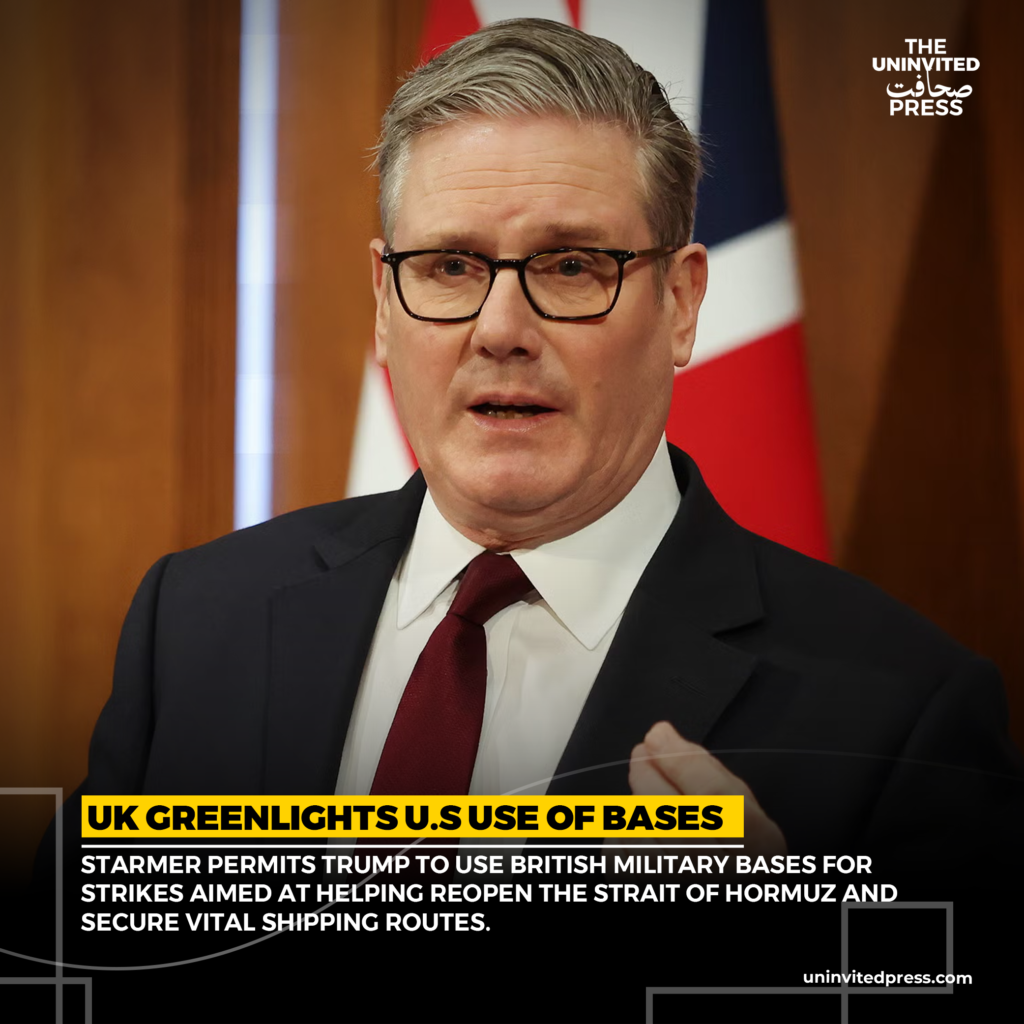
UK Prime Minister Keir Starmer has authorised the US to launch strikes from British military bases to reopen the Strait of Hormuz and secure shipping routes amid the escalating 2026 Iran war.
Starmer Authorises US Strikes from British Bases to Secure Strait of Hormuz:
UK Prime Minister Keir Starmer has granted the United States permission to launch strikes against Iranian targets from British military bases, explicitly aimed at neutralising threats to the Strait of Hormuz and restoring vital shipping routes disrupted by the ongoing 2026 Iran war. The decision, confirmed late Friday, marks Britain’s most direct involvement yet in the three-week conflict that has already killed more than 1,400 people, displaced hundreds of thousands and driven oil prices up nearly 47 per cent.
The move comes just hours after President Donald Trump rejected ceasefire calls and as Iranian drones struck Kuwait’s Mina Al-Ahmadi refinery for the second time in 24 hours, underscoring the urgent need to secure the narrow waterway through which one-fifth of the world’s oil supply passes.
Policy U-Turn: From Logistical Aid to Active Basing Support Amid Hormuz Crisis:
Starmer’s government had previously offered only logistical support to US and Israeli operations. Friday’s green light represents a significant policy shift, driven by the rapid escalation of Iranian retaliation against Gulf states perceived as backing Washington and Tel Aviv. After US-Israeli pre-emptive strikes killed Supreme Leader Ali Khamenei on 28 February, Iran shifted its campaign to energy choke points. Israel’s 19 March bombing of the South Pars gas field triggered Tehran’s latest wave of attacks, including dual strikes on Kuwait’s largest refinery.
With Brent crude holding above $119 a barrel and fears of a full Hormuz blockade growing, Starmer faced mounting pressure from Washington and British business leaders. Trump had publicly criticised European allies for insufficient help in securing the strait. The UK decision aligns with that call while carefully framing British involvement as limited and defensive.
Defence Secretary John Healey confirmed the authorisation in a brief statement: “Our bases will support allied efforts to keep the world’s most important shipping lane open. This is not about regime change. It is about protecting jobs, energy prices and international trade.”
Hormuz as Flashpoint and Starmer’s Reluctant Pivot:
The Strait of Hormuz has long been a strategic vulnerability. Iran has repeatedly threatened to close it during past tensions, but the 2026 war has turned rhetoric into action. Iranian drones and speedboats have targeted tankers, while missile strikes on Gulf refineries have already forced partial shutdowns in Kuwait, Qatar and the UAE. The UK maintains a permanent naval presence in the region through the Combined Maritime Forces and has used Akrotiri extensively for operations in the Middle East since the 1990s Gulf War.
Starmer, who campaigned on a more cautious foreign policy, initially resisted deeper entanglement. However, the economic fallout-rising fuel costs hitting British households and businesses-combined with direct US requests changed the calculus. Diego Garcia, a joint UK-US facility, is already home to US B-52 bombers and surveillance aircraft that could reach Iranian targets within hours.