

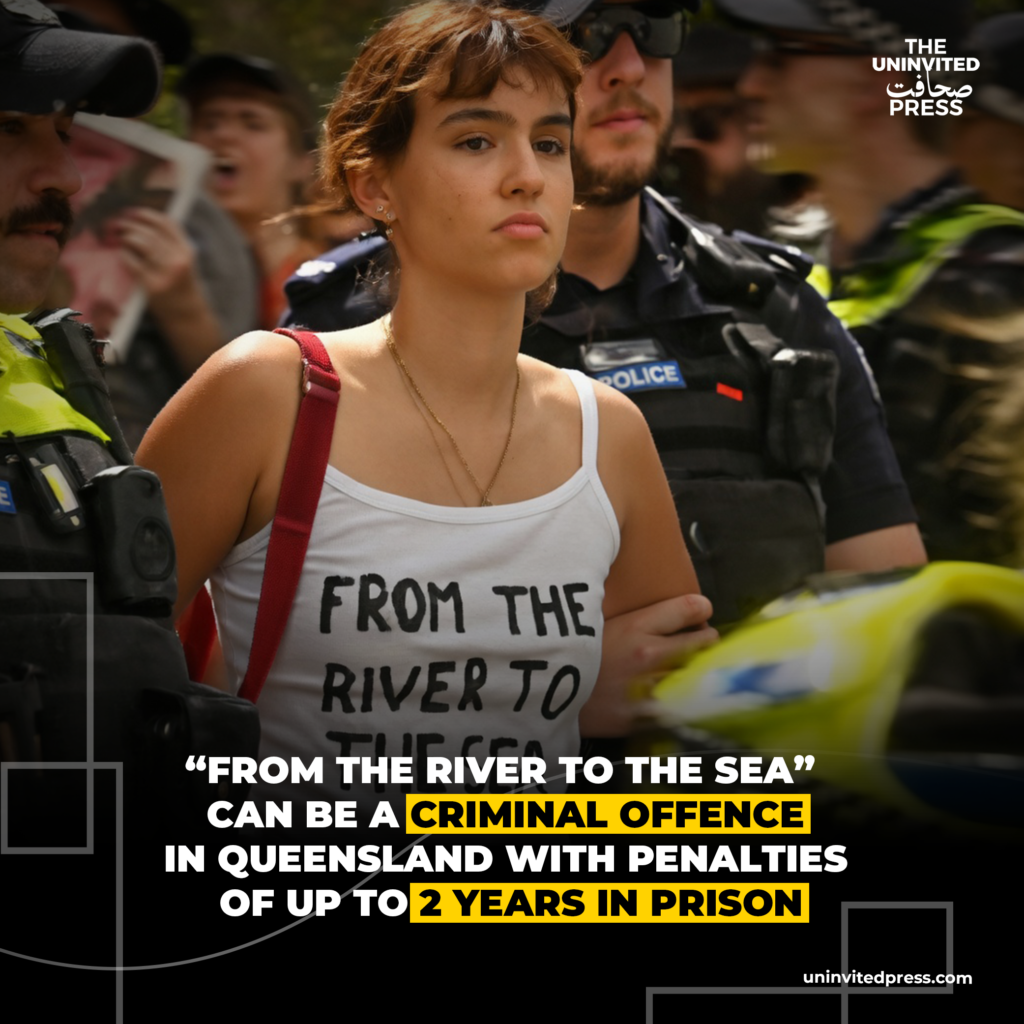
Protesters arrested on first day of controversial law as critics decry ‘authoritarian’ measures targeting Palestinian advocacy.
In a move that has ignited fierce debate over free speech and public safety, Queensland has become the first Australian state to explicitly criminalise the pro-Palestinian slogan “From the river to the sea” and the phrase “Globalise the intifada.”
Under the new hate speech provisions, enacted as part of the Fighting Antisemitism and Keeping Guns out of the Hands of Terrorists and Criminals Amendment Bill 2026, public recitation, display, distribution or publication of these expressions can result in up to two years in prison if they are deemed likely to “menace, harass or offend” a member of the public.
The law took effect on 11 March 2026, and within hours, Queensland Police arrested two pro-Palestinian activists outside the state parliament during a protest organised by Students for Palestine. A 33-year-old man, identified as Liam Parry, was charged with the offence of “recital, distribution, publication or display of prohibited expressions” after allegedly using the phrase at the rally. He is scheduled to appear in Brisbane Magistrates Court on 8 April. An 18-year-old woman wearing a singlet bearing the slogan was also arrested and later issued an adult caution.
Background of the Legislation:
The Queensland government, led by Premier David Crisafulli, introduced the reforms following rising concerns over antisemitic incidents, particularly in the wake of the deadly Bondi Beach attack in Sydney in December 2025, which killed 15 people and heightened national tensions around extremism and community safety. Jewish community leaders welcomed the measures, arguing they provide police with necessary tools to combat hate and protect vulnerable groups.
Supporters of the ban, including the Queensland Jewish Board of Deputies, contend that “From the river to the sea, Palestine will be free”-a phrase widely used at pro-Palestinian demonstrations-carries antisemitic connotations, implying the elimination of Israel as a Jewish state and evoking calls for violence or erasure of Jewish presence between the Jordan River and the Mediterranean Sea.
The legislation also expands offences related to prohibited symbols and intimidation at places of worship, with some penalties reaching seven years.
Public backlash and concerns regarding civil liberties:
Human rights organisations and pro-Palestinian groups have strongly criticised the laws as an overreach that conflates legitimate political expression with hate speech. Amnesty International warned that the ban poses a “serious threat to fundamental freedoms” and is incompatible with international human rights standards on freedom of expression, particularly when it does not require incitement to violence.
Greens MPs described the arrests as having “all the hallmarks of an authoritarian police state,” likening the measures to the repressive era of former Queensland Premier Joh Bjelke-Petersen. Critics argue the subjective test-whether the expression “might reasonably be expected to cause” offence-creates a chilling effect on protest and hands a “heckler’s veto” to the most sensitive observers.
The phrase “From the river to the sea” has long been contested: supporters view it as a call for Palestinian liberation, equality and justice across historic Palestine, while opponents insist it denies Jewish self-determination. Legal experts note that its meaning can be “indeterminate,” and automatic labelling as antisemitic is not universally accepted.
Opposition to the law has highlighted inconsistencies across Australian states and fears of broader crackdowns on dissent. Similar debates have emerged federally, with rushed anti-hate measures post-Bondi accused by some of disproportionately targeting pro-Palestinian voices.