

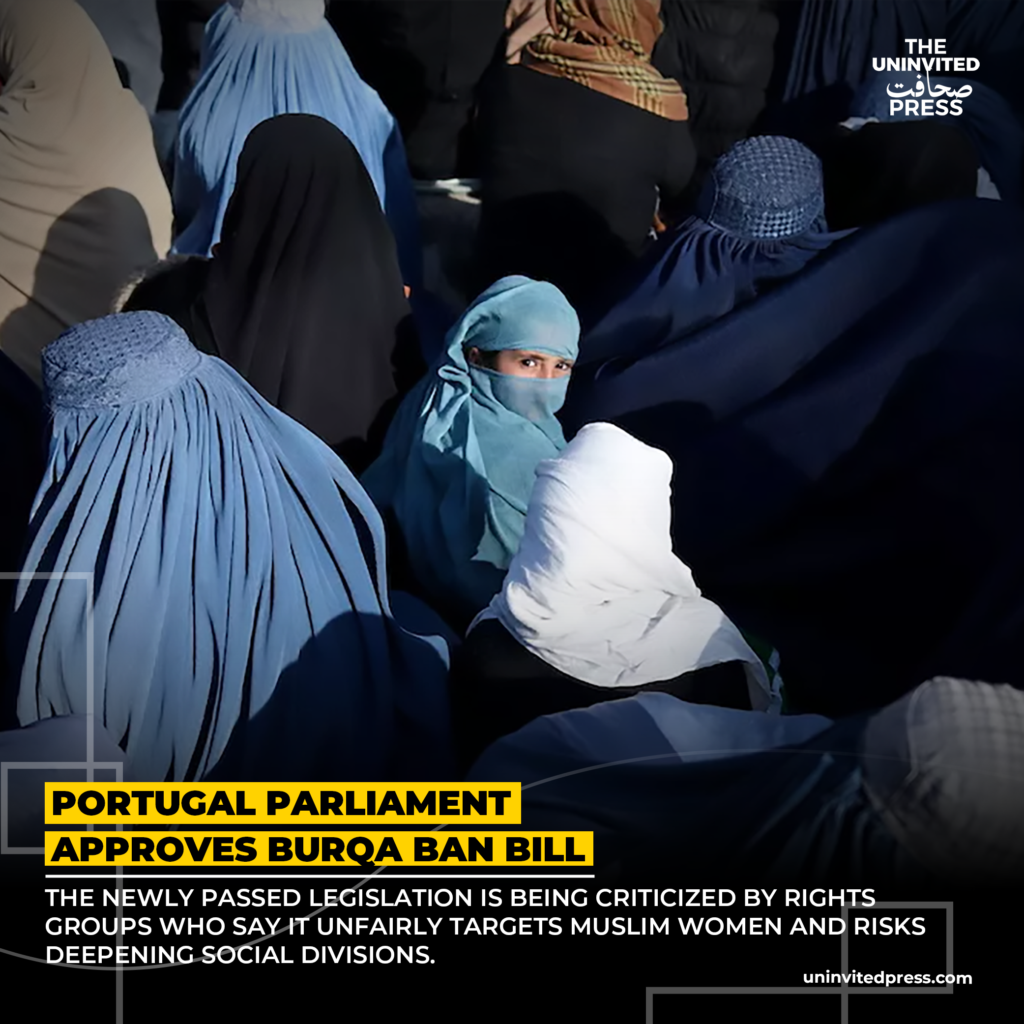
Portugal’s parliament approved a burqa and niqab ban on October 17, 2025, proposed by far-right Chega, amid criticism for targeting Muslim women and risking divisions.
Portugal Moves to Ban Full-Face Veils, Igniting Debate Over Religious Freedom and Far-Right Influence:
Portugal’s parliament has approved a controversial bill banning full-face veils like the burqa and niqab in most public spaces, a move proposed by the far-right Chega party and criticized by human rights groups as discriminatory against Muslim women. Passed on October 17, 2025, with support from center-right parties, the legislation imposes fines up to 4,000 euros and potential prison time for coercion, highlighting the rise of populist policies in Europe. In a country with a tiny Muslim minority-estimated at just 0.6% of the population-the ban raises alarms about religious freedom and social cohesion, potentially aligning Portugal with nations like France and Belgium while deepening domestic divisions.
Chega's Breakthrough: Burqa Ban Clears Parliament in Tense Vote with Protests Outside:
The bill sailed through parliament with 126 votes in favor, 88 against, and four abstentions, buoyed by the center-right minority government’s coalition partners. Chega’s André Ventura championed the measure, arguing it addresses “forced” veiling and promotes equality, drawing parallels to bans in France and Denmark. During the session, Ventura faced pushback from left-wing female lawmakers who accused him of hypocrisy and discrimination.
Visuals from the debate showed a divided chamber, with protesters outside parliament holding signs decrying the bill as Islamophobic. The legislation exempts medical masks and professional gear but specifically targets religious veils, with penalties escalating for repeat offenses or coercion.
Introduced in July 2025, the bill underwent committee review before the October vote, where amendments were discussed but largely rejected. Its passage marks Chega’s first major legislative win since surging in the 2024 elections.
From Few Veils to National Ban: Portugal Joins Europe's Face-Covering Crackdown:
Portugal’s Muslim community, numbering around 65,000 (mostly Sunni from former colonies like Mozambique and Guinea-Bissau), is small and integrated, with only a few dozen women estimated to wear full-face veils. Yet, the ban taps into broader European trends, where countries like France (2010 full ban), Belgium (2011), and Denmark (2018) have restricted religious attire under secularism and security pretexts.
Chega, founded in 2019 by Ventura-a former soccer commentator turned politician-has capitalized on anti-immigration sentiment, growing from one seat in 2019 to 50 in 2024, making it the third-largest party. The party, often labeled populist or far-right, advocates for stricter migration controls and cultural assimilation.
This legislation emerges amid Portugal’s political instability following the 2024 elections, where the center-right Democratic Alliance formed a minority government reliant on occasional Chega support. Critics argue it’s symbolic politics, addressing a non-issue to rally conservative voters, while exacerbating Islamophobia in a country with low religious tensions.
The ban’s significance? It could strain Portugal’s reputation for tolerance, a nation that decriminalized drugs in 2001 and legalized same-sex marriage in 2010, now veering rightward on cultural issues.
Equality Claim or Islamophobic Overreach? Divided Voices Clash After Burqa Bill Passage:
Chega’s Ventura celebrated the vote, stating: “If anyone wants to wear a burqa in public, they will have to take a flight to Saudi Arabia or Afghanistan.” PSD’s Andreia Neto echoed this, framing it as a “debate on equality between men and women.”
Human rights groups condemned it sharply. Amnesty International Portugal called it “discriminatory and disproportionate,” arguing it violates religious freedom and women’s autonomy. The Islamic Community of Lisbon’s president, Abdool Karim Vakil, described it as “unnecessary and Islamophobic,” noting the minimal impact but symbolic harm.
Left-wing parties like BE labeled it a “populist distraction” from economic issues. No immediate response from the Portuguese government on enforcement plans; attempts to reach the prime minister’s office were not successful.