

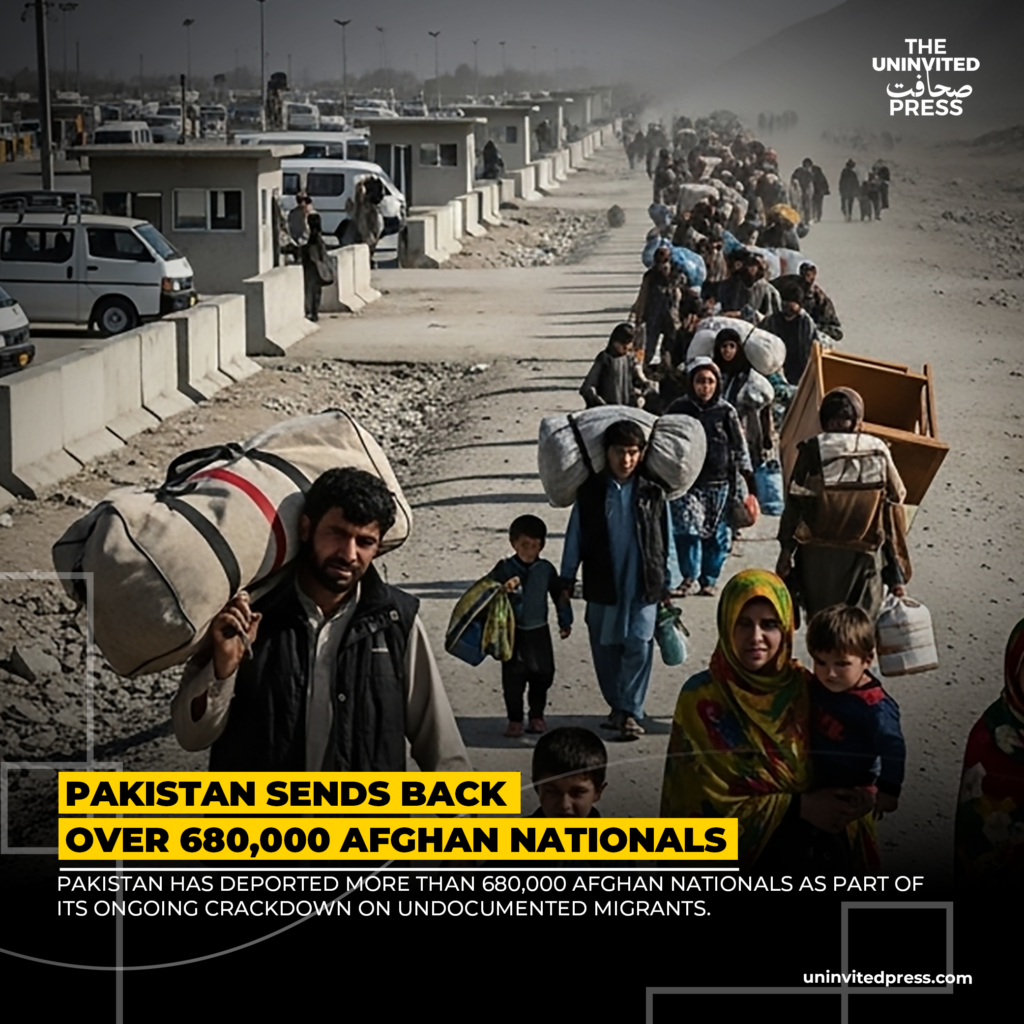
INCIDENT:
FULL STORY:
Pakistan’s deportation campaign began in earnest on October 3, 2023, when a high-level committee under the National Action Plan declared that all illegal immigrants must leave voluntarily by October 31 or face forced removal. The focus was initially on undocumented Afghans, who made up the vast majority of foreign nationals in the country. By November 1, 2023, deportations kicked off, with authorities establishing 49 holding centers and deploying police for raids.
In the early days, reports emerged of arbitrary arrests, home demolitions, and the seizure of assets valued at billions. By mid-November 2023, over 174,000 Afghans had left, many under duress. The operation paused briefly but resumed with vigor in March 2025, when the interior ministry ordered undocumented foreigners and ACC holders to depart by March 31, marking a shift to include semi-registered groups.
By April 2025, deportations of ACC and PoR card holders began, expanding the scope dramatically. Official Pakistani figures from early January 2026 cite 682,141 repatriations, including 69,431 ACC holders and 216,634 PoR card holders. However, international data paints a broader picture: UNHCR records 963,300 returns from Pakistan in 2025 alone, with 138,600 classified as outright deportations. Cumulative totals reach 1.7 million from September 2023 to November 2025, according to relief reports.
Recent months have seen a spike, coinciding with winter’s onset. Since September 2025, deportations have targeted all Afghans indiscriminately, leading to daily expulsions-such as 2,010 on a single day in early January 2026. Deportees often endure overcrowded holding camps lacking basic amenities, resulting in health crises like untreated illnesses and deaths from exposure.
CONTEXT & BACKGROUND:
Afghans have sought refuge in Pakistan for decades, fleeing conflicts from the Soviet invasion in the 1980s to the Taliban’s 2021 takeover. Pakistan hosts one of the world’s largest refugee populations, with 1.77 million registered Afghans as of June 2025, per UNHCR. Many were born in Pakistan and have never lived in Afghanistan.
The current drive stems from deteriorating Pakistan-Afghanistan relations. Islamabad accuses Kabul of harboring TTP militants responsible for attacks inside Pakistan-24 suicide bombings in 2023 alone, 14 allegedly by Afghans. Economic strains, including remittances and trade disruptions, have fueled the policy. Critics argue it’s a political tool to pressure the Taliban on border security.
Historically, Pakistan has conducted smaller repatriations, but this scale is unprecedented. The 2021 U.S. withdrawal from Afghanistan triggered a fresh influx, swelling undocumented numbers to an estimated 1.7 million. The campaign’s expansion in 2025 to registered refugees has drawn sharp criticism, as these groups were previously protected under international agreements.
Afghanistan is under Taliban rule, faces a humanitarian emergency with over 22 million people needing aid. Returnees arrive to makeshift shelters, food shortages, and restricted rights-especially for women and girls, banned from education beyond grade six. The deportations risk violating non-refoulement, the international principle barring returns to places of peril.