

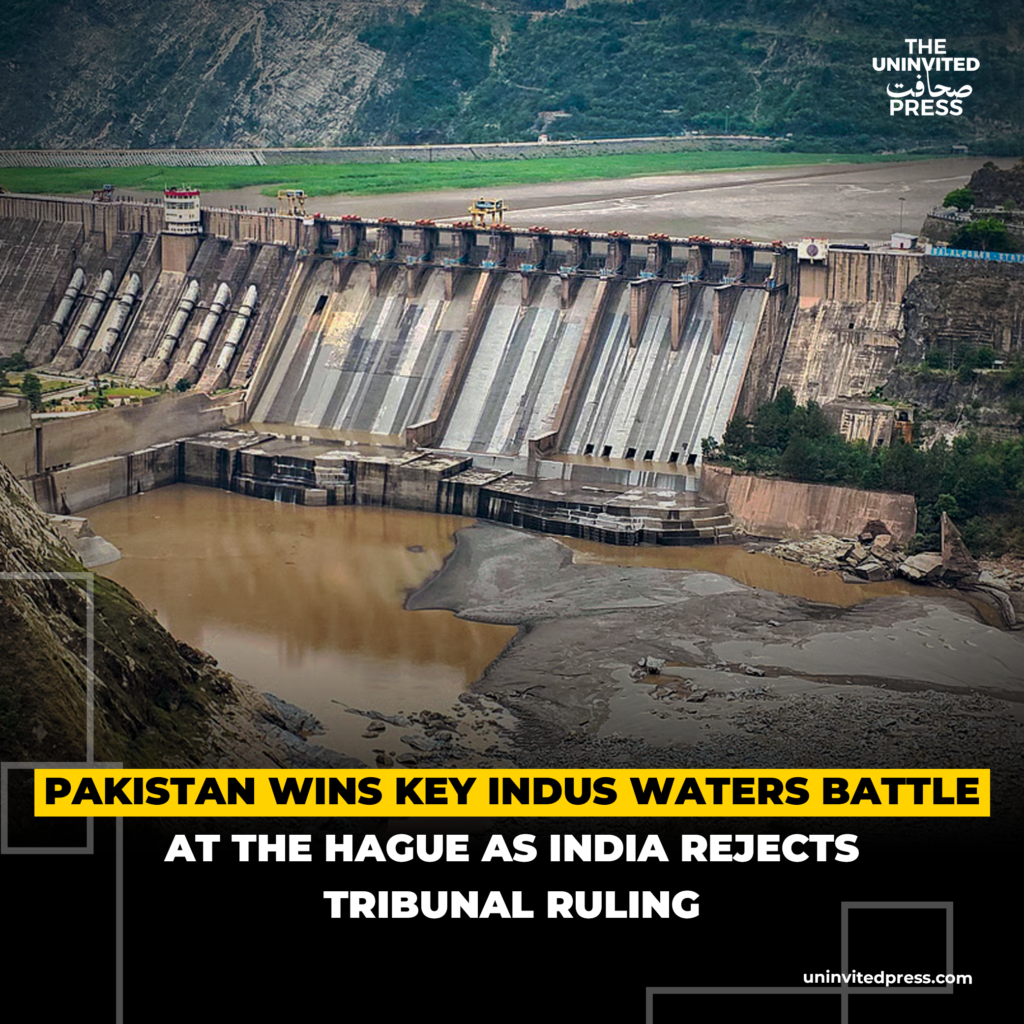
Court of Arbitration declares 1960 treaty remains fully binding; New Delhi dismisses verdict as lacking jurisdiction.
In a significant legal victory for Pakistan, a Permanent Court of Arbitration panel in The Hague has ruled that India cannot unilaterally suspend the Indus Waters Treaty, rejecting every argument New Delhi advanced to justify placing the six-decade-old water-sharing agreement “in abeyance.”
The five-member court issued a unanimous award on Monday, 31 August 2026, declaring that the 1960 treaty “remains fully in force” and that India “must observe its obligations” under it. Those obligations include rules governing the design and operation of hydropower projects on the western rivers that flow into Pakistan.
The ruling marks the first time an international tribunal has directly addressed the legality of India’s decision, announced in April 2025, to hold the treaty in abeyance following a deadly attack on tourists in Indian-administered Kashmir. India had linked the suspension to demands that Pakistan “credibly and irrevocably” end alleged support for cross-border terrorism-a charge Islamabad has consistently denied.
The Hague Upholds Indus Waters Treaty:
The Indus Waters Treaty, brokered by the World Bank and signed in 1960, has long been regarded as one of the most durable water-sharing agreements in the world. It allocates the waters of the Indus River system between the two nuclear-armed neighbours. India controls the eastern rivers (Ravi, Beas and Sutlej), while Pakistan holds primary rights to the western rivers (Indus, Jhelum and Chenab), which irrigate roughly 80 percent of Pakistan’s agricultural land and support the livelihoods of tens of millions of people.
Tensions over the treaty intensified after India announced the abeyance measure in the wake of the Pahalgam attack, which killed 26 civilians. New Delhi also closed the Attari border crossing and took other punitive steps. Pakistan responded by initiating proceedings before the Court of Arbitration under Article IX and Annexure G of the treaty, seeking clarity on the treaty’s status and interim protections against certain Indian hydropower works.
Hearings on the treaty’s status and interim measures took place in April 2026 at the Peace Palace in The Hague. India did not participate, maintaining that the court itself was “illegally constituted.”
The tribunal examined the grounds India had cited publicly-sovereignty, allegations of cross-border terrorism, Pakistan’s alleged refusal to renegotiate, demographic pressures, clean-energy requirements and climate change. In its unanimous decision, the court found that none of these justifications permitted suspension or termination of the treaty under its own terms or under general international law.
The treaty, the court emphasised, remains in force unless both parties jointly modify or terminate it through a subsequent agreement. India’s decision on “abeyance,” the panel concluded, was not permissible.
In a parallel order on interim measures, the court restricted construction at the Ratle Hydro-Electric Plant on the Chenab River in Indian-administered Kashmir. It prohibited India from concreting the dam wall and power intake structure above specified levels until 90 days after a World Bank-appointed Neutral Expert issues a final decision on whether the project’s design complies with the treaty. That decision is expected by July 2027. India was also directed to notify the court, Pakistan and the Neutral Expert of any changes to the construction schedule.
Pakistan Wins Key Indus Waters Battle at The Hague:
Pakistan welcomed the outcome. Deputy Prime Minister and Foreign Minister Ishaq Dar described the award as a decisive rejection of India’s “unlawful attempt” to place the treaty in abeyance. “The Treaty remains fully in force and binding on both parties,” he said. “India must fully comply with its obligations under the Treaty and with the binding decisions of its dispute settlement mechanisms.”
Other Pakistani officials and commentators framed the ruling as a reaffirmation that international agreements cannot be set aside for political convenience and that water cannot be weaponised.
India rejected the award within hours. The Ministry of External Affairs called the Court of Arbitration “illegally constituted” by the World Bank “in patent breach of the terms of the Treaty.” It stated that the tribunal “has no jurisdiction whatsoever to pronounce on India’s sovereign decisions” and that its pronouncements “will have no effect on India’s actions in connection with the projects being undertaken by India.”
New Delhi reiterated that the abeyance of the treaty remains in force until Pakistan ends support for cross-border attacks. India has long argued that parallel Neutral Expert proceedings, also facilitated by the World Bank, are the proper forum for technical disputes over projects such as Ratle and Kishenganga, and that the arbitration process runs counter to the treaty’s dispute-settlement architecture.
The Indus system is critical to Pakistan’s food security and economy. Any prolonged disruption or unilateral alteration of flows carries serious risks for agriculture, especially in the populous provinces of Punjab and Sindh. For India, the western rivers also represent important hydropower potential in the Himalayan region, and New Delhi has framed its projects as consistent with the treaty’s provisions for limited, non-consumptive use.
Analysts note that while the court’s award strengthens Pakistan’s legal position and underscores the principle that treaties cannot be suspended unilaterally, enforcement remains uncertain. India has refused to recognise the tribunal’s previous awards and has indicated it will continue work on its projects. The practical impact of the ruling will therefore depend on diplomatic pressure, the forthcoming Neutral Expert determination, and the broader state of bilateral relations.
The Indus Waters Treaty has survived wars and decades of hostility. The latest ruling reaffirms its formal legal status, yet the gap between legal obligation and political will continues to cast a shadow over one of South Asia’s most sensitive shared resources.