

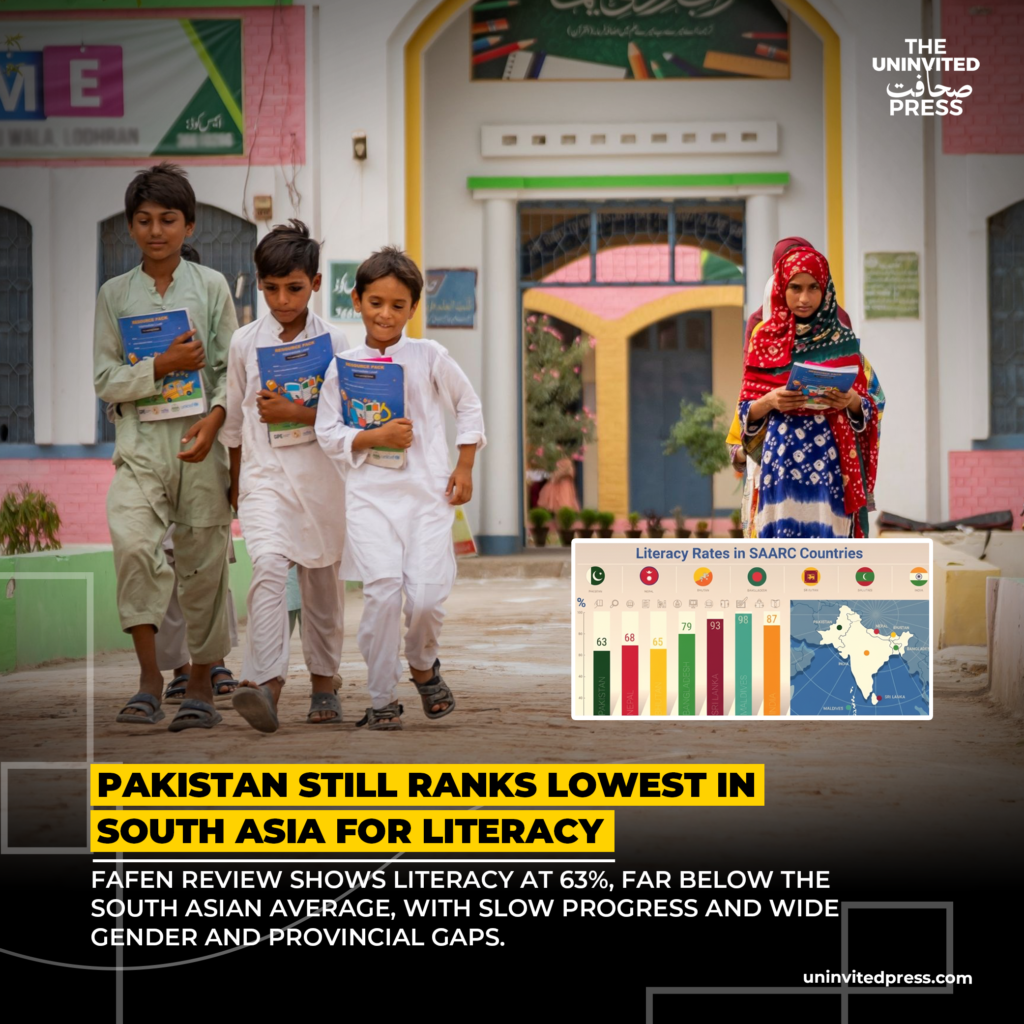
Pakistan’s literacy rate stalls at 63%, lowest in South Asia per FAFEN review, with slow progress and wide gender-provincial gaps hindering growth in Islamabad and beyond.
Pakistan’s Literacy Crisis: 63% and Falling:
Pakistan’s literacy crisis persists as the nation trails far behind its South Asian neighbors, with only 63% of people aged 10 and above able to read and write a simple sentence. A new review by the Free and Fair Election Network (FAFEN), released on February 2, 2026, highlights a meager three percentage point rise since 2018, underscoring systemic failures in education that leave one in three Pakistanis illiterate. This shortfall not only hampers economic growth in a country of over 240 million but perpetuates poverty cycles, widens inequalities, and threatens long-term stability-demanding urgent reforms to bridge gaps that see women and rural provinces disproportionately affected.
Pakistan’s Literacy Growth Stalls, FAFEN Says:
The FAFEN reviews, draws from the Pakistan Social and Living Standards Measurement-Household Integrated Economic Survey (PSLM-HEIS) 2024-2025, conducted by the Pakistan Bureau of Statistics. It reveals a national literacy rate of 63% for individuals aged 10 and above, defined as the ability to read and write a simple sentence with understanding. This marks a sluggish increase from 60% in the 2018-2019 survey, representing just a 0.5% annual growth over six years.
Provincially, Punjab leads with 68%, followed by Sindh at 58%, Khyber Pakhtunkhwa at 55%, and Balochistan trailing at 46%. Urban areas fare better at 77%, compared to rural 56%, highlighting infrastructure disparities. Gender inequalities are pronounced: male literacy stands at 73%, while female is 54%, a gap that has narrowed only marginally from 22 points in 2018.
Regionally, Pakistan lags behind all SAARC nations. The Maldives boasts 98%, Sri Lanka 93%, India 87%, Bangladesh 79%, Nepal 68%, and Bhutan 65%, per World Bank data cited in the report. South Asia’s average is 78%, 15 points above Pakistan.
Pakistan’s Education Crisis: Urgent Alarm:
Pakistan’s literacy struggles stem from decades of underinvestment and systemic issues. Post-independence in 1947, the rate was around 16%; it climbed to 26% by 1981 and 45% by 2001, per census data. The 2010 18th Amendment devolved education to provinces, but inconsistent funding-hovering at 2% of GDP versus UNESCO’s recommended 4-6%-has stalled progress.
The COVID-19 pandemic exacerbated gaps, closing schools for over 18 months and pushing 22 million children out of education, per UNICEF. Conflict in regions like Balochistan and KPK, coupled with cultural barriers for girls, compounds the issue. SAARC peers like Sri Lanka invested early in universal education, achieving near-100% primary enrollment.
UNESCO estimates illiteracy costs Pakistan $10 billion annually in lost productivity. With 40% of the population under 18, failure to educate risks perpetuating poverty-60 million live below the line-and instability. Provincial disparities fuel regional tensions, while gender gaps hinder women’s workforce participation, at just 22%. This review arrives amid global Sustainable Development Goal 4 deadlines, where Pakistan risks missing 2030 targets.