

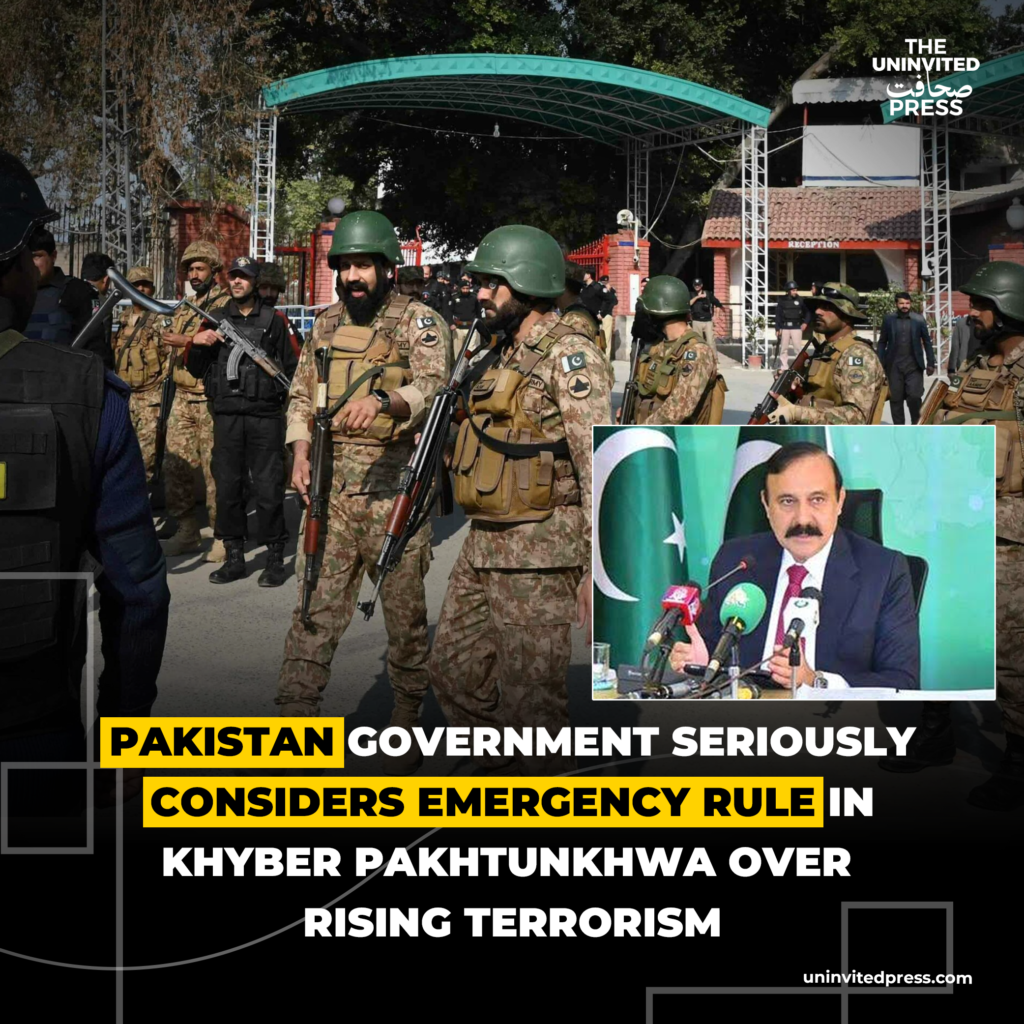
Federal minister cites provincial government’s failure to curb attacks as political tensions mount ahead of opposition march.
Pakistan’s federal government is “seriously considering” imposing emergency rule in the northwestern province of Khyber Pakhtunkhwa (KP), citing a sharp rise in terrorist attacks and what it describes as the provincial administration’s failure to restore order, a senior minister said this week.
Parliamentary Affairs Minister Tariq Fazal Chaudhry told reporters at Parliament House on Wednesday that the Centre is examining the option under Article 232 of the Constitution. “The provincial government’s lack of interest or success in controlling it (terrorism) is the reason for which the imposition of emergency under Article 232 is being discussed,” he said.
The remarks come as political tensions between the federal coalition led by the Pakistan Muslim League-Nawaz (PML-N) and the Pakistan Tehreek-e-Insaf (PTI)-run KP government escalate over a planned opposition march to Islamabad on October 4. The march aims to press for the release of PTI founder and former prime minister Imran Khan, who remains in jail.
Sharp rise in attacks and security force losses:
Official figures shared by federal ministers paint a grim picture of the security situation in KP, a province that borders Afghanistan and has long been a frontline in Pakistan’s fight against militancy.
According to documents cited by ministers, terrorist attacks in the province from January to September 2026 reached 680. In the first half of the year alone, 122 police personnel were killed-a nearly 94 percent increase from 63 in the same period of the previous year. Injuries among security personnel more than doubled.
Recent incidents have underscored the intensity of the violence. On September 18, a suicide bombing and gun attack on a mosque inside a police compound in Kohat killed at least 31 people, including 16 officers, and wounded more than 100. Days later, a suicide attack on a police and customs checkpoint in the Darazinda area of Dera Ismail Khan district left at least 12 dead and dozens injured. Groups linked to the banned Tehreek-e-Taliban Pakistan (TTP) and allied factions have claimed or been blamed for many of these assaults.
Pakistan has responded with airstrikes and ground operations targeting militant hideouts both inside KP and across the border in Afghanistan, killing dozens of fighters according to official statements. Yet the cycle of attacks has continued, with security forces reporting regular interceptions of infiltration attempts along the frontier.
Federal ministers have accused the PTI provincial government of lacking resolve. Information Minister Attaullah Tarar has gone further, claiming the KP administration facilitates terrorists through soft policies and alleged financial interests in illegal activities such as mining. He described the PTI as the “B team” of the TTP-a charge the provincial government rejects as politically motivated.
Federal Government Holds Off on KP Emergency Move:
Article 232 allows the president to proclaim an emergency if the security of Pakistan or any part of it is threatened by war, external aggression, or internal disturbance beyond the capacity of a provincial government to control. The proclamation must later be approved by parliament. Separately, Article 234 provides for governor’s rule if a province cannot be governed in accordance with the Constitution.
Law Minister Azam Nazeer Tarar and other federal officials have stressed that any such step would follow constitutional requirements. Chaudhry expressed confidence that the Pakistan Peoples Party (PPP), a key coalition ally, would support the move if needed. He insisted the consideration is driven by security, not politics, and said the government is prepared to face the political cost.
KP Chief Minister Sohail Afridi has dismissed the threats. He has reiterated that the October 4 march will proceed and called for a revised national counterterrorism policy that incorporates provincial input. PTI leaders argue that the province has been fighting terrorism for years and that the federal government shares responsibility for the broader security environment, including relations with Afghanistan’s Taliban authorities.
Sources close to the federal government indicated late Wednesday that Islamabad has, for now, held off on any immediate proclamation, choosing instead to give the PTI another chance to de-escalate by reconsidering the march.
KP’s Security Crisis Amid Political Tensions:
Khyber Pakhtunkhwa has endured waves of militant violence for more than two decades. After the Afghan Taliban’s return to power in 2021, the TTP and affiliated groups intensified operations from across the border, exploiting the difficult terrain and porous frontier. Successive Pakistani governments have launched major military operations, yet the threat has proven resilient.
The current debate mixes genuine security concerns with high-stakes political confrontation. Imposing emergency or governor’s rule would remove the elected PTI government in a province where the party retains significant public support, particularly around the demand for Khan’s release. Critics warn that such a step risks deepening polarisation at a time when coordinated action against militancy is most needed.
For residents of KP, the immediate reality remains the daily threat of attacks on police posts, markets and places of worship. Whether federal intervention materialises or political dialogue prevails, the underlying challenge of restoring lasting security in the province shows little sign of easing.